Nexi, which is vying with Worldine for the title of European payment champion, posted revenue of €835m in Q2, up just 3% on an unadjusted basis. Good growth in Merchant Solutions, up 10% to €474m, and Issuing Solutions, up 7% to €270m was dragged down by declining sales in the Digital Solutions division, which has been hit by the impact of banking consolidation in Italy.
Paolo Bertoluzzo, CEO, said revenue growth would have been 8% when adjusted for currency fluctuations, acquisitions, businesses held for sale etc and “confirms solid and profitable growth in all our businesses and in the different geographic areas in which we operate, despite the ongoing uncertain macroeconomic situation.”
The merchant division interests us most at Business of Payments. Like Worldline, Nexi is becoming increasingly dependent on sales to merchants as their traditional business model of process outsourcing for banks comes under pressure. Merchant Solutions accounted for 57% of total revenue, up from 53% in the same quarter of 2022.
Bertoluzzo was pleased with the “acceleration of revenues in Merchant Services in the DACH region, and acceleration in e-commerce, broadly across geographies.” However, Bernardo Mingrone, CFO, added that merchant services growth was “a touch lighter than what we might have expected” and blamed tough comparisons from 2022. For example, the growth in high-margin foreign card transactions in Italy, Nexi’s largest market, slowed to just 6% in June as you can see below.
There was more positive news further down the P&L. Nexi is proving adept at realising synergies from the acquisitions of SIA, Nets and Concardis. It has closed five of 25 processing platforms, says it’s on track to decommission another five in H2 and, longer term, to reduce the number to just four. Similarly, it has closed 11 of 45 data centres and is on track to shut another two in H2.
Total expenses fell 3% to €399m yielding a welcome 10% increase in EBITDA to €436m.
Looking in more detail at Merchant Solutions, payment volume rose 8% to €209bn in Q2. Over half Nexi’s volume still comes from Italy but growth in its home market was just 6% compared to 11% elsewhere. The DACH region was particularly buoyant and recorded “strong double-digit” increases across the quarter.
Two thirds of Nexi’s merchant volume is from SMEs with the remainder split between eCommerce and Large/Key accounts. Highlights include:
SME – volume up 14% in H1 driven by 145K extra POS terminals and 250,000 additional customers compared with a year earlier. Management called out significant growth in Italy and Poland. The SoftPOS roll out is progressing across geographies.
eCommerce – volume up 8% in H1 and revenue up double digits as client numbers rose 10% year on year. Sales accelerated in Italy and Nordics. There was good performance from A2A (the old P24 business) in Poland. Management is pleased with progress signing new ISV partnerships. A commercial agreement with Shopware, the German eCommerce platform, is now live in Italy and DACH. Nexi says it has been selected as Shopify’s preferred partner in Poland.
Large account/key account (LAKA) – volume up 10% with most new wins in omni-channel retail, hospitality/restaurants and mobility/petrol.
Alongside the results, Nexi announced it had taken a 30% stake in Computop, the German eCommerce gateway. The purchase price was not disclosed. This partnership is highly complementary to the Concardis acquiring business and reinforces Nexi’s presence as market number two, behind Worldline/PayOne. Computop claims 30% of the German eCommerce payment market but processed volume fell 12% in 2022 to €30bn. The poor performance partially mirrors a general fall in eCommerce volumes in Germany but Computop also lost customers when it exited the adult and gambling segments. Nevertheless, Computop is also believed to be under pressure from international acquirers with integral gateways such as Adyen, Stripe and Checkout.com.
Speaking about potential future corporate activity, Bertoluzzo said that Nexi was not interested in entering the UK market where Barclays is reportedly looking a strategic options for Barclaycard. “At the moment, we are not looking at the UK, we have other priorities and that’s not necessarily a market that we consider for us attractive.”
We would expect one of these other priorities to be the merchant acquiring business of Spain’s Banco Sabadell which announced a JV with Nexi in February this year. Surprisingly, Nexi gave no update during its results announcements, but Sabadell has suggested that the deal may now not close until H1 2024, six months later than scheduled.
BancoBPM, is certainly no longer a Nexi priority. The Italian bank has chosen to ignore its long standing partnership with Nexi and opted for a joint-venture with BCC Pay, a local newcomer. Bertoluzzo said the revenue impact of losing the bank is expected to be zero this year and negligible next year. He felt that BPM customers were “used to Nexi products and propositions that are quite advanced for Italian standards, and quality of service” indicating confidence that Nexi can defend its existing customer base.
Asked whether he felt that PE firms were inflating valuations for payment companies, Bertoluzzo explained that “the multiples that we see around these days are probably far too low, given the potential value generation of the sector.” He went on “we’re not particularly worried about private equities coming in and inflating price and so on and so forth, because honestly, buying additional assets is not our priority. So we are very selective on what we’re looking at and currently, we are looking at a very, very small number of potential small opportunities, where honestly, we don’t see private equities around.”
Discussing progress divesting non-core businesses, management said that the sale of NetsDBS had been delayed by the unexpectedly early publication of EU draft directive on electronic ID wallets. However, they still hope to close the transaction “in the coming weeks.” There was less positive news about Ratepay, the German BNPL business inherited from the Concardis acquisition. Berltoluzzo said “It’s not the most ideal market to sell a consumer finance business.”
Finally, commenting on the Italy’s progress towards electronic money, Bertoluzzo said “Personally, I’ve not been using cash for the last many, many, many weeks… but as soon as you go outside the metropolitan areas, there is still a lot of cash payments around. …the overall penetration of digital payments in Italy, is probably today in the low mid 30s, which is still very much behind what you see in the rest of Europe…There is a long, long run in front of us in terms of cash to digital payment conversion. It’s happening. It’s good it’s happening, but there is a long, long way to go.”
PayU GPO is an emerging market eCommerce gateway, orchestrator and payment facilitator that operates in 30 countries. The acquisition will enhance Rapyd’s capabilities in Latin America and central Europe, notably Poland. The combined group will service over 250,000 clients globally in 41 jurisdictions with a workforce of 1,700 across 22 countries.
The sale certainly looks like an excellent deal for Prosus. It gains a welcome cash injection and will retain PayU’s largest and fastest growing markets – Turkey, and India. The GPO businesses which Rapyd is acquiring are growing slowly and are barely profitable. As a trade buyer, Rapyd should be able to find plenty of synergies. However, as PayU is itself built from numerous acquisitions, the integration and decommissioning of its multiple technical platforms may be challenging.
Rapyd, which has already raised $770m according to Crunchbase, is asking investors for a further $700m to fund the PayU GPO deal. Arek Shtilman, CEO, says this will be the largest fintech raise so far in 2023 and that he wants to take advantage of the downturn in technology finance to make more acquisitions.
The price represents 1.6x revenue or 68x underlying trading profit based on the PayU GPO FY 23 figures published with the Prosus annual results.
These showed that Pay U GPO annual payment volumes rose 13% to $39 billion. This is a modest performance for a payment business targeting digital merchants and much lower than the increases of 22% and 54% in previous years.
Revenue was up 15% at $393 million but PayU GPO posted a trading loss of $14 million including a $23 million provision “related to merchants in Brazil and in the travel industry.” Underlying trading profit was $9m.
Barclaycard, the UK’s second largest merchant acquirer, reported disappointing growth in payment volumes in Q2 2022, an increase of just 4% to £77.3bn. This is well below the consumer price inflation rate of 10% in the UK and indicates Barclays is losing market share. Customer numbers also grew 4% to 401.000.
Barclays has a strong track record at cross-selling acquiring to its UK business banking customers. However, it has found going tough recently as fintechs with newer technology – notably Adyen and Checkout – are poaching its enterprise clients. A good example is Checkout’s work with Sainsburys.
Reuters reported last month that Barclays had hired consultants to look at options for Barclaycard, its payment business which includes card issuing and acquiring. The mandate was to examine “whether some of the payments businesses should be expanded or combined with other providers through a merger or joint venture.”
With a strong position in Europe’s largest card market, Barclaycard’s merchant operations would be very attractive to outside investors. Options could include selling all or part of the business to to private equity (with Bain/Advent likely first in the queue) or creating a JV with one of the global acquirers such as Worldine, Nexi or Fiserv.
Barclays released no additional information with the Q2 results.
Merchant services continues to fuel growth at Worldine which reported Q2 revenue rising by 8% to €1.172bn. Giles Grabinet, CEO, said the result was “supported by a solid double-digit performance in Merchant Services, confirming, in particular, our enhanced competitive positioning resulting from our continued successful integration of the former Ingenico.”
Merchant services revenueincreased 13% to €849m driven by “strong double digit growth” in Commercial Acquiring with positive performance in Switzerland, Benelux and Germany bolstered by “a good start” to the new business lines in Italy and Greece. Payment acceptance, which includes gateways and terminals, scored “good double digit growth” in revenue led by the continued recovery of online sales in travel-related verticals. However, there was a “soft performance” in digital services despite a “good level of activity” in Turkey and Benelux.
While Merchant Services prospers, Worldline’s two smaller divisions seem stuck in the doldrums. Financial Services revenue was flat at €236m and Mobility turnover fell 8% to €87m.
OMDA, Worldine’s preferred measure of profitability which is roughly equivalent to EBITDA, was up 11%. Again, this was driven by merchant services which grew OMDA 13% to €399m although margins fell very slightly to 25%. Operating leverage and delivery of synergies outweighed higher costs.
After taking into account €244m of exceptional items including €133m to amortise past acquisitions and €70m of post-acquisition costs, operating income was roughly flat at €120m for H1.
Turning to the details of the Merchant Services performance, acquiring volume was €120bn in Q2, up 49% on same quarter of 2022. Excluding the recently acquired ANZ, Axepta and Eurobank portfolios, organic volume grew a more modest 10% in H1 with online (+15%) outperforming instore (+7%). The incremental volume from the acquisitions seems to be less profitable than the existing business. The extra €73bn processed in H1 yielded an incremental €229m revenue, reducing the take rate 21bps to 0.73%.
Merchant count rose 7% to 1.39m excluding ANZ. The customer base includes 1.2m instore customers (up 7%) but just 190K webshops (up 5%). Worldline says it is now averaging 7K net new merchants each month “despite some repricing actions.“
Management reported a number of product updates, client wins and new partnerships with the Q2 results.
Evonity, the Belgian manufacturer of electronic vehicle (EV) fast charging points, has become the first customer of Worldline’s EV Charging Payments Suite. EV charging is quite a complicated payment process and needs to be delivered with a consistent customer experience across all continental European markets. Worldine’s proposition includes a PINpad integrated into the charging station as well as pre-authorisation, incremental authorisation and online reversals.
Other client wins include Blizzard and Valve in the gaming vertical and SNCB (Belgian railways) for a “global one-stop shop payment solution” including all channels and domestic, international and alternative payment schemes. Key partnerships include VTEX, an enterprise eCommerce platform and travelplanbooker.com. Worldline claims its distribution now reaches 15% of European retailers and this makes it an increasingly attractive partner for ISVs.
Worldline’s strategy is to expand its geographical reach through partnerships and/or acquisitions of retail banks’ merchant services businesses. The closure of the Banco Desio deal in Q2 brings 15,000 merchants and €2bn volume in Italy. This is a bolt-on to Worldline’s existing operations and bulks up its presence in a market which is still 50% cash and has plenty of room for growth. Worldline plans to start migrating the merchants to its own systems shortly. Banco Desio will distribute Worldline product through 250 branches.
Looking ahead, management gave an update on the proposed joint venture with Credit Agricole in France which would give Worldline access to continental Europe’s largest payment market. Credit Agricole will provide distribution of Worldline product through 36 regional banks and 16,000 banking advisors. The deal is expected to close in Q4 with revenue starting to flow in 2025.
Worldine has been paying down debt, leaving it the fire power to make more portfolio acquisitions in Europe. Giles Grapinet said: “many banks are driving strategic reviews of their payment portfolios, particularly in the Merchant Services space fully cognizant that the market has been transforming and they need really to do serious things to adapt to this new reality.”
Santander’s payment subsidiary, PagoNxt, posted another quarter of good results, with strong growth in payment volumes across all its major markets. This performance highlights the success of Santander’s strategy to in-source and consolidate its payment activities. PagoNxt comprises all of Santander’s payment assets, including Getnet, a leading multi-national merchant acquirer, Ebury (trade finance), Payments Hub, and Superdigital, a financial marketplace for the economic inclusion of the underbanked.
Getnet, PagoNxt’s merchant services unit grew total volume processed 22% in Q2 2023 to €49bn with ATV falling 9% to €21.78.
Volume grew in most major markets in the first half, with increases of 32% in Europe, 31% in Mexico and 15% in Brazil. The positive performance in Europe was driven by continued rebound in Spain as travel and tourism recover from the pandemic. The business opened Getnet Portugal with a range of Newland terminals nicely branded with Santander’s shade of red. It’s suprising how often banks miss the opportunity to use payment devices to raise brand awareness,
A core plank of the Getnet strategy is to expand the geographic footprint based on a standard set of global products. Management highlighted launches in H1 of a working capital solution, dynamic currency conversion, Android POS and vertical propositions for airlines and restaurants. The Android POS is called Get Smart and is available in Spain but only for customers with “a high volume of sales.”
In Latin America, where Getnet claims to be the third largest acquirer, the business has launched its services in Argentina and begun leveraging the global platforms in Mexico. Management expects to launch in Chile during the second half of this year.
Away from Getnet, PagoNxt says Payments Hub has made significant progress to become Santander’s wholesale payments processing provider. It claims that a “significant volume” of payments in Spain has already been migrated making the business “one of the largest A2A payment processors in the Eurozone.” Management also reports “making progress” in consolidating wholesale payments from operations in Brazil, Mexico and the UK to the Payments Hub global platform.
Total PagoNxt revenue from all divisions was up 17% at €277m in Q2 and with operating expenses rising just 14%, there was a slight improvement in the operating loss to €18m. The higher expenses reflect the “ongoing investment plans to develop and implement global technology.”
Discover’s second quarter results showed continued good growth at Diners Club but payment volume from third party cards running over Discover’s Global Network (DGN) fell sharply.
Diners Club, which is still largely a series of national franchises, saw an 18% increase in volume, totalling $9.9 billion, driven by the ongoing rebound in global travel and entertainment (T&E) and corporate spending.
In contrast, DGN, which counts cards from 25 third-party schemes such as SIBS and RuPay cards running over Discover rails when used outside their home country, experienced a 10% decrease in payment volume to $10.4 billion. Logically, these should also benefit from the current boom in travel and tourism but the company merely attributed the disappointing result to “lower transaction volumes.” It declined to give further explanation.
Discover continues to invest in DGN and Roger Hochschild, CEO, highlighted five new partnerships signed in the quarter including Guavapay, a low-profile UK issuer/processor. DGN also expanded its acceptance network with the addition of Phos, the SoftPOS start-up recently acquired by Ingenico and Tyl from Natwest.
Management also revealed that Discover had been over-charging its merchant and acquirer customers since 2007 and would be taking a $365m provision to refund the cash. The issue stems from misclassification of certain cards into hits highest interchange bracket. Individual amounts repaid will likely be quite small but involve a very large volume of customers, many of whom may be difficult to track down. This is going to be quite a project for the unlucky team that gets landed with it.
Banked, one of a number of well-funded open banking start-ups, is yet to generate meaningful revenues, according to financial statements deposited at UK Companies House.
For the 13 months to December 2022, Banked booked just £45K revenues as sales from a series of high profile partnerships had yet to materialise. The company recorded an operating loss of £14.8m taking its accumulated deficit to £22.5m at year end and says it will need to raise new money this year.
Banked was founded by Brad Goodall and Neil Ambler who worked together at 10x, a London based core banking provider. The duo have proved astute fundraisers. Banked is well financed, having received £36.4m in capital from a set of high-profile investors including three leading banks – Bank of America, Citi and NAB – as well as Rapyd, the acquirer/PSP.
This is a crowded market. Banked competes with a large field including Truelayer, Tink, Token, Trustly, Volt and Yapily. These firms simplify the process for merchants to incorporate open banking as a payment option on their checkout pages by aggregating connections to thousands of banks.
Merchants want open banking acceptance to be bundled with the payment service they buy today from their bank, acquirer or PSP. They don’t want to buy a separate product which they have to integrate themselves. Consequently, open banking specialists, like Banked, tend to focus on a white label distribution model. Banked’s strategy of taking investment from potential partners could be a smart move.
Bank of America has already incorporated Banked’s product into the eCommerce checkout offered by its merchant services division. NAB is expected to use Banked technology to offer its merchants PayTo, an Australian equivalent of open banking. Banked also has partnerships with payment orchestrators including Primer, Gr4vy and Apexx which will further extend its reach.
Simply getting Banked’s “pay by bank” button on checkout pages won’t guarantee commercial success. Banked needs shoppers to choose its button in preference to paying with cards, Paypal or any other method they use today. Changing consumer payment behaviour is a formidable challenge and Banked will be reliant on its partners, notably the banks, to educate and incentivise shoppers to start using open banking payments.
To support its expansion plans, Banked has established subsidiaries in Lithuania, Australia and the USA. Goodall has relocated to California to lead Banked’s foray into the US market.
The Lithuanian subsidiary, Pay by B, is a payment institution giving passported access to merchants across the EEA. Pay by B lost £0.287m in 2022 leading management to recognise an impairment loss of £0.47m.
Management reports investment continuing into 2023 although “additional equity funding is being sought… to further support growth.” Management says it hopes to close this new fundraising in Q3.
Higher interest rates coupled with fears of long-term price inflation continue to erode company valuations. Strawhacker calculates that sale multiples for mature payment businesses have fallen from 11 times EBITDA to between eight and nine times. This take us back only to pre-pandemic levels and shouldn’t be a cause for panic. But the impact on high-growth cash-consuming companies is more profound. For example, Checkout.com has reduced its valuation from $40bn just 18 months ago to just $9.2bn today.
Latest documents from the Wirecard trial show Markus Braun retrospectively created supervisory board minutes and described compliance as “crap.” Wirecard was a fraud, no question. But beneath the criminality were some real businesses that live on today. Santander created PagoNxt out of Wirecard’s core technology, Deutsche Bank hired the product team and Nomupay, an Irish start-up, picked up Wirecard’s licences in Turkey and Asia.
Nomupay itself just raised $54m to invest in expanding operations and improving the product offer. It claims to be live in 20 countries and works for regional operations of Spotify, Ikea and Facebook. Much of the business is likely based on the 20,000 Asia merchant customer relationships that Wirecard bought from Citibank in 2018 but Nomupay also has an EU licence through the recent acquisition of Click2Sell in Lithuania. One to watch.
Small businesses buy insurance and mobile phone packages online. Yet the payment industry has, so far, managed to resist all attempts at comparative shopping. The UK regulator’s latest attempt to inject more competition into the market has borne fruit with the launch of Statement. This start-up, which has raised £1.5m pre-seed funding, allows merchants to upload their merchant service invoices and get an automatic, tailored quotation from a range of suppliers. If it works, this should be a real winner and long overdue.
Payment companies like embedded payments because the integrations make merchants less likely to churn. But there’s a fine line between a sticky customer and a hostage. Toast, the US restaurant ISV which includes payment processing as standard, has added $0.99 to all online orders over $10. Toast’s new fee is paid by diners. The money goes direct to Toast and is on top of the 3% commission the ISV already charges merchants. Why? Because it can. Restaurants are hopping mad but can’t avoid the tax without switching to a new software provider which takes a great deal of time, effort, staff training and money.
Large merchants can avoid getting locked into abusive vendor relationships by running payments in-house. Zalando Payments, owned by the German eCommerce retailer, reports excellent progress with €27bn processed in 2021. After charging its parent a chunky 2.7% processing fee, Zalando Payments generated revenues of €276m with a profit of €40m. Two thirds of its turnover comes from processing; the remainder from an in-house BNPL product.
Toast and Shopify, both leaders in small business software are making moves on corporate clients. Toast is partnering with FreedomPay, an enterprise-grade POS payment gateway with a strong position with Oracle’s POS clients, to gain distribution into larger customers. The FreedomPay tie-up will make it easier for Oracle clients to defect to Toast without having to switch out their capital-intensive POS infrastructure.
Shopify announced that Shop Pay, the one-click checkout powered by Stripe, will be available as a standalone product. Enterprise customers using 3rd party commerce platforms can now access Shopify’s vast database of stored card credentials without needing to take any other software modules. The greater the number of retailers using Shop Pay, the larger the database of stored credentials becomes and the more powerful the Shop Pay proposition becomes. Shopify published a compelling case study showing a client considering leaving for Checkout to save money but deciding to stay because of Shop Pay.
Separately, Adyen announced a partnership with Shopify that, it says, will help Shopify better serve enterprise clients. Commenting on the same deal, Shopify merely said its Adyen integration had been enhanced to include iDEAL and Cartes Bancaire.
FIS is having second thoughts about demerging Worldpay as a stock-market listed company. Reports suggest it may sell a majority stake to private equity for $15-20bn, rather less than the $43bn FIS paid for the business in 2019. Advent, who helped buy Worldpay from Royal Bank of Scotland back in 2010 is rumoured to be in the running. So is GTCR, another US investor.
Worldpay is also rumoured to be one of three potential bidders for those parts of the sprawling PayU empire lying outside the PSP’s growth markets of India and Turkey. The other bidders are said to be Nuvei and Raypd. Poland, where PayU inherited the in-house payment service of Allegro, the online retail giant, is the largest PayU unit on sale.
Staying in Poland, we’re big fans of Blik, the wildly popular mobile payment standard which claims 60% of all eCommerce transactions in that country. A local analyst suggests this figure is slightly exaggerated. If you include recurring and foreign transactions, the share falls to 35%-45%. Still impressive but not quite so dominant.
In Italy, Banco BPM says it now has no plans to sell its merchant services unit. Instead, it is demanding an upfront payment from a potential partner in return for a long-term commercial agreement. Nexi, the incumbent, Worldline and BCC Pay (a joint venture including the Italian Co-operative banks) are said to be in the running.
Market Pay, the French acquirer spun out of Carrefour, continues its expansion plans with the acquisition of Novelpay, a Franco/Polish POS payment software developer. Novelpay also brings a distribution relationship with PAX which gives Market Pay European cost leadership in the supply of product from the world’s second largest terminal vendor. Market Pay has already bought dejamobile, bringing Softpos capability and Acoustic, an enterprise POS platform managing 60,000 terminals.
New Shopping
We’re keeping a close eye on autonomous stores. This new form of shopping moves transactions from the retailer’s ECR to the shopper’s phone and presents a clear threat to incumbent POS acquirers in many markets. Auchan has launched its first checkout-free store in Poland. Auchan uses technology from Trigo which is already powering checkout-free stores for Tesco, Rewe and Aldi. In contrast, Amazon Go closures continue. It’s not Amazon’s technology at fault but a lack of retail basics, according to industry commentators.
Whatever the technology, some shoppers will try and game the system. Several UK supermarkets have begun insisting customers show a receipt before leaving self-checkout stores. This gives yet another reason to switch to digital receipts although customers are often resistant to giving the email or phone number needed to deliver them. Singapore start-up Pi-xcels (pronounced pixels) can send a digital receipt to the shopper’s phone in the same tap as an Apple Pay payment. Having shown this at MPE back in March, Pi-xcels already has a proof of concept live with Ingenico.
Smart carts offer a middle way between a standard self-checkout and a fully autonomous store. Carrefour seems keen. It is said to have ordered 5000 from Tel Aviv based vendor Cust2mate and will be deploying in two French hypermarkets later this year. Morton Williams in the US has reportedly purchased 100s of the same model cart. Shoppers using smart carts pay using the integral PINpad which will please incumbent processors.
People love paying with contactless by tapping cards or their phone on the POS terminal but other form factors remain very niche. Statistics from Poland show smartwatch payments get a boost every summer as people head outdoors but are still very small by number. Maybe wearable gift cards will give the market a boost. Zara has ordered 18,000 contactless keychains which can be loaded and reloaded with a closed-loop gift card. UK based Multi-Pay is providing the technology.
We’ve all got a biometric device in our pocket but that’s not stopping vendors searching for even more convenient ways of identifying ourselves so we can automatically pay for stuff. Facial recognition will soon be live at 20K Seven Bank ATMs in Japan but there are some obvious drawbacks. A man in Brazil has been arrested for taping photos to a dummy in order to trick mobile banking facial recognition. Police confiscated a large pile of photos and 17 card machines.
Palm recognition payments is lower risk although, if we’re all still carrying phones, still largely pointless. Undeterred, following Amazon’s announcements last month, WeChatPay is piloting at palm payments at metro stations in mainland China. A bold move in a country still haunted by its mismanagement of the Covid pandemic.
Product
The EU published proposals for a third payment services directive (PSD3). These ideas lack the radicalism of PSD1 and PSD2 which together created the European payments industry as we know it today. The latest suggestions will enhance consumer protection but won’t boost cross-border payments to the same extent as the earlier directives. Neither does PSD3 address the chaotic customer experience preventing widespread adoption of open banking transfers in place of cards.
Although much of the industry appears to have moved on from PSD2, the impact of badly implemented strong customer authentication (SCA) continues. Fraud specialist Forter reports that 20% of 3DS2 attempts fail and the problem is worse on mobile, especially in Germany. The fraudsters themselves may have moved on. Forter reports increased alternative payment fraud, especially gift cards.
We’ve not heard much from Verifone in a while but the US giant is back with a new logoand a renewed brand positioning as “the payments architect.” Verifone has suffered greatly through multiple ownership changes and strategic U-turns but still processes over $500bn annually. There is a huge opportunity to cross sell eCommerce and acquiring to its POS customers so a brand promise about simplifying complexity makes perfect sense.
Lisbon is the latest city to go contactless on its trains and buses. Littlepay, a POS payment gateway specialising in mass transit, will process the transactions. Unicre and Cybersource are the acquirers with Indra supplying the validators. Littlepay which is owned by Vix, a transport ticketing giant, is making good progress and has clients live in Finland, Spain, UK, France and USA.
Mass transit drove contactless uptake in London and other metro centres around the world but the Netherlands are first with an entire national transit system working tap-in and tap-out with contactless. And the validators take credit cards which will be a relief to visitors often mystified by Dutch refusals to accept Visa and Mastercard.
Dutch payment exceptionalism will be declining swiftly following Mastercard’s decision to retire Maestro and switch its customers to Mastercard debit. The same is true in Belgium and in Germany where girocard will in future be co-badged with Mastercard debit or Vpay. 15m girocards will be upgraded by the end of this year. The switch means cardholders can use girocard to make online purchases for the first time which will give the domestic scheme a significant boost.
Giro seems on good form to face the future. What of Carte Bancaire, its French counterpart? 2022 results show payment volume grew 5.5% to €685bn, accounting for two thirds of household current spending and 20% of entire Eurozone card volume. Ignore Carte Bancaire at your peril.
Nexi has quietly launched its first pan-European terminal with devices from Castles and software built in-house by the new Nexi Digital Finland hub. The terminal is called nPay and will be available first via NETS in Nordic markets and subsequently in Italy.
As China opens up to international visitors again, the lack of international card acceptance outside major centres is unhelpful for travellers and merchants alike. The two leading local payment wallets are lining up the international schemes to allow visitors to pay anywhere in China by linking their international credit card to an Alipay or Wechat wallet. Mastercard is working with Alipay and Visa with Wechat. We may see the partnerships reciprocated. If Ali/Wechat generated a virtual Visa/Mastercard to pay at POS outside China, it would immediately bring the wallets an international acceptance network.
Infrastructure
IDC research revealed that just 5% of financial institutions believe they have “future-ready” paytech installed today. Global spend on “outdated” payment systems reached $22bn last year as banks run fast to innovate on legacy platforms. It’s easy to see why investors are pouring capital into cloud payment processing software and services.
Berlin-located Payrails, which offers payment platform as a service, just raised $13.5m from a high-grade investor base including Andreeson Horowitz. UK start-up Shape Technologies just launched a similar offer specifically for ISO’s and ISV’s. And LoopingOne, a marketplace payment infrastructure platform based in Amsterdam, raised €2m seed funding. Ebury, a unit of PagoNxt, was an early investor.
While banks are badly in need of new payment tech, one commentator suggests merchants don’t recognise the same problem. A payment recruiter posted that he’d not worked a “head of payments” role for a year. His conclusion is many merchants believe they have payments set up properly now. As a result, they are recruiting for operational not strategic positions while often merging payments with their core product teams.
SoftPOS
We’ve seen another month of partnership and product announcements as the SoftPOS ecosystem slowly assembles. But we’re still waiting for major news of customer success.
Investors have backed MyPinPad, one of the earliest SoftPOS vendors, with an extra $13m of cash and a new branding reflecting its “strong and secure fusion of connection, confidence and trust.” MyPinPad has accumulated losses of £34m but recently revealed it was providing the technology to Tietoevery’s SoftPOS launched last month with Axxtrans, a Swedish ISV.
Worldline has launched SoftPOS in Poland with a special offer including no standing charges for two years and no processing fees on the first €22,000 transaction. The standard price list was already a very generous €1.5 per month + 0.25% per transaction. “Free” is always a great marketing proposition but risks opening thousands of loss-making merchant accounts that don’t trade.
Rubean is winning most SoftPOS tenders in Germany at the moment and scored another success with RS2. The Malta-based processor has recently launched a direct-to-merchant business in Germany and hopes Rubean’s SoftPOS will help attract new customers.
Although we’re seeing relatively few merchant announcements, it was good to learn that LVMH, the luxury retailer, will be using Tap to Pay on iPhone (Apple’s proprietary softpos) for queue busting and clienteling.
Openbanking
UK vendors tell us they have the best open banking regulatory framework in the world but are confused about why the market has been so very slow to take off. Reports of a vendor roundtable from Money 20/20 suggest the industry is mainly talking to itself. Without a scheme or industry consortium to set the rules and communicate the advantages to shoppers, open banking payments risk remaining a well-funded solution looking for a problem.
What next? Andrei Cazacu from Truelayer (one of the open banking API aggregators) gives a set of reasons not to panic and Simon Lyons from OB Connect has put forward a ten point plan including absorbing variable recurring payments into the current BACS direct debit system.
London-based Volt, which aggregates open banking aggregators, has raised $60m, at a $350m valuation, to build out its global acceptance network. The CEO said he was “staying focused and humble.” Meanwhile, both Shopify and Worldpay announced that Volt would be their preferred partner for open banking payments. This potentially gives Volt presence on hundreds of thousands of checkout pages although gives no guarantee of volume. Shoppers may still choose to pay with cards.
We are beginning to see innovative start-ups build customer experience around core open banking APIs. UK-based Atoa, raising $6.5m says its USP is to reduce merchant fees by up to 70% compared with cards by accessing Yapily’s open banking aggregation service. The user experience is based on QR codes which works for table service restaurants but not retail. The transaction fee of 0.6% does not look like a bargain.
Crypto corner
Increasingly assertive regulators are putting the brakes on the remaining madcap crypto ideas that still have funding in place. In Frankfurt, Bafin has called time on BCB Group, a London based crypto processor that was trying to buy a German bank. Protecting depositors is now the name of the game.
The British Government still likes the idea of the country becoming a global crypto centre leading Ministers to demand that crypto assets should be regulated as financial services, not gambling. There’s nothing wrong with casinos provided punters know the odds are against them. But there is a clear risk of legitimising scams and ponzi schemes by describing digital currencies as securities when they are just bets on red or green.
The UK has also moved a step closer to a central bank digital currency (CBDC). The initiative, known officially as the digital pound but unofficially as Britcoin, has strong political support and was backed by a new joint study between the Bank of England the Bank of International Settlements in Basle. Officials say the digital pound might not be built on blockchain technology and would be limited to £3-5000 per person to avoid competing with banks.
Other news
Sifted lists start-ups from Adyen alumni including Tebi, June, Solvimon, Silverflow, and Atoa. It’s a very impressive roster and shows the massive boost Adyen has brought to Amsterdam’s payment ecosystem.
Adrian Mol, founder of Mollie, the Dutch PSP he named after himself, gave a fascinating interview with Sifted. We learned that Mollie will be profitable by 2024, that he would like to layoff 5% of staff every year; and that his parents did not name him after Adrian Mole.
Useful research on payment orchestration from Spreedly showing over half of organisations manage more than five payment integrations.
And finally
Payment professionals looking for a Summer holiday destination can now safely travel to St Helena – the small rock in the South Atlantic where Napoleon died in exile. The island’s merchants are finally accepting card payments. Ryft, a small UK fintech, has built a bespoke onboarding solution to comply with local regulations.
Press reports and analyst comments indicate that PayU’s businesses outside of India and Turkey are for sale in a process being run by Bank of America. Worldpay, Rapyd, and Nuvei are said to vying to take control of the emerging market PSP. The target price is said to be $250m.
PayU is owned by Prosus, the Amsterdam-listed investment unit of South African Naspers, which hit the jackpot as an early investor in Tencent. Prosus has published its results for the year ending March 2023, shedding some light on PayU’s recent performance.
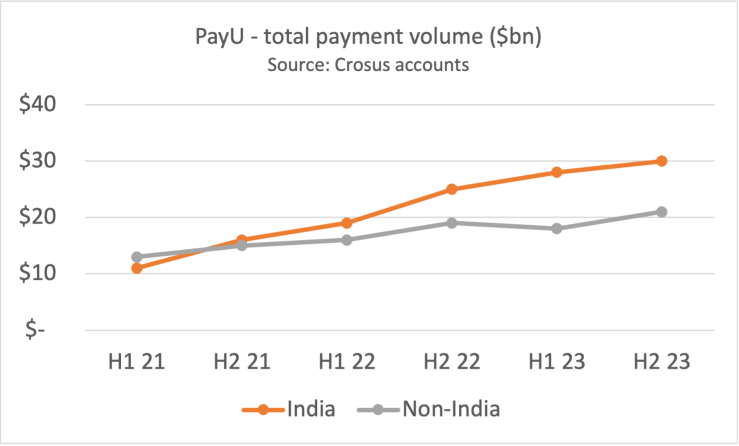
PayU’s payment volume grew 23% in FY 2023 to $97 billion. Most of the growth came from its 8m SME customers in India. Volume processed on the subcontinent rose 32% to $58 billion. What management describes as its Global Payments Organization (GPO), which includes all PayU business outside India, saw volumes rise just 11% to $39 billion.
Revenue from PayU’s core PSP business grew 23% to $792 million, driven by a strong performance in India and Turkey. Sales in India overtook the rest of the world for the first time, recording a turnover of $399 million, a rise of 31%. Outside India, revenue was up a more modest 15% at $393 million. Of this figure, roughly one third comes from Turkey (not included in the sale process) and another third from Poland (which is).
ATV was up 5% in India to $40.39 and remained flat outside India at $31.45.
The take rate in India was flat at 0.69% but rose 4 basis points in the rest of the world (RoW) to 1.01%. PayU provides eCommerce gateway services and payment orchestration but is not an acquirer, so a 1% take rate is reasonable. It represents an average revenue of 30 cents per transaction.
PayU recorded a trading profit of $11 million in India with a margin of 3%. Outside India, PayU lost $14 million, although it would have made a small profit except for a £23 million provision “related to merchants in Brazil and in the travel industry.”
PayU also booked $143 million in revenue and a trading loss of $27m on its 21% minority stake in Remitly.
Divesting the non-Indian and Turkish PayU businesses makes sense. These other markets are growing slowly and, collectively, are barely profitable. A trade buyer should be able to find plenty of synergies although the numerous technical platforms might be challenging to integrate. PayU also brings scale in Poland where it includes the former Allegro Payments, spun out of Europe’s leading online marketplace which was formerly owned by Naspers. PayU Poland recorded revenues of $248m in 2021. You can read more at Cashless.pl.
Of the three potential suitors, Rapyd has the strongest emerging market focus today and probably best understands this corner of the payment world. On the other hand, Worldpay badly needs a growth story to tell when it demerges from FIS in early 2024 and PayU might fit the bill. As for Nuvei, it has Ryan Reynolds on its share register so anything is possible.
Pay U has built its business largely through acquisition. Key purchases include:
Wibmo – Indian based white-label payment gateway bought by Pay U for $70m in 2019. Wibmo claims to have 160 bank and fintechs as customers in over 30 countries processing over 3bn transactions annually. Pay U laid off 150 staff in India at the end of 2022
Citrus Pay – a mobile wallet and gateway business operating in India, bought for for $130m in 2016. Citrus Pay claims $3bn processed annually.
Zooz – one of the first payment orchestrators, Israeli based Zooz was bought by Pay U in 2018, reportedly for between $80 and $100m. Zooz technology is at the heart of Pay U’s “payments hub” which connects its various technical capabilities.
Red Dot Payment – based in Singapore, Red Dot offers an webshop in a box, including payments, for micro merchants. Pay U acquired the business at a $65m valuation in 2019.
Iyzico – Pay U purchased this Turkish POS and eCommerce PSP with mobile focus for $165m in 2019. H&M, and Decathalon are customers. Iyzico processes 65bn lira annually which is around $2.5bn today at today’s exchange rates.
Polski Standard Płatności, which operates Blik, the wildly successful Polish payment method, has reported excellent 2022 financial results.
According to Cashless.pl, total revenue grew 88%to €46.4m driven by markedly higher transactions across all channels. Net profit almost trebledto €23.93m.
Blik, which boasts 13m active users, is a payment standard jointly owned by Mastercard and seven local banks. Blik is not a PSP and does not move money around. The 2022 results may give an indication of size of the open banking payment infrastructure opportunity in other countries. There is profitable revenue to be made. No question. But maybe not at the scale many are hoping for.
During 2022, Blik initiated 1.2bn transactions to a value of €35bn split between retail (eCommerce and POS), ATM and P2P. Across all channels, the take rate was 13bps and revenue per transaction 4 cents.
Blik’s eCommerce user experience has been notably successful in Poland. Mobile banking apps generate a six-digit code which shoppers enter into the eCommerce checkout page. Shoppers can then ask the website to remember them for one-click checkout next time. Here’s a quick explanation from Millennium Bank, one of Blik’s shareholders.
Blik was used for 714m eCommerce transactions in 2022, up 37% on the previous year. It now accounts for an astonishing 60% of all eCommerce transactions in Poland. Blik has gained share primarily from direct bank transfers rather than credit cards. Online transaction value nudged up 3% to €26.66.
For years, shoppers could only use Blik at POS by keying a six-digit code into the payment terminal. It’s no surprise that customers preferred to continue using cards. But following Mastercard’s investment, POS transactions are now enabled for NFC using Mastercard network tokens (MDES) which has greatly improved usability. Transactions are growing swiftly from a low base. There were 228m POS transactions in 2022 of which 70m were contactless. Importantly, the partnership with Mastercard allows Poles to pay with Blik at POS terminals outside Poland.
Dariusz Mazurkiewiczs, Blik’s President, said the good results “allow us to take bold steps in international development on our own.” Blik will shortly launch in Romania and has just acquired Viamo, a Slovak mobile payment specialist.