Allpay, a highly profitable British PSP focused on the public sector, has reported excellent results with turnover up 21% to £48.7m in year ending June 2023. Operating margin rose to a very creditable 16%.
Along with Pay360 (recently sold by Capita to Access Group), Allpay is one of a small number of specialist providers of bill payment solutions to the UK public sector. This includes direct debits, card payments, debt collection tools, a white label app and the ability to accept cash payments via the Paypoint, Payzone and Post Office retail networks. Allpay boasts more than 500 housing associations and one third of British local authorities as clients.
Allpay also has a growing business supplying pay-out products which allow authorities to distribute benefit payments directly to low-income families, often onto one of Allpay’s pre-pay Mastercard’s. During the cost-of-living crisis, more people have been relying on state assistance of various kinds and Allpay reported a record £37.5m loaded to its cards in March 2023. These cards can include MCC and ATM blocking as well as spend limits that give public sector bodies more control on what money is spent on.
Allpay manufactures cards for itself and others and has invested £1.5m into new production technology.
Prepay is fast becoming an excellent business line for Allpay. Revenue from pre-pay and other services grew 72% to £10.3m. Turnover from the much larger bill payment segment was up 12% at £38.4m.
Cost of sales rose just 2% resulting in gross profits increasing 47% to £25m.
Administrative expenses were up 28% to £17m including £11m of staff costs. Employee numbers rose 6% to 271 at an average cost up just 5% at £40K. Allpay is based in rural Herefordshire and less impacted by the high and rising pay costs hitting Fintech providers in London.
Operating profit more than doubled to £8m with margins rising to a very creditable 16.3% compared to 9.4% in 2022.
Allpay is growing nicely, has a blue-chip customer list, maintains a positive cash flow, is largely debt-free and pays a consistent dividend to its owners. With Killeen now 67 years old and still the sole owner of the company, Allpay must be an attractive acquisition target for private equity or trade buyers.
JP Morgan is struggling to turn market share gains into revenue. Positioned at the commodity end of the processing market, JPM’s volume has been outpacing its competitors since 2017 (see chart) but turnover has been lagging. From data presented at a recent Investor Day, I calculate JPM generated just $1.25bn revenue on its colossal $2 trillion volume in 2022. Worldpay, with a similar total volume processed, recorded sales of $4.8bn in the same year.
JPM’s management doesn’t see scope for increasing prices. Instead, it wants to grow profit margins by commercialising developer-friendly value-added services and expanding outside the US, especially in Europe. JPM modestly told analysts that merchant acquiring was “still work in progress” and that it remains committed to investing in product and distribution.
A key part of JPM’s European expansion plan was the $800m it spent to buy 49% of Viva Wallet. Less than 12 months after the deal, the US bank had already fallen out with its new partner. Two of JPM’s board directors resigned and Haris Karonis, Viva’s founder and CEO, replaced them with his own people. Viva has expanded from its mPOS roots and the resignations are said to stem from management’s decision to process payments for a Greek adult entertainment channel. A golden rule of M&A is “don’t do joint ventures” but, if you must, always take a majority stake.
“Dark clouds are gathering over European payment firms” according to Jefferies, a research firm out to generate headlines over the festive season. On closer reading, most of the gloom centres on the general economic outlook rather particular issues with individual businesses. The exception is Worldine which the analysts believe faces “multiple company-specific headwinds.” It’s no surprise that Worldine is reportedly considering asset sales or investment from Credit Agricole to shore up its sagging share price.
And in Spain, Redsys, which routes payments on behalf of over 60 financial institutions, shocked the nation with two outages in November. These were the company’s first failures in 12 years.
Payment investors everywhere will be cheered that Stripe is finally making money ($). Revenue has rebounded after a quiet 2022 while costs have been kept well under control. Sales to enterprise customers are going particularly well although there’s a clear risk of over-reliance on a few key relationships. One analyst suggests Shopify alone accounts for one third of Stripe’s payment volume.
London based SumUp which claims 4m small businesses customers in Europe, the Americas and Australia has raised €285m fresh funding at a valuation of €8bn. The cash will be spent on widening the product beyond mPOS to broader financial services and expanding beyond its current 36 international markets. SumUp now claims to have positive operating cashflow.
Raypd’s controversial CEO has made waves in Iceland with his vocal support for the Israel government’s war in Gaza. Two large merchants have already announced they will boycott the processor. It’s certainly an opportune moment for Adyen to enter the Icelandic market, announcing a partnership with Straumur, part of Kvika Bank, which claims 25% market share.
The sector is not dead yet. Nice-based Izicap, which has a clever SME proposition sold in partnership with Bank Populaire, Credit Agricole and Nexi is still trading and hasn’t yet exhausted the €15m raised in 2022. And I’ve been impressed with Krowd, a London-based start-up with a strong merchant proposition that powers some Amex offers programmes.
Brexit bonus
Outside the EU, the UK competition authorities have discovered a backbone. The Payment Systems Regulator (PSR) is reviewing cross-border interchange fees paid by UK acquirers on card-not-present transactions from Europe. Before Brexit, EU regulations kept these fees at 0.2% for debit cards and 0.3% for credit. Freed from the dead hand of Brussels bureaucracy, Visa and Mastercard increased them to 1.15% and 1.5% respectively, generating a handy extra £150-£200m annual Interchange for issuing banks in the EU. The PSR says “we have not seen any persuasive evidence to indicate that the increases were necessary or appropriate” and is expected to re-impose the previous Interchange level.
Paradoxically, the PSR says it has no interest in regulating Interchange flowing the other way, from EU merchants to UK issuers. British banks will be happy. European merchants less so.
EPI is a northern European initiative but there’s a similar move in the south of the continent. Spain’s Bizum, Italy’s Bancomat Pay and Portugal’s MB Way have agreed to allow customers to make instant payments across each other’s networks. The three mobile payment solutions carried a total of 1.47bn transactions in 2023 on behalf of 43m people so there could be considerable demand for the service.
The national debit schemes are also working on inter-operability. French integrators FrenchSys and Elitt have partnered with Lavego, a Munich-based network operator, to bring Girocard acceptance to standard FRv6 terminals. These are supported by all French acquirers and this move could help Giro gain wide acceptance in France. The move underlines Giro’s ambition to move well beyond its narrowly defined German debit heritage.
New Shopping
We’re tracking the growth in autonomous stores in case because this could spark the long predicted shift in transactions from the merchant’s devices to the shopper’s phone. If so, it could have profound implications for European merchant payments.
SSP, a catering company, has opened autonomous stores at Dublin and Oslo airports. Shoppers tap a payment card on a PAX IM30 unattended terminal at the entrance before picking up sandwiches or other purchases from the shelves. Planet (the acquirer) makes a pre-authorisation and generates a token which is sent to Zippin, the Californian vendor providing the store software platform, camera and sensors. On exit, the final basket is calculated and Zippin sends a payment request to Planet.
There’s a fine line between an autonomous store and a large vending machine. Carrefour has opened an 18m2 fully autonomous shop near Brussels airport. Shoppers need to have downloaded the Carrefour BuyBye app before entering the shop. Reckon AI, a Portuguese start-up, is providing not only the technology but also helped design the outlet.
Autonomous stores need sophisticated artificial intelligence to spot product sold loose, such as fruit and vegetables. Aldi says 3/10 customers buying loose products won’t use conventional self-checkout machines so it is piloting automatic recognition of fruit and vegetables in Cologne using Diebold Nixdorf’s “Vynamic Smart Vision” product.
As consumer frustration with badly implemented self-checkout machines grows, this use of AI a potentially great way of helping customers and cutting costs at the same time. Shoppers take 15 seconds to select the right fruit or vegetable from the menu, but the AI can do this in just 3 seconds.
Retail is about choice as much as convenience which is why we’re seeing merchants offer multiple checkout options in physical stores. For example, some Tesco convenience stores are now offering four choices – staffed, traditional self-scan checkout, Magic Tills (which tell you what’s in your basket but you pay on the terminal) or GetGo (scan a QR at the store entrance and just walk out with payment automatically billed to your account). Trigo is providing the sensor technology.
Wearable payments
Advances in provisioning card credentials are making it easier to turn any object into a payment device. There’s a lot going on in the industry although it’s doubtful whether any of these ideas will get beyond niche use cases as long as we’re all carrying a phone in our pockets.
SmartChip Switzerland has demonstrated a contactless enabled fingernail (see video) working with Infineon and Digiseq, a UK vendor which claims the leading platform for managing remote card credentials. Dave Birch, Digiseq’s chair, explains how it works. Digiseq and Infineon have also worked on a pre-certified ring-inlay which jewellery producers can build into their products.
In Poland, Invispay has launched a range of payment-enabled watch straps priced between €99 and €299 which can be provisioned with card credentials from a number of local banks. Wearonize, a Swiss fintech-as-a-service, is providing the technology.
Tapster is a Swedish start-up also looking to turn personal objects of various kinds into payment devices. Working with Fidesmo as its technology partner, Tapster is supplying a payment ring to customers of Italian bank, Intesa Sanpaolo. The devices use Mastercard tokens.
I’m still not convinced but I’ll let Tapster’s CEO makes his (quite entertaining) case.
Product
One of the reasons for Worldpay’s recent underperformance has been the lack of a convincing international retail offer so the creation of WorldPay Omnichannel as a partnership with FreedomPay is good news. This proposition brings together Freedom Pay’s POS and Worldpay’s eCommerce gateways through a single integration with common tokenisation across the platforms. HMV, the British entertainment retailer, is the first customer, taking Worldpay Omnichannel for its Dublin and Antwerp stores.
Elsewhere, Worldpay’s British merchants have facilitated a total of £10m charity donations via its integration with Pennies, a 3rd party service that rounds-up POS transactions to the nearest pound. Given that Worldpay has been working with Pennies since 2011 and that the Pennies integration is used by 14 of its largest merchants, £10m does not sound very much. I’m not criticising Worldpay, and £10m is very welcome for the charities that have benefited, but there may be better ways of persuading shoppers to make more meaningful donations.
Mastercard and Visa’s attempts to introduce sonic branding never caught on but Paytm in India is making $150m pa from subscriptions to its Soundbox service which gives merchants audible confirmation that payments have arrived.
Wesub, a Polish start-up, is looking to become the Klarna of subscription commerce. Wesub takes ownership of the product at point of sale and is responsible for collecting payments from the consumer. The business has recently expanded into France and Switzerland.
Pay Eye, another Polish start-up, has launched in the USA with its biometric payment product and is getting good media coverage.
Two new value added services for POS terminals are tipping and digital receipts. Matt Jones looks at the culture of tipping and the implications for payment products. Vendors to watch include TiPJAR in the UK and Béné in the US.
Digital receipts are attracting attention, especially since the French Government finally implemented a partial paper receipt ban in August 2023. Hat tip to Pi-xcels, on winning the Worldine Payments Challenge in Paris with its clever way of passing a receipt to the shoppers phone without needing an email address or number. “No app just tap,” they say.
Group payments is another growing category. People need help dividing payments for shared holidays or electricity bills. Collctiv is an early leader, having processed £37m from 160K pots and 800K users. Users can settle with Apple/Google Pay or PayPal. The business has expanded to the US following its participation in Techstars New York. A combination of Ryft, a marketplace payment specialist, and Stripe handle the processing on a fintech-as-a-service model.
Regulators are getting tough on fintech as a service start-ups following the high-profile failure of Railsr and others. The moral for customers is that outsourcing compliance sounds great but you’re only as good as the supplier you choose. If they make mistakes, you could be in trouble.
SoftPOS
SoftPOS enables any Android or iOS device to accept card payments. This presents vendors of ruggedised handhelds an obvious upselling opportunity to their existing retail customers. Zebra, the industry giant which boast over 10,000 channel partners has announced its first SoftPOS customer. Thom Group, the French jeweller is implementing the solution in 600 stores and says it will help staff break free from fixed till points. Softpos will be running on 1,000 Zebra EC50 mobile terminals. Rayonnance acted as integrator with Axepta BNP Paribas as the acquirer.
Courier delivery is also proving fertile ground for SpoftPOS. PolCard (Fiserv) is implementing its solution with DHL delivery drivers working on behalf of the Media Expert electronics retailer. PolCard’s PolGo application is integrated with Media Expert’s own software on the DHL device.
The value of Softpos in many markets is reinforced by the growing availability of soft fiscal printing. Again in Poland, Worldine has launched combined Softpos, ePOS software and soft fiscal printer on one Android device. The fiscal software comes from Wirtualne Kasy Fiskalne, a Polish start-up whose name helpfully translates as virtual cash register. There’s a general solution for retail and very niche one one for vending machines at car washes
Open banking
The deadline for setting up the body to oversee the development of open banking in the UK has been postponed once again. We’re now expecting it to go live towards the middle of the year with the first deliverable – the snappily titled “non-sweeping Variable Recurring Payments” (VRPs) – unlikely to appear until Q3.
PSD3 offers grounds for optimism but won’t move the dial in the short term. Jan Van Vonno from Tink engagingly explains its the new regulations likely impact on open banking in just three minutes.
Maybe 2025 will be the year open banking goes mass market. It’s not going to be 2024.
For widespread adoption, we need clear use cases that add value to merchants and shoppers. For example, many airlines reject Revolut cards because they are pre-paid. In response, the bank fintech has launched Revolut Pay for Airlines which converts Revolut card transactions into A2A payments. This advantages both consumers, who get 1% cashback, and airlines who receive a guaranteed payment. Revolut Pay would make a great application for open banking payments.
POS payments might be another. Kevin, a well-funded Lithuanian fintech, is the first to develop open banking payments at POS via NFC. Here the product team explains how it works.
Yet even if/when volume accelerates, there remains the question of how anyone’s going to make money from open banking. The European Payments Council has published default fees for “premium” open banking services which range from 2c-4c per transaction. The tariff for the Euro equivalent of VRPs, for example, would be just 2.72c. That’s not much. Massive scale will be needed to generate meaningful profits.
Cash
The latest annual payment survey from the British Retail Consortium shows cash usage growing for the first time in many years, from 15% to 19% of their members’ transactions. The BRC thinks this is “reflects a choice by many households to use cash to budget more carefully.”
Nevertheless, many merchants are going cash-free and this is worrying policymakers, especially in the UK, Sweden and the USA where LA is the latest US city to bans cashless stores. Washington DC, which also passed a rule obliging merchants to accept cash, has begun enforcing the new regulation. One restaurant owner, anxious about robberies, is refusing to comply. “Even if I have to gather a couple of violations, I don’t think you can really put a dollar value on the safety of the staff and the guest,” he said.
Meanwhile, in Germany one cafe put up this sign “Due to the current tax situation, we will unfortunately no longer accept card payments from January 1, 2024. We ask for your understanding. Thank you!” This “tax situation” may be that VAT is reverting to pre-Covid levels or maybe that the restaurant does not want to pay any tax.
Credit: @ted_knudson
Crypto corner
We’ve certainly come a long way in 12 months. Last February, a far-sighted individual paid $1.6m for this Bored Ape NFT jpg. It’s no ordinary monkey. The million dollar ape features “solid gold fur, with a multicolour grin, service uniform and heart-shaped glasses”. Priceless.
The bubble is over. Bored Apes are on offer around $60K as I write.
In CBDC news, British MPs have warned that plans for a digital pound (known as Britcoin) should proceed with caution, saying: “The extent of the benefits is unclear… nor is it yet clear that a digital pound is the only (or best) means of achieving them.” Other than that, they think it’s a great idea. Meanwhile, the Bank of England has hired Diana Carrasco, head of merchant services at Lloyds Bank, to head the project.
Other news
Looking to the New Year, here’s a collection of 140 trend decks compiled by the world’s top analysts. AI is everywhere but it’s like Crypto and Metaverse never happened. As Groucho Marx might have said, “here are my forecasts. If you don’t like them I have others.”
Benedict Evans gives an entertaining presentation discussing AI and concludes that nobody knows what’s going to happen. And if Ben doesn’t know, nobody does.
Maybe Sebastian Siemiatkowski has the answer. Klarna’s CEO has implemented a hiring freeze, saying that AI productivity tools inevitably mean he will need fewer staff.
With dogged determination, Wordline is ploughing on with its Metaverse strategy, announcing “season two” of its Metaverse Shopping Hub. The product is now available for Decentraland and Spatial. And through PayOne for DACH markets. If anyone every makes to the end of season two, please let me know.
EasyPark Group (owner of RingGo and ParkMobile) sold by BMW/Daimler to private equity investors in 2021 has been hacked. Customer data including partial PANs was stolen.
And I had the great pleasure of moderating a webinar for MPE featuring two giants of central European payments – Ralf Gladis, CEO of Computop and David Rintel, CEO of Trust Pay.
And you can meet me in person at MPE in Berlin. I’ll be moderating panel discussions on financial inclusion and customer experience.
Dojo, the SMB card payment brand created by Paymentsense, has taken the UK market by storm but with its parent company racking up £498m debt, a tricky re-financing is looming in 2025.
Based by the canal in Paddington, in a swish office building shared with the English Premier League, Paymentsense is the brainchild of two low-profile serial entrepreneurs – Juan Farrarons and George Karibian. The team also founded Judopay, a mobile payment gateway recently sold to Fabrik, and Capital on Tap which issues credit cards to SMEs.
Paymentsense says that “investors continue to prioritise growth over short-term profit and are investing heavily in both technology and customer acquisition.“ Their confidence has been rewarded by payment volume trebling in just two years, reaching £33bn in the year to March 2023. I can’t think of another European POS-focused payment brand growing as quickly.
Dojo added a net 26,000 customer locations and now serves 146,000 premises. The customer base is moving upmarket which is a positive trend. Average volume per location rose 26% to £227,000 and larger merchants now include restaurant chains Cote and Pizza Pilgrims.
Paymentsense has been migrating more merchants to its in-house acquiring service. This helped turnover grow 66% to £298m with the take rate ticking up 7 bps to 0.9%.
Management explains that Dojo was only possible once the company built its own processing platform and stopped being reliant on Fiserv/First Data. As Nick Fryer, CTO explained in this interview with Fintech Magazine:
“It was frustrating that we couldn’t change the product, which was very similar to everyone else’s, and our key sales tools; our salesforce [were] awesome, but we knew we could do even better by our customers. So we looked at ways of taking control of the product, trying to make it better and more customer-focused.”
Paymentsense cleverly built the Dojo brand around the PAX A920. Other providers can re-sell PAX devices but only Paymentsense sells Dojo. In just a few years, the eye-catching white terminals have become ubiquitous on Britain’s high streets. The original Dojo has now been joined by the smaller Dojo Pocket. This includes ePOS integration so that restaurant staff can generate bills and take payment at table. A counter-top terminal is promised soon.
Walkup, a restaurant booking app purchased for £20m in 2022 and now renamed Dojo.app adds to the hospitality proposition. However, Walkup seems to have made little impact so far. It recorded an operating loss of £847K on sales of just £473K.
Dojo’s investment in a large field sales force backed with aggressive digital marketing is one key reason for its success. Dojo also appeals to SMBs by only insisting on a minimum six-month contract and being willing to pay up to £3,000 to buy customers out of multi-year contracts with other providers. This advantage has been eroded by the regulator’s drive to cap contracts at 18 months. Another early differentiator was Dojo’s commitment to next day settlement, although this has now also been replicated by competitors.
Almost all merchants are in the UK. The small Irish operation – which processes through Valitor Rapyd – accounted for just £8m sales but Paymentsense has big plans. It has secured an e-money licence in Ireland which gives the ability to operate across Europe.
For the Paymentsense group as a whole, administrative expenses rose 31% to reach £244m. More than half the extra cost was accounted for by a 76% increase in employee expenses which rose to £71m driven by both higher staff numbers (almost 1,000) but also sharply higher salaries. Total spend per staff member was 49% higher at £73,000. The staff need somewhere to work. Paymentsense is taking a new 55,000 sq ft office in Bristol.
While management is pleased that adjusted EBITDA, the company’s preferred measure of profitability, more than doubled to £69m, the bottom line doesn’t look so pretty.
After deducting £122m of depreciation and amortisation and a further £62m of net interest payments, Paymentsense lost £141m before tax, roughly the same as the previous year. Accumulated group losses recorded by Typhoon Noteco, the ultimate UK holding company, now stand at an eye-watering £582m according to documents deposited at Companies House.
The group’s outstanding debt rose £86m to £498m giving a debt to EBITDA ratio of 7.2x. A £320m bond at 8% is due in 2025 and a long-term loan of £180m at 16.25% is due in 2026. Refinancing this debt mountain could be a challenge in today’s market conditions.
Paymentsense has built an impressive sales and marketing machine but competitors have begun to react to the Dojo phenomenon. The business will need to continue to innovate if it is to avoid a crunch in 2025.
Fidel API, a start-up introducing the concept of “programmable money” to the management of card-linked loyalty programmes, revealed widening losses with its 2022 annual results.
Card-linked loyalty has been around for some years but is a notoriously difficult market in which to achieve the scale needed for profitability. Bink, a high-profile start-up which boasts both Barclays and Lloyds banks as shareholders has accumulated losses of £67m in eight years. Only London-based Reward Insight is making money. Its most recent accounts showed a profit of £2.6m on turnover of £43m.
Fidel is controlled by Subatra Dev, its founder. Most card-linked propositions are aimed at marketing directors but Fidel API is targeting developers by offering direct API access to transaction data from Visa, Mastercard and American Express.
Despite its high-profile clients, Fidel’s business performance in 2022 was modest. Turnover grew 19% to $3.59m, mainly due to “higher non-recurring platform revenues from a key customer.” Despite a push in North America, three quarters of sales are in the UK.
Operating losses widened from $11.4m to $21.8m driven by “continued investment… in people, technology and operations.” Employee expenses almost doubled to $14m with an average of 103 staff during 2022 costing $135K each.
Fidel API raised $44m in 2022 from a blue-chip investor rosta including Bain Capital and exited the year with $27m cash in the bank. Card-linking sounds wonderful on paper but, in practice, is a very tough market. The developer friendly approach is novel but management will need to work hard to deliver a return to its investors.
Last month’s poor results from Worldline and Adyen have not set a trend. Nexi’s Q3 numbers came ahead of market expectations. Management said there was no sign of the slowdown in Germany which has so rattled Worldline’s shareholders. Nexi’s stock price is recovering nicely while Worldine is still bumping along the bottom.
Adyen bounced back after its plain-speaking Dutch management presented analysts with a more realistic assessment of the company’s growth prospects and promised a slowdown in the breakneck pace of new hires. Adyen’s Q3 revenue was up 22% and with the processor now targeting 50% EBITDA margins by 2026, significant cash profits are on the horizon.
The dilemmas faced by European legacy acquirers are well described in Nightmare on Acquiring Street, a new paper from PSE Consulting. This lays out the speed at which the market is moving to “gateway acquirers” such as Stripe, Adyen and Checkout, which offer a tightly integrated bundle of services operating over a single platform.
Source: PSE Consulting
Processors operating with old technology and without modern checkout and boarding tools are struggling. Barclays and Credit Agricole are the only banks remaining in the list of top European acquirers and both now recognise the need for change. Credit Agricole has announced a JV with Worldline and Barclays is exploring options for Barclaycard which could involve a sale or joint-venture.
As well as the impact of technology trends, European acquirers also need to contend with a profound shift in channel buying behaviour by small businesses, the most profitable customer segment. A new report from Flagship Consulting demonstrates the extent of the risk.
Source: Flagship Consulting
Independent software vendors (ISVs) and other platforms are now taking between 40% and 65% of new merchants signed in the US. This trend is coming to Europe and threatens banks ability to sell direct to SMBs. ISVs are demanding increasingly high commissions from the acquirers. Bain estimates that 90% of payment revenue is at risk of changing hands.
The impact on the ISV’s themselves is less well documented but these businesses are now finding they can generate up to half their revenue from commissions on payment processing. This is incentivising bad behaviour and we’re seeing incidents of market abuse where ISVs impose penalties for merchants that use 3rd party payment products.
Shopify, the leading eCommerce retail platform, charges a 2% surcharge if merchants don’t process transactions through Shopify Payments. And Lightspeed, a restaurant POS software vendor with over 10,000 customers worldwide, insists that all new customers take its integrated payments product. Those who don’t will be hit with a 0.5% transaction surcharge.
This hasn’t gone down well in Canada where one restaurateur reported being charged $300 for using a competitor payment terminal. “It’s not illegal, but it’s unethical,” said the local business association. Lightspeed have now introduced a price pledge to match competitor pricing in any country. But it’s worrying that many ISVs are now treating their customers as hostages. This won’t end well.
Corporate activity
Advent, the US private equity giant has bought London-based MyPOS for $500m.MyPOS, which became a merchant acquirer last year, claims 170,000 mPOS merchants in 30 countries and generated €11m EBITDA in 2022 on revenues of €60m. Advent has bought MyPOS through a newly established “payment and technology platform” called Circle which will be chaired by Laurent Le Moal, ex CEO of PayU. Expect more deals to come.
Total Processing, a small but fast growing ISO based in Manchester, recruited Martin Gilbert of Revolut as a heavyweight chair just six months ago. He has wasted little time in arranging the sale of the business to Nomupay, the well-funded Dublin-HQ’d processor formed from the ashes of Wirecard. Nomupay is clearly one to watch.
Tencent, the Chinese technology platform, has paid $100m for an 8% stake in Global Blue, the market leader in Tax Free Shopping, at a valuation of $1.25bn. The Tencent relationship will cement Global Blue’s position with high-spending outbound Chinese travellers.
Silverflow, the Amsterdam based payment orchestrator has raised €15m at a valuation “significantly higher” than its previous raise in 2021. The money will be used to support the company’s expansion into Latin American and the Far East.
Shift4 has finally closed the $525m acquisition of Credorax Finaro. The eighteen-month delay, caused by the presence of a sanctioned Russian oligarch on the Finaro share register, has given management plenty of time to plan the integration. The combined business has scale (c.$200bn volume), international reach and the capability in eCommerce which Shift4 has been lacking.
AIB and Bank of Ireland have abandoned efforts to create a domestic money transfer app to compete with the runaway success of Revolut. The banks had spent a total of €17m on the project which was to be called Yippay (yes, really) but ran into regulatory obstacles. Nexi had been contracted to build the product.
The Irish banks may be better served joining the European Payment Initiative (EPI) which has completed its acquisitions of iDEAL and Payconiq. This gives the EPI a solid basis of technology and transaction flow on which to build a common digital wallet for all European markets.
New Shopping
We’re keeping a close eye on grocery. Shifts in supermarket payments can move the whole market. But not yet. The FT concludes that, twenty years after the debut of online groceries, shoppers still prefer buying food in real life. Despite the pandemic boost only 12% of UK groceries are bought online.
But in-store shopping is changing rapidly with the introduction of self-checkout, Smartcarts and autonomous stores.
Italy’s first autonomous store has opened in Verona. In contrast to many pilot implementations, this one is a large format Tuday supermarket. The technology, supplied by Sensei, a Portuguese start-up, can even detect variable weight items through an integration with the scales. Payments are from Nexi. Shoppers don’t need to use the app. They can pay at a standard POS if they choose.
Tesco is trialling a similar process at one UK store. Again, shoppers don’t need to use the retailer’s app. They just walk up to the checkout which will “magically present them with a list of the products they have picked up”. Shoppers can pay with a card in the normal way. The technology is from Trigo, an Israeli start-up already working with REWE, Aldi and Auchan and in which Tesco has a small stake.
A2Z, the Israeli start-up which is leading development of smart carts, announced the delivery of an initial order of 250 to Monoprix, the French supermarket. These carts contain sensors that automatically record your purchases. A2Z believes it will sell a total of 30,000 smart carts in France alone over the next three years through IR2S, its distribution partner.
There is a live debate about self-checkouts. It’s clear they can work well for small basket sizes but not for the weekly shop. Whether it’s using a handheld scanner or fixed self-checkout terminal, the process puts too much work on the shopper.
In biometric news, PayEye, a Polish start-up which allows people to pay with an iris scan has launched a new range of hardware. Called eyePOS, the terminals include a special camera but also take standard payment cards. PayEye offers them for an introductory price of €11.25 per month.
Despite overwhelming consumer demand to pay at POS by tapping their mobile phone on the terminal, there are still some circumstances when a physical card is needed. One is the M6 toll road in the English midlands. The operator has annoyed tens of thousands of motorists by removing the ability to use Apple or Google Pay. The rationale? A Government dictat that it was illegal have a mobile phone in your hand while in control of your vehicle.
After a predictable outcry, the Government has conceded an exemption for making a contactless payment and the toll road systems will be upgraded for Apple Pay.
In-car payments
The toll road problem would be avoided if all motoring-related payments – parking, charging and fuelling – were brought together in a single app accessed from the car dashboard.
Mercedes Benz has built its own payment service but Volkswagen is following a different approach of co-ordinating a set of partners. VW has launched “Pay to Fuel” for its Skoda brand working with Mastercard, Parkopedia and ryd, a German fintech that offers a pay-to-fuel app.
Meanwhile, VW has sold PaybyPhone to Fleetcor, a large US B2B payment company for $300m. PayByPhone, generates c.$40m annual revenues from its app which gives access to 4m parking spaces in 1,000 cities across Europe and North America. Payment volume was $900m in 2022, giving a very healthy take rate of 4.4%.
Fleetcor plans to expand the PayByPhone service to include EV charging and automatically buying fuel at service stations.
Product
Alcohol and cigarette vending machines are common in Germany, but age verification can be tricky. It’s good to see Girocard, the domestic debit scheme, working with Feig, a leading vending machine supplier, to restrict sales to those old enough to buy the products.
Also in Germany, Bluefin has gained Giro certification for the TECS platform it acquired earlier this year and launched a white-label POS service for ISVs. Newland is providing the Android terminals. In other hardware news, ITCARD, a Polish acquirer with 90,000 POS, has started deploying Ingenico’s Axium terminals. This is positive news for Ingenico which has been very slow to market with a workable Android product.
One reason why Stripe is so popular, despite its high prices, is that it makes life easy for its customers. For example, you can now manage Klarna disputes from within the Stripe dashboard. Previously, Stripe merchants needed to deal with Klarna customer services via email.
It’s no surprise that Stripe can get its merchants to write great testimonials. Here’s the CIO of La Redoute, the giant French catalogue retailer, explaining why he chose Stripe as its global PSP/processor. “It has been an incredible and enjoyable journey working with Stripe’s team,” he says.
Stripes’ platform strategy is sparking interesting innovation. Lopay is a UK mPOS provider built on top of Stripe’s APIs. Lopay (the clue is in the name) undercuts SumUp and iZettle by charging just 0.99% for debit/credit transactions. It says it has signed 20,000 merchants in 18 months. Lopay charges 0.8% extra for instant settlement and says this is a very popular option.
DeluPay is targeting a similar market in France with a solution based on QR codes linked to open banking transfers. 1,000 merchants have signed up to benefit from transactions free under €2 and 0.5% thereafter. If you understand French, watch the CEO get quite a grilling on this early morning business TV show. The presenters struggle with the consumer proposition and keep asking why they wouldn’t keep using Apple Pay or Paypal.
The Polish Post Office is looking to capitalise on the 10m users of its mobile app by adding InPost Pay as a checkout button for local web shops. Customers can then pay within the app using Blick, cards or cash on delivery.
Finally, take a look at Shop.app. This is a very impressive AI powered search engine that allows you to construct a basket across over 1m Shopify merchants. Payment through Shopify Payments of course.
SoftPOS
SoftPOS is a downloadable payment application that allows any Android device equipped with an NFC chip to take money on cards. This represents a clear threat to the terminal manufacturers who, together, ship over 100m units each year. Sunmi is the first to respond. It’s latest Android hardware range includes a low-cost terminal designed for SoftPOS and shipped without a PCI certificate.
I think SoftPOS will make a quicker impact in the enterprise market than for micro-merchants. For example, Alaska Airlines is working with Stripe to allow 7,000 crew members to accept contactless payments for food and drink using their airline issued iPhones. This should speed up in-flight service.
Dotykacka, the Czech retail and restaurant software provider with over 20,000 merchants, has launched SoftPOS in the Czech Republic and Slovakia. The solution is from Softpos.io, a Danish start-up with Nexi providing the processing.
MyPOS has launched SoftPOS in the UK with merchants paying 1.6% + 7p per transaction and no monthly fee. I think it’s a mistake for vendors to forgo a standing charge as there’s a high risk of attracting large numbers of merchants that never make any transactions.
The steady rollout of Apple’s Tap to Pay as an alternative to Android has reached France. Group BPCE, Adyen, myPOS, Revolut, SumUp, Viva Wallet and Wordline are offering the product at launch.
Open banking
The latest Open Banking Impact Report shows UK open banking payments doubled compared to 2022 and now running at £4.5bn a month, still small modest compared to c.£65bn on cards and c.£110bn on direct debits.
There are now 45 open banking payment providers in the UK. This is probably rather more than the market needs and many vendors must be wondering they can stay in business long enough to reach break-even.
Who is going to consolidate the overcrowded open banking market? The CEO of Go Cardless, a very well-funded UK direct debit specialist, said it would likely be making acquisitions. Go Cardless already bought Noridgen, a Latvian open banking provider earlier this year.
If open banking payments are going to become mass market, vendors need to provide a superior customer experience to cards. One good example is William Hill, provider of online gambling and sports betting, which will be offering open banking for both pay-ins and pay-outs. This is a sector where bank transfers offer clear advantages over cards, notably the ability to pay winnings instantly. Truelayer is providing the technology.
If the industry doesn’t move quickly, the tech giants will drive the market forward.
Apple has started using open banking to offer iPhone users the chance to view their bank balance and transaction history before confirming an Apple Pay transaction. Although it would be a small additional step for Apple to start directing Apple Pay transactions over open banking rails, it may be reluctant to lose the 0.15% commission it charges card issuers today.
Cash
We’ve covered the rip-off fees from many ATMs in tourist locations before. Honest Guide (1.3m subscribers) explains the scandal better than we can. Euronet doesn’t come out well.
With the debate raging about whether merchants should be obliged to accept cash, it’s good to see merchants playing an active role for or against. This sign was spotted by Chris Higham in Newcastle.
And which button would you press in this Las Vegas taxi? Photo from Booshan Rengachari.
CAB Payments has been one of the least successful IPO’s of 2023 with shares down 80%. The FT explains why.
French authorities have levied €414m fines on four Meal Voucher providers for anti-competitive practices in this €6bn market. This is very profitable business – the providers charge 2.5% to the employers and 2-5% for the restaurants.
Cellpoint Digital, which claims to have invented payment orchestration, reported widening losses in 2022 as the London HQ’d business stepped up investment in sales and product development.
Originally founded in Copenhagen in 2007 by Kristian Gjerding, who is still the CEO, Cellpoint’s first customer was Danish Railways and the business still specialises in the global travel sector. Unsurprisingly, turnover was badly hit by Covid but people are flying again and activity is recovering. According to documents posted at UK Companies House, sales grew 14% in 2022 to $2.63m on the back of a 48% increase in the number of transactions processed. There has been a particularly marked rebound in the Americas which now accounts for two thirds of sales.
Cellpoint boasts a blue-chip, customer list including airlines such as Southwest, Emirates, Virgin Atlantic and Iceland Air but also Radisson Hotels and Specsavers, the opticians. The common thread is the need for merchants to deploy a single, global payment acceptance and routing platform which gives them access to local card processors and alternative payments. The prize is lower acceptance costs, higher conversion rates and reduced fraud.
Continuing the positive 2022, management reports that 2023 has started well. New client wins include two airlines – GOL and Beond – as well as Akwaaba, an online grocery retailer. Sensibly for a small business which needs global reach, Cellpoint is turning its attention to partnerships as a route to market. New relationships include Mikroe, a mass transit ticketing vendor, BillingPlatform, Kount, Sabre and Riskified.
Cellpoint claims its customers can choose from a very impressive 221 acquirer and PSP connections globally. Of course, maintaining and growing this network of connections and partners does not come cheap. Administrative expenses rose 29% to $22m. Higher spend was driven primarily by a threefold increase in employee costs to $12.9m as Cellpoint grew headcount in sales and product development. Staff numbers stood at 168 at year end at an average cost of $77K.
Cellpoint also stepped up spend on R&D, which rose from $2.8m to $8.9m as management implemented “a comprehensive overhaul of existing technologies in order to pave the way for new, ore cutting-edge and performant capabilities.”
Operating losses widened to $19.4m and the business was also hit by a $3.69 negative currency translation leading to a total net loss of $22m. Accumulated losses now stand at $69.9m.
Despite receiving $18.6m net new investment during 2022 from Toscafund., Cellpoint closed 2022 with just $1.8m cash in the bank. Fortunately, existing shareholders contributed a further £10.2m after year end and management has “received written assurances of continued financial support.”
Cellpoint has one of the most robust and battle-hardened orchestration propositions in the market. But overheads are considerable, and management will need to work hard to generate transaction volumes sufficient to deliver cash profits. Continued strong shareholder support will be essential for it to continue as an independent business. If not, the core technology and customer relationships could be a prized asset for an ambitious global processor.
Discover’s Q3 results showed a sharp slowdown in volume processed by its 25 network partners. These are third party schemes, such as SIBS and RuPay, whose cards run over Discover rails when used outside their home country.
Network partner volume was down 17% in Q3 to $9.8bn. Management said that Ariba Pay, a longstanding Discover partner which helps businesses settle invoices, was the main contributor to the poor performance. Partner volume has not increased since the end of the pandemic. This trend is particularly surprising in the light of reports from Visa and Mastercard of continued c.20% growth in cross-border commerce, and will be giving Jason Hanson, Discover’s new payment supremo, cause for concern.
In contrast, Diners which is still largely a series of national franchises, continues its positive trend. Boosted by the upturn in global travel and tourism, Diners volume grew 11% to $9.7bn.
Visa and Mastercard’s Q3 financial results are well covered elsewhere. At Business of Payments, we’re more interested in what the investor updates tell us about trends in the European market and the success (or otherwise) of new products.
Mastercard continues to outperform Visa in Europe although its pace of growth has moderated. The two schemes are now almost neck and neck. Mastercard’s merchant payment volume grew 26% in Q3 to $602m while Visa’s was up 20% to $637m. Total scheme volume was up 23% in dollar terms although this falls to 14% when calculated in euros. Overall ATV was steady at $36.24.
European politicians and regulators have long been worried about an over-reliance on US payment networks. The European Payments Initiative and the Digital Euro are two of the latest responses. Asked about the threat of protectionism, MichaelMiebach, Mastercard’s CEO was adamant that his business would always have a role in any payment ecosystem saying. “We’re seen as a technology company, a global technology company, not necessarily as a US payment brand.” That’s a bold statement and one which does not align with current sentiment at the European Central Bank and elsewhere. Dependence on foreign owned payment systems is a risk for any jurisdiction.
Last week, Worldline’s profits warning highlighted weakening European payment volumes, especially in Germany but Miebach said he saw no slowdown. “Consumer spending remains pretty steady in Germany and generally in Europe…. So Europe’s been a bright star, continues to be for us. So we don’t quite relate to what others are reporting.”
Portfolio wins
The deceleration in Mastercard’s European volume growth is primarily due to the removal of the NatWest portfolio win (16m cards) from the annual comparisons. But Mastercard has continued to win new card portfolios including 10m Deutsche Bank cards and 20m from UniCredit. Miebach said the Deutsch Bank conversion “has already started. It’s a combination of debit and credit. It will happen over an extended period of time. It’s not a flip-the-switch kind of scenario.”
Mastercard is also working with issuers to migrate more than 100m Maestro cards (mainly in Germany and the Netherlands) to its own-brand debit product. This is good news for consumers as their cards will now work online. It’s less good news for merchants who will be faced with higher transaction charges.
Visa is also positive about Europe, remarking that it has opened seven new locations over the last five years and more than doubled its workforce. Visa claims more than 100 relationships with European fintechs and even bought two of them – Tink (open banking) and CurrencyCloud (cross-border money transfers).
Excluding Maestro, the total number of Mastercards in Europe rose 13% increase to 796m. Visa did not publish numbers for card this quarter but reported that, excluding the UK, the number of active Visa cards in Europe is up 50% since 2019. Including the UK, where it has lost one third of the debit market to Mastercard, the figures would not seem so pretty. However, Visa’s management says it expects to migrate 40m cards from 40 issuing clients in Europe over next few years. The company says that these incomings portfolios are skewed to high margin cross-border transactions.
Tokenised transactions
Increasingly, cards are tokenised which means that the fraud-prone 16 digit PAN is not included in the transaction data. Visa processed 14bn tokenised transactions worldwide in Q3, up 60% year on year. Tokens make card transactions significantly more secure, and this means that issuers are much less likely to block them. This is very good news for merchants. Ryan McInerney, Visa’s CEO, said “we’re seeing, on average, somewhere between 4% and 5% higher approval rates across our partners. And we also see it with a reduction in fraud — a 30% reduction in fraud.”
Mastercard reported “the number of tokenized transactions has more than doubled over the past two years. We just processed over three billion tokenized transactions in one month.” Management highlighted the importance of tokens in allowing Mercedes-Benz customers in Germany to “pay for fuel directly from their vehicle using only their fingerprint.”
Open banking
Although Visa was blocked from buying Plaid, an open banking leader in the US, it was able to acquire Tink, a similar business HQ’d in Sweden. Management said that Tink “continues to perform very well in Europe…and we look forward to the opportunity to bring Tink outside of Europe.”
Mastercard has acquired Token, another European open banking provider. Questioned about the commercial model for the schemes to enter open banking, Mastercard’s Miebach said “We’re putting in our open banking connection to make it clear is there a balance on the account. It’s called the payment success indicator. That is the product. And it is a per-click fee related to the API call. So that is the model.”
Contactless
Mastercard says contactless now represents 63% of face-to-face transactions globally. Miebach explained why mass transit was so important. “By converting transit to Open-Loop, we gain access to more low-ticket, high-frequency transactions, both at the station and the surrounding merchants.”
Visa reports 76% of all F2F transactions outside the US are contactless, up 5ppts. The US is growing more quickly, albeit from a lower base. Contactless share was up 13ppts to 40%. Rapid transit is driving adoption worldwide. Visa says it enabled 150 new transit systems for contactless, taking the global total to 750. Impressively, 40% of these new customers are using Cybersource, Visa’s in-house acceptance solution, as their payment gateway.
Gateways
Cybersource seems to be out-performing Mastercard Gateway Services, its direct competitor. Cybersource attracted 2,600 additional customers in 100 countries in Q3. McInerney put its success down to investments in omni-channel, tokenisation (vital for mass transit) and fraud prevention capabilities.
Both schemes have products that allow money to be sent to one of their cards. Visa reported 7.5bn Visa Direct transactions globally in Q3 up 19%. In Europe, it is supported by 1000 programmes managed by 100 Visa partners. McInerney said Visa Direct is “focused on bill payments, on earned wage access, on insurance disbursements, on P2P more broadly in new geographies around the world, both domestic and cross-border.”
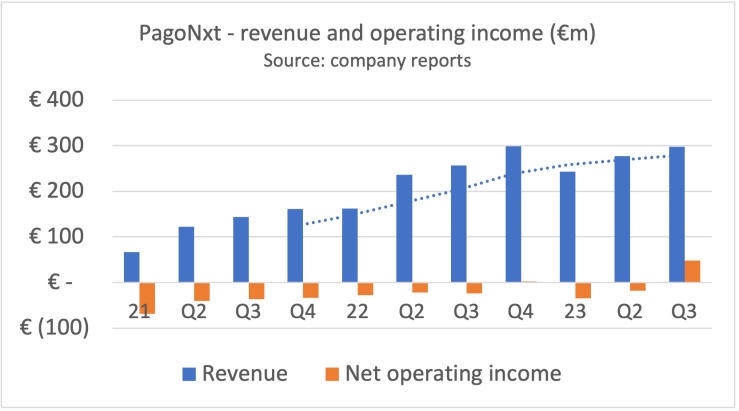
Lifting the gloom a little, PagoNxt, Santander’s payment business, reported sparkling Q3 results including a maiden operating profit. This performance highlights the success of Santander’s decision to in-source and consolidate its payment activities. PagoNxt comprises all of Santander’s payment assets, including Getnet, a leading multi-national merchant acquirer, trade finance expert Ebury, Payments Hub which brings together the bank’s account to account transactions, and Superdigital, a financial marketplace for the economic inclusion of the underbanked.
Q3 merchant payment volume was up 27% to €54bn “backed by good merchant performance” in Mexico, Brazil, and Europe and share gains in all core markets. Transactions grew 26%, leaving ATV steady at €22.46.
Management gave few other updates but said that the Payments Hub is “already one of the largest processors of A2A” in Europe and is now processing transactions from Santander businesses in Spain and the UK.
Overall revenue was up 16% in Q3 to €298m but expenses fell 11% to €251m. It’s not clear what has led to the decline in operating costs but the impact on operating profits was very positive. PagoNxt reported an operating profit of €48m for the quarter at a healthy 16% operating margin, compared with a loss of €24m in 2022. It will be interesting to see whether this is a blip or the first step towards steady growth in profitability.
Barclays has updated investors on its strategic review of Barclaycard, the UK’s leading card issuer and the second largest merchant acquirer. Reuters reported in August that Barclays had hired consultants to advise “whether some of the payments businesses should be expanded or combined with other providers through a merger or joint venture.”
Confirming for the first time that a review of merchant acquiring was underway, C.S. Venkatakrishnan, Group CEO said “I think there’s a broader strategic question for us, which other banks have faced. [Payments is] a very technology-driven business. Is there a comparative advantage in developing the technology or in implementing the technology or is there a comparative advantage in helping service [merchants] as part of a larger set of banking services? That’s the question we’re looking at, and then I think the commercial arrangement will come out of the answer to that question. So, that’s the way we are thinking about that business.”
Despite its strong distribution through the bank’s network of business advisors, Barclaycard is believed to be losing market share in SME to Dojo and with larger corporates to Adyen and others. Lack of investment in new products is understood to be a the heart of the problem and could be addressed if the sales team had access to technology from a modern payment vendor.
If Barclays decides to divest its merchant acquiring business, several private equity funds, including Bain/Advent, would certainly be interested. A sale price of £2bn has been suggested based on EBITDA of £300m but management may struggle to achieve this following the sharp declines in the stock price of listed European payment businesses such as Adyen and Worldline. This might tip the balance towards incorporating Barclaycard inside a JV with a technology partner such as Fiserv, Nexi or Worldline. Two other major European banks are currently in processes to do just this – Sabadell with Nexi and Credit Agricole with Worldline.
Meanwhile Barclaycard UK acquiring volume recovered a little in Q3 to record 9% year on year growth, having increased just 4% in the previous quarter.