Italian Summer Boosts Nexi

Nexi’s Q3 results showed a strong performance in Italy as tourists returned to the Mediterranean in droves although this travel-related boost was offset by weaker growth elsewhere in Europe. This financial update came hot on the heels of last month’s detailed strategy update. [See Ten Things We Learned from Nexi’s Capital Markets’ Day]

Even in September, Italian payment volume was running 50% ahead of 2019. This not only boosts turnover but also margins as merchants are often charged a premium for foreign card transactions.

Nexi payment volume, Italy vs 2019. Source: company report

Payment volumes continue to grow at double digits in all Nexi’s markets outside Italy although performance in the DACH region suffered from “discontinued clients due to optimised risk profile.” This is a polite way to say that some unwanted customers were fired. 

Across all European markets, Nexi reports SME merchants particularly buoyant. Volume was up 29% in the first nine months. Switzerland and Poland are reported notably strong. Total POS terminals were up by 200,000 in last twelve months with most of the extra estate deployed in Italy.

Large account volume was up 17% and management is particularly pleased with a landmark SoftPOS win at Danish Railways. Train guards can now sell tickets on their standard Android tablet instead of needing to carry a separate payment terminal. Paolo Bertoluzzo, CEO, also highlighted SoftPOS as a resilience tool: “We have been helping a Nordic customer that was under a cyber-attack that had nothing to do with us, but we have been able to bring them back into active sales mode, thanks to a superfast rollout in few hours of SoftPOS for their stores.” 

Nexi also claim SoftPOS is showing good commercial traction in Denmark, Greece and Hungary. 

eCommerce volume was up 16% including notable increases in account-to-account payments in Poland (where Nexi owns P24) and Finland. Bertoluzzo explained. “We are focusing more and more on the mid-market, which tends to be a very attractive local segment, faster-growing, where we have seen very nice wins also when competing with the specialized Neo PayTechs.”

Overall revenues were €853m in Q3, up 7.1% at what Nexi calls “constant scope.” This excludes the impact of acquisitions and FX.

Merchant solutions continue to outperform the other business units. Its revenue was up 9.6% at €483m. Issuing solutions recorded sales up 5.9% but digital banking turnover was flat. Management blamed banking consolidation in Italy.

Reflecting the good summer, Italy (Nexi’s largest market) outperformed, with sales revenue up 9.9% compared with considerably less impressive returns of 4.4% for SE Europe, 3.9% in DACH + Poland and 3.7% in Nordics.

Cost control was impressive, up just 1.9% with personnel costs flat asssisted by “our ability to extract further efficiencies and the synergies coming from the integrations,” according to CFO . Bernardon Mingrone. This sounds like code for significant job losses. Management also confirmed that integration synergies were track to deliver €105m this year. 

Nexi is benefiting from long term supply contracts which don’t adjust with inflation. This shifts the short term pain to vendors but cost pressures must ultimately flow through at some stage.  

The combination of 7% revenue growth and flat operating costs saw EBITDA up 12% to €463m. Margins grew 2ppt at constant scope to 54%.

Paysafe reorganises around its customers, says crypto just 3% of revenue

New CEO, Bruce Lowthers, declared himself happy with the first five months of Paysafe’s turnaround. Announcing Q3 results, he said he was so pleased with progress that “I personally purchased 1.2 million shares of Paysafe stock on the open market.”

Paysafe was formed by the merger of a European high-risk business, with a background in consumer wallets used to fund gambling and gaming accounts, and a US acquirer with a heritage serving more conventional high street small businesses. Lowther was hired following a series of profits warnings related to Paysafe’s digital wallets including Neteller and Skrill.

Lowther thinks Paysafe has been its own worst enemy. An over complicated organisation built around product silos has been “leaving money on the table.” In response, the new management has introduced global sales teams structured around customer segments which Lowther expects to “greatly increase our global pipeline and average deal size.” Similarly, all payment acceptance products are being brought together in a new merchant solutions business unit.

The new global verticals are iGaming, retail/hospitality, streaming/online gaming, travel & entertainment and digital assets. The latter may be short-lived given recent market developments.

Questioned on Paysafe’s exposure to crypto currencies, Lowther explained “We’ve got a nice little crypto business… Binance is a great customer. We’ve had them for a little while, and we provide a private label wallet for them.” Alex Gersh, the new CFO, seems less excited, saying “overall, the crypto business that we have is less than 3% of our overall revenue base.”

The updated organisation is expected to accelerate cross-selling merchant acquiring/processing and wallets to the respective customer bases but also make it simpler to follow customers into new geographies. Examples given include Q3 successes of launching “with 10 merchants from Paysafe portfolio into Latin America, including with Bet365 in Mexico.“

Although investors are clearly reassured that the company has its financials under control and will be holding to full year guidance, Paysafe continues to underperform. In Q3, global payment volume was up a relatively modest 5% at $32.5bn. 

Total group revenue grew 4% in the quarter to $366m and adjusted EBITDA was down 10% to $95m as overall margins contracted 4ppt to 27%. Net income showed a token $1m profit.

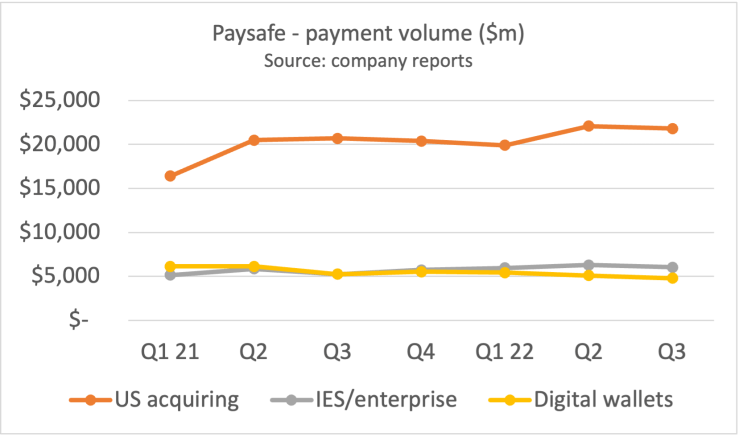
Looking at the subsegments, US acquiring grew its payment volume just 5% to $28.8bn. This was helped by “continued strength in small businesses” although the overall result indicates Paysafe has lost market share. More positively, the unit shows very strong operational leverage. US acquiring revenue rose 12% to $185m and EBITDA was up 24% at $50m as margins expanded 2ppt. Take rate rose 5bps to 0.85%.

The enterprise acquiring and gateway division (IES), which will now be managed together with US acquiring in the new merchant solutions unit, is seeing considerable challenges. Despite 15% volume growth to $6.0bn, take rate fell 12bps to just 0.3%. The result was a 17% decline in revenue to $18m with adjusted EBITDA swinging to $5m loss from $4m profit in the same quarter of 2021.

The Digital Wallet division was the cause of Paysafe’s recent troubles. The good news is that business has stabilised as “strong momentum in regulated iGaming and Latin America was partially offset by “continued softness” in Europe. Despite volume down 9%, revenue was just 3% lower than the same quarter of 2021 and did grow a little at constant currencies. Adjusted EBITDA was down 11% to $68m but management says that investments in improved customer experience are beginning to pay off. The company is opening 100K new wallet accounts each month on average and consumer funding has begun to rise – up 2% y-o-y in constant currencies.

FIS – $500m cuts ahead as profitability stagnates and UK revenues fall 15%

Soon after Stripe’s announcement of mass layoffs, FIS used its Q3 results to warn investors that future revenue and profits would be lower than expected. Gary Norcross, in his last call before stepping up from CEO to Chairman, said “We are not pleased with the profitability performance of the business.”

Stefanie Ferris, the incoming CEO, will respond by taking $500m out of the company’s cost base in an “enterprise transformation” programme that will include job cuts, organisational restructuring and lower capital spending. Harris promised “the outsourcing of non-value-added activities and reviewing and rightsizing the current workforce.” Meanwhile, FIS booked a further $60m expense related to company’s never ending platform modernisation project.

Total revenue was up just 3% in Q3 at $3.6bn with low growth in all three divisions – capital markets, banking solutions and merchant solutions. Management said it was seeing “early signs of US consumer shifting spend from discretionary to non- discretionary verticals pressuring yield.”

Despite clear indications of inflationary pressures, especially in wages, “due to competitive job markets for the skilled employees who support our businesses,” FIS has costs under control. SG&A was down 1% at $977m.

Total adjusted EBITDA, the company’s preferred measure of profitability, was up 1% at $1.575bn. Net income was flattered by a $225m gain on the sale of its remaining stake in Capco Consulting to Wipro. 

The merchant solutions division most interests us at Business of Payments. Merchant payment volume was up 3% to $544bn as weak performance in the UK was aggravated by the strong dollar. International volume was down 4% to $132bn. US volume was up 5% to $412bn, a little healthier but still lagging FIS’s competitors. FIS lost one large Payfac client which knocked 1ppt off global volume (c. $20bn annualised)

Merchant solutions revenue was up just 2% at $1.18bn. Management said growth would have been 6% excluding impacts of the Ukraine War and Sterling’s weakness.   

Within Merchant Solutions, Global eCommerce continues to perform well, delivering 22% revenue growth at constant currencies, and signing new customers including Asian airline carriers. FIS is happy with the initial success of its guaranteed payment product in which merchants pay extra to have FIS cover any fraud losses. FIS continues to invest in Global eCommerce as “we expect e-commerce to ultimately account for 50% plus of total segment revenue.”

In contrast, FIS recognises systemic problems in SMB (revenues down 1%) and UK enterprise, the former Worldpay UK, which saw sales fall 15% at constant currencies. Both divisions are heavily dependent on POS payments at old economy merchants in “big box retail, grocery and pharmacy.”

These are non-discretionary consumer spend categories and should be recession resistant but FIS says its UK business is “continuing to see macro softness impacting revenue growth.” Ferris believes the UK is already in recession “and then they changed Prime Ministers at least once, maybe twice. And so the economic conditions in the UK are pretty challenging. And as we look out even over the next 60 days, it’s tough to call it. They are in a recession, their consumers are struggling, and we are tied to consumer spend.”

Recession or not, with consumer inflation at 10%, merchant acquiring revenues should not be falling 15%. The UK performance indicates FIS is losing significant market share. 

SMBhas been adversely impacted by changing market dynamics,” said Harris. FIS is still selling POS acceptance through ISOs but merchant buying behaviour is moving to omni-channel payment solutions sourced from ISVs. Ferris, the new CEO, said “we’re strategically deprioritizing [SMB] and moving all of those partners that we’ve historically had there over to our embedded payment strategy with Worldpay for Platforms.”  The latter is a new product based on the Payrix acquisition which allows Worldpay to compete with Adyen and Stripe for business with complex ISVs such as marketplaces.

Merchant solutions EBITDA was down 7% at $555m with margins falling 4ppt to 47% “primarily due to inflationary cost pressures and accelerated investment in e-commerce and Payrix sales channels to capitalize on developing secular growth trends.”

Banking solutions revenue was up 4% at $1.68bn in Q3. FIS blamed longer sales cycles for this lacklustre performance. The much smaller Capital Markets unit grew revenue 3% to $671m. 

ACI – management upbeat despite lower Q3 revenue and profits

ACI Worldwide disappointed with lower revenues and profits in Q3. Nevertheless, management gave an upbeat assessment of the company’s prospects for 2023 as cash from this year’s new deals starts to arrive and the benefit of new SaaS products comes on stream.

Relocated to Miami in 2019, ACI has been selling software to financial institutions since the early 1980s and now claims 6,000 direct customers worldwide including 1,000 financial institutions and intermediaries. It serves more than 80,000 merchants indirectly through banks and PSPs. ACI also provides electronic bill payment services to utilities in the US through its Biller segment.

Total revenue was $307m. This was 3% lower than the same quarter of 2021 although, if you exclude FX and the divesture of Corporate Online Banking, there would have been a slight increase. 36% of total revenue is earned outside the US. Recurring revenues represent 80% of total and give a good indication of the rather flat underlying performance in recent quarters.

New sales are reported promising. ACI stated that annual run rate (ARR) bookings were up 35% and that revenue would start to arrive in the new year.  Billing normally commences 3-6 months after signing new merchants and after 12 months for banks. Odilon Almeida, CEO said: “[we] saw notable bookings success across all segments, providing visibility into future revenue growth…. We are also on track to launch our next-generation, real-time payments cloud platform in 2023, driving new growth across our business segments.” 

2023 may be looking good but, for the moment, all three ACI business lines have been under pressure.

Merchant revenue, which is more heavily skewed outside the US than the other units, was down 9% to $36m. Even with 6ppts of the decline due to the strong dollar, this is an unimpressive performance compared with the positive results reported by its global competitors. Adjusted EBITDA was down 31% to $10m as margins contracted 8ppt to 28%.

Despite the unhappy financials, management remains optimistic about transaction growth.“We actually see transaction volumes picking up as we’re entering the fourth quarter and exiting the year,” said Scott Behrens, CFO.

Revenues from the Bank segment were down 11% to $118m and adjusted EBITDA down 26% to $50m. Despite the move to SaaS, ACI is still very reliant on software license sales which are heavily backloaded into the final quarter. This is clear from the graph above. Management explained that new customers like the SaaS model but existing clients still buy licenses. As Almeida said: “We have not seen a lot of migration from license to SaaS in our base. I mean what is license continues to be licensed. And SaaS is all about new logos. The SaaS business that we are generating is all about new logos in banks.”

The company continues to win contracts to implement national real-time payments infrastructure. The latest is Qatar’s Central Bank. Other bank wins included Nexi Group and the Italian branch of Worldline. The company echoed feedback from other banking technology vendors that the European market is softening in comparison to US and Asia. 

Biller revenue was up 5% to $154m but EBITDA down 18% to $26m. ACI has found itself locked into fixed price contracts at a time when average ticket value is rising swiftly due to inflation, notably in domestic energy bills. As a result, ACI’s interchange payments have risen sharply but its revenues have not, resulting in sharp margin contraction. The CEO reassured investors that he is on weekly calls to resolve the position through renegotiations with key customers.

Total adjusted EBITDA, the company’s preferred measure of profitability, was $46m in Q3, down 38% with margins falling 10ppts to 22%. FX and the divesture contributed just 2ppts of the contraction. 

Total operating income fell to $3.5m from $30m in Q3 2021, a margin of just 1%. However, cashflow was boosted by proceeds from the $100m sale of the online banking division. 

Sabadell – softens commitment to sell merchant payments division as Q3 volume grows 33%

Banco Sabadell softened its commitment to wholly divesting its merchant payments division following Q3 results showing sharply improved market share, payment volume and fee income. Worldline, Nexi and Fiserv are all reported to be in the running to pay about €400m for Spain’s largest independent merchant acquirer. Sabadell’s CEO, Cesar Gonzalez-Bueno, said the bank is still evaluating options.

Payment volume was up 33% to €13.6bn in Q3, driven by a continued strong recovery in the Spanish travel and tourism market following the pandemic. Fee income is not disclosed but “continues to grow above turnover,” according to Gonzalez-Bueno. “In other words, we are improving our margins while we keep growing the business.”

Sabadell’s share of POS devices reached a record 20.0%, up 81bps YTD, and its share of payment volume was 16.7%, up 66bps YTD. 

With a business this good, why is Sabadell selling? According to Gonzalez-Bueno it’s about aligning with a partner which has the right products for tomorrow rather than choosing the highest cash offer today. But he indicated that Sabadell had not yet agreed the form a partnership might take, suggesting the bank may be considering a joint-venture or marketing alliance as an alternative to an outright sale. His quote from the Q3 analyst call is worth reading in full.

“We have very clear ideas around what we are looking forward in terms of partnership on our point-of-sale business… we are not only growing in volumes, in number of machines, but also we are growing in income…. .we don’t see any fragility short-term [but]…there is a tremendous potential of upgrading .. the services that we provide in the market. So, anything that we do.., if we do it, and we are analyzing alternatives, would be with an industrial mentality… we will not seek an increase of capital or an increase in value, but generating even more and better business with our clients. So, in that sense, the partnership could take different shapes.”

– Cesar Gonzalez-Bueno, CEO

Fiserv – Clover, Carat contribute to solid Q3 results, Europe underperforms

Fiserv reported a solid quarter of reasonably broad-based growth with its Q3 results. “This demonstrated the resilience of our business model and should position Fiserv well to withstand current uncertainty,” said Frank Bisignano, CEO.

Of Fiserv’s three operating units, it is Merchant Acceptance which interests us at Business of Payments. This division accounts for 41% of total revenue and profits. 

Merchant payment volume was up 8% in Q3 and transaction growth up 5%. Volume was impacted 2 ppts by loss of a processing client. Although operating worldwide, only 14% of Fiserv’s revenue is outside the US so currency translation causes less distortion than at many of its competitors.

Fiserv does not publish its sales by geography, but has underperformed on our side of the Atlantic. Bisignano said “We did not have a great quarter in the European theatre.” Management is hopeful of an upturn. “[We] see new opportunity with the launch of our Deutsche Bank joint venture in the quarter,” said Bob Hau, CFO  [See Deutsche Banks’s Vert is looking a little Green]

Merchant acceptance revenue grew 9% to $1.88bn in Q3 split between 10% growth in processing and 7% in product sales. 

Management believes the uncertain macro environment has been helpful as merchants are looking to consolidate multiple vendor relationships. This favours full service providers such as Fiserv and explains the good performance of Clover and Carat (the rebranded enterprise segment) which grew revenues 19% and 18% respectively. More details below. It also explains the less positive performance of the remaining business lines – SMB (excluding Clover) and processing – which we calculate were up just c.3% in Q3.

Merchant Acceptance adjusted operating income [roughly equivalent to EBITDA] rose 11% to $610m as margins expanded 30bps to 32.5%. 

Fiserv “mutually terminated” its Korean joint venture and booked a $120m loss.

Merchant credit losses ticked up to $18m in Q3, roughly 1% of turnover. Fiserv keeps a very chunky $1.9bn collateral from merchants as security against future losses.

Cashflow has been impacted by supply chain issues in China relating to point-of-sale devices. Anecdotally, many acquirers are suffering from inconsistent deliveries from vendors but only Fiserv has called this out.

Clover had another good quarter. Payment volume was up 21% and revenue up 19%. Reflecting continued upselling beyond processing, software/services now account for 15% of Clover revenue, up 260bps year on year. New wins included Caesars Superdome in New Orleans, demonstrating that Clover can scale from single site to multi-lane high frequency use cases.  

Fiserv has extended Clover’s distribution by commercialising an ISV-friendly version – Clover Connect. This added a very impressive 37 new partners in the quarter including Salon Ultimate Software, a comprehensive solution for salons and spas.

Adding to Clover’s software ecosystem, Fiserv acquired NexTable in September. This table management and booking solution enhances BentoBox, which was purchased earlier this year. Management has been very pleased with BentoBox as merchants which take this software alongside Clover generated 3x ARPU versus a Clover only restaurant. 

Carat, the omnichannel operating system for enterprise clients also out-performed with revenue up 18% in Q3. In recognition of Carat, Fiserv won “Merchant Acquirer of the Year” at the MPE Awards in July. Carat is really just a clever marketing wrap for Fiserv’s existing capability but there’s no shame in that.

Mastercard Europe – strong dollar offsets boost from travel volume

Mastercard’s Q3 results showed healthy increases in worldwide revenues, mainly due to continued strong growth in high margin international transactions. Worldwide cross border payment volume was up 29% in constant currencies with very high growth (+73%) in travel related spend offset by smaller increases (+13%) in cross-border eCommerce.

With investors worrying about macro conditions, management reassured that Mastercard is well prepared for the coming storm. Michael Miebach, CEO said: “Consumer spending remains resilient and cross-border travel continues to recover. The macroeconomic and geopolitical environment remains uncertain. Inflationary pressures have remained elevated. Should the market outlook weaken, we are prepared to act quickly to modulate our expenses.”

Local currency weaknesss hit Mastercard’s European business, just as it has with all the global payment companies reporting in dollars. Sachin Mehra, CFO, revealed that every $0.01 change in the $/€ exchange rate hits topline revenue by $55m per quarter.

Currency fluctuations apart, management is very positive on its European operations as it believes Mastercard is outperforming Visa in winning issuing mandates from banks and fintech’s. Sachin Mehra said: “We continue to see good Mastercard performance in Europe. Remember in terms of what you are seeing in our metrics, you’re seeing not only what the underlying economies are doing but also the impact of our share growth which has been taking place in Europe. It’s kind of the amalgamation of all of that which is coming through.”

Total purchase volume on Mastercards in Europe[1] was up 1% to $478bn in Q3 but looks healthier (up 16%) when measured in constant currencies. Whichever measure chosen, Mastercard beat Visa whose European payment volume was down 6% in dollar terms in Q3.

ATV on card purchases was up 8% to $33.61.

Mastercard’s forced withdrawal from the Russian market impacted the total number of purchase transactions, which fell 7% to 14.2bn. This is the second successive quarter of decline. The total number of cards[2] rose 5% on the quarter but remains 1% below Q3 last year.  

In line with the continued shift to digital money, Mastercards are used less frequently for cash withdrawals. Cash volume in Europe fell 24% to $142bn with ATV down 16% to $142.

Intra-EU cross-border is a good indicator of the health of the European travel/tourism market and continued to show strong year on year increases – up 36% y-o-y and 40% up on 2019. However, Mehra expects “some moderation within Europe” in Q4 as comparisons get tougher. 

Mastercard reported strong growth in the UK where it has won a large issuer customer from Visa. Less positive was a $208m provision for litigation with UK merchants relating to allegations of over-charging Interchange. This follows a $27m settlement with a UK merchant in Q3 21 in a similar but unrelated case. The merchant is believed to be Sainsburys, a large supermarket.

Elsewhere, management is bullish on Germany where a portfolio win at Deutsche Bank will shortly come on stream and Mastercard also hopes to benefit from the forthcoming switch from Maestro to Mastercard debit. This is expected to drive additional eCommerce transactions because Maestro cards cannot be used on the Internet.

Despite the meltdown in crypto trading activity, Mastercard continues to build out its Defi ecosystem. In Q3 it announced plans for whitelabeling a crypto asset tracking and custody solution from Paxos Trust Company. This gives Mastercard some option value without needing to make a financial commitment. Whether any of its bank partners had decided against offering crypto services, but will now change their mind because Mastercard is sponsoring a product, is an open question.

Mastercard has also struck a deal with Checkout.com and Young Platform in Italy to use Mastercard Send as an off-ramp for crypto to fiat conversion. Again, this is low risk but gives Mastercard some upside if trading restarts in earnest.

Other product news included:

  • Impressive results from Mastercard’s Digital First solution which provides a set of tools allowing issuers to better manage cardholder accounts. Across the first 200 banks taking part, Mastercard reports 2ppts higher approval rates, 4ppts reduction in fraud and 10% higher average spend per account. Chase in UK,  Citi Banamex and ING in Spain are among the latest European customers.
  • Dynamic Yield, a product recommendation and personalisation engine bought from McDonalds for $325m, has gone live with a German fashion brand with 1400 stores.

[1] excluding Maestro

[2] excluding Maestro

PagoNxt – strong volume growth, losses narrow

With commentary focusing on Santander’s loan quality and bad debt provisions, investors paid little attention to PagoNxt’s performance within the Spanish bank’s Q3 results. That’s a shame because Santander’s move to consolidate all its payment assets in a single, ring-fenced organisation with a new brand is a bold strategic move. And one that other European banks may follow.

Within the PagoNxt umbrella, GetNet is the largest business unit and includes the merchant acquiring assets in Europe and Latin America. PagoNxt’s other three divisions are international trade (comprising OneTrade and Ebury) delivering specialist trade finance and FX support to cross-border business, Payments Hub which consolidates Santander’s in-house wholesale payments capability and Super Digital, a “financial marketplace for the economic inclusion of the underbanked.” The proliferation of brands is confusing for customers and would benefit from rationalisation.

GetNet is the division which most interests us at Business of Payments. PagoNxt bought Wirecard’s platform from the administrators in 2020 to provide Getnet’s core technology and has been aggressively hiring a heavyweight European management team to make the most of the new asset. It’s too early to know whether this bet has paid off – platform migration is a notoriously tricky business – but the purchase does allow PagoNxt to win at buzzord bingo. We can only admire its “global, cloud-native, data-driven… connected, retail-time, flexible and highly scalable technology platform that is fully cloud and API-based…”

Few new business or product details were given with the Q3 results, but all trends seem positive. 

Total payment volume was €42.4bn, up 33% compared to the same period last year. Active merchants were up 7% to 1.27m. It’s a consistent trend that payment volume is growing faster than the merchant count, indicating that Getnet is paying attention to the quality of its customers. Volume per merchant grew 25% year on year in Q3 to an annualised €134,000.

Getnet Europe continues to outperform. Payment volume was up 42% in the first nine months (at constant currencies) mainly driven by the Spanish market “which displayed a strong performance across all industries.” Management say it has opened three new European markets in the quarter, supporting its goal of becoming a leading pan-European acquirer able to compete with Worldline, Nexi, Adyen and Elavon. Elsewhere, payment volume was up 35% in Mexico and 18% in Brazil.

Overall, for the PagoNxt group as whole, revenue was up 78% in Q3 to €257m. With operating expenses rising a little slower (up 56%), net operating losses narrowed to €24m from €36m a year earlier. 

Strong European performance at Visa gets lost in translation

Visa reported another strong performance in the July-September quarter. This is Visa’s Q4 and completes the 2022 financial year. Despite looming headwinds of inflation, the Ukraine war and the threat of global recession, consumers keep spending on Visa cards. Alfred Kelly, CEO, said “the reality is that while consumers might be altering a bit what they buy in different categories.… they’re still spending the same amount of money and using the same ways to pay as they did before.”

Looking forward, management remains confident reporting that “business trends have remained strong and stable” into the new financial year. “We remain as certain as we’ve ever been about our extraordinary long-term growth opportunity. There is still plenty of cash to digitize in core consumer payments.”

Distancing itself from plastic cards, Visa now describes the paying public as “credentials” and there are 9% more of these than one year ago. Many credentials are now tokenised by Apple Pay and other services. In fact, there are now more tokens than credentials. And there are 10% more merchant locations worldwide at which these credentials are accepted. 

The recovery of international travel is a positive for Visa as its charges higher fees for cross-border transactions. Vasant Prahbu, CFO, said “summer travel in and out of Europe was also very strong, with a travel index to 2019 in the 130s, up 13 points from the third quarter. European travel appears to have benefited most from the strong dollar.”

While a strong greenback is great news for American tourists, it’s less helpful for US listed corporations that report in dollars. A very positive European performance by Visa got lost in translation. 

Despite quarterly transaction growth of 16%, European payment volume actually fell 6% year-on-year in the quarter to $533m. ATV declined from $50 to $42. Taking constant currencies paints a much happier picture. Payment volume was up 12%. It’s an even more positive story when the UK (where Visa has lost issuing clients) is removed. Mainland European volume was up 30% at constant currencies. 

Management is particularly pleased with progress in the German debit market. Visa has profited from Mastercard’s withdrawal of Maestro to add more than 12m debit credentials including ING, DKB and Comdirect. Santander Germany will begin issuing Visa credentials in 2023. 

Shrugging off currency fluctuations, Al Kelly is taking the long view, saying “We really like what we’re seeing in the continent in Europe in terms of the growth that we’re seeing there, which is really strong.”   

Turning to product updates, while Mastercard is investing in inter-bank payment rails, Visa is pushing Visa Direct as safe and secure alternative to account-to-account payments. These often lack basic consumer protection. In contrast, Visa Direct offers “zero liability, chargebacks and solid dispute management.” There are a claimed 7bn “endpoints” worldwide to which a Visa Direct payment can be pushed. FY 22 transactions were 5.9bn up 42% year on year. New programmes include Vipps, the Norwegian mobile payment app, which is to offer users access to Visa Direct for all domestic payments. Another new signing is Thunes, which boasts a network of mobile wallets in over 44 countries, giving Visa Direct  access to 1.5bn digital wallets.

Other news included:

  • The UK is no longer the world’s number one market for contactless transactions. The US has finally begun to adopt tap-to-pay and is now the global leader in number of transactions.
  • Mass transit (tap to ride) was up 70% in 2022 surpassing 1bn transactions worldwide for the first time.
  • Although the crypto market continues to be volatile, Visa (like Mastercard) is signing deals to help people spend their crypto. FTX, a crypto-exchange, will issue Visa credentials. Click here to join the wait list.

Worldline Q3 – solid revenue growth, buys into softpos and marketplace payments

Worldline’s Q3 update provided another very solid set of results demonstrating continued progress towards its objective of building “a premium global Paytech at the heart of the European payment ecosystem.” Revenue is growing nicely, bolt-on acquisitions are filling product gaps and the sale of the Ingenico hardware business brings capital firepower to compete with Nexi and others for merchant portfolios as they become available.

Total revenue increased 20% in Q3 to €1.158bn although the company prefers to quote a rather lower figure of 10% growth, excluding currency and acquisitions. This is sensible expectations management although an American business wouldn’t be so modest. Forward guidance is 8-10% organic revenue growth.

Originally spun out of ATOS, primarily as a back-office processor, Worldline has reorientated itself. Merchant services now account for 72% of group revenue, up from 66% a year ago. Merchant services revenue is the powerhouse, growing 30% in Q3 to €828m or a still impressive 14% excluding acquisitions and a positive exchange rate boost from the strong Swiss franc. Worldline cites market share gains and volume growth. 

Payment volumes grew 17% year on year to €90bn and stand 33% higher than 2019. Growth is broad-based; in-store volume was up 16% and online volume up 23%. Q4 is reported to have begun “still in a very solid trajectory.”

Q3 highlights include a rebound in tourism which boosted travel and hospitality verticals and contributed to a strong performance from DCC. Client wins included Lufthansa Group which will make use of Worldline’s TravelHub solution which “brings 150 payment methods, multi-acquiring, tokenisation and a range of fraud services through a single connection.”

In contrast to merchant services, Worldine’s two other business segments look underpowered, growing sales well below inflation. Financial services revenue increased just 1.5%. Worldline is under sustained price pressure from its large banking customers.

The sale of the Ingenico terminal business to Apollo has finally completed. This brings €1.4bn extra capital which Worldline is likely to spend on further acquisitions as it consolidates the European merchant services market in competition with arch-rival Nexi. The Apollo deal comes with a five year partnership agreement which is likely to commit Worldline to continue selling Ingenico terminals to its banking and merchant customers. An extra €0.9bn is available subject to performance. 

Wordline made two important product acquisitions in Q3. 

  • Marketplaces – a 40% stake in Online Payment Platform (OPP), a Dutch payment gateway which boasts over 100 marketplaces and platforms as customers including eBay Kleinanzeigen, Marktplaats and Royal FloraHolland. Marketplaces account for about one third of European online payment volume today but require specialist support. OPP has sixty staff and its product set includes fast merchant onboarding, split payments, pay-outs, virtual IBANs and dispute management. Worldine has a call option to buy the remaining 60% in 2026.
  • SoftPOS – Worldine has bought a 55% stake SoftPOS, a very well regarded Polish softpos vendor which launched in 2019. Softpos is an existing Worldline partner but is also working with ING in Poland and Romania as well as Credit Agricole in Poland. The latter is through an arrangement with Elavon. It’s not clear whether SoftPOS’s current banking partnerships will be negatively influenced by the stronger Worldline relationship. Worldline has the option to take full control in 2024. 

The SoftPOS capability forms the basis for new product called Worldine Tap on Mobile which is aimed at all merchant segments but also as a white label through partners. For example, Worldine is making Tap on Mobile available on Zebra’s range of handheld devices. Zebra is a giant in the world of enterprise devices with over 10,000 channel partners globally. Many of these are ISV’s that will be interested in providing merchants a bundle of Zebra hardware, Worldine payments and their own software application.

SoftPOS has many transformational use cases but the one chosen for the launch video is not one of them. In this scenario, softPos makes life more difficult for both merchant and customer.