Adyen margins under pressure as it invests for growth

Adyen’s share price took a knock after H1 results as investors were unimpressed at a sharp reduction in margins. The business is growing faster than ever but incremental payment volume is delivering diminishing revenue. The extra €46bn processed in H1 (over H2 21) produced an additional €43m revenue (a take rate of just 9bps) and zero EBITDA.  

Management insisted that no customers are loss-making and that it was still “onboarding profitable volume at scale” and that “there is strong operating leverage in the business.”

Adyen take rate and gross margin

Overall, payment volume grew 60% year on year to €346bn with the recently established POS business up 97% to €45bn as Adyen grows its share of multi-channel retailers. On the results call, Ingo Uytdehaage, CFO, assured analysts of continued progress. Adyen is in a “fast growing space and our runway is significant.”

The declining take rate was explained by a number of factors including a rebound in airline volume (for which Adyen only provides gateway services) and tiered pricing which offers discounts to enterprise merchants as their volume increases. More positively, existing customers seem happy. Churn remains <1% and current merchants are providing 80% of the volume growth. This indicates how well Adyen has positioned itself as the go-to provider for many of the most successful digital businesses.

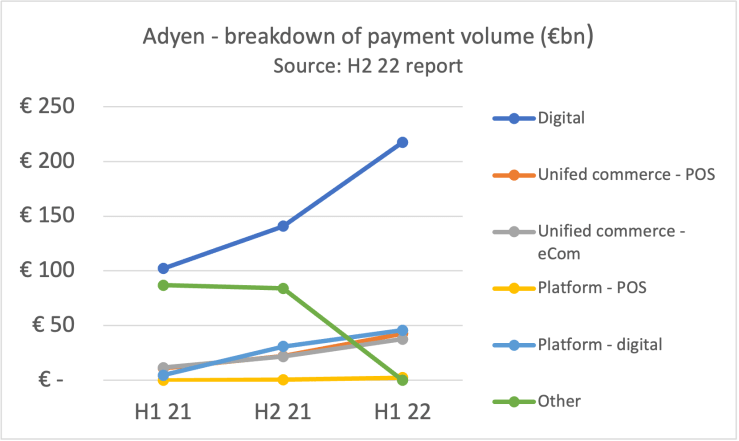
Adyen has divided its business into three segments – Digital, Unified Commerce and Platforms.
Adyen payment volume breakdown

Digital includes merchants trading purely online. Volume more than doubled from €102bn to €218bn. 

Unified Commerce includes merchants trading both POS and eCommerce. Volume was up from €22bn to €80bn of which POS now accounts for more than half. Adyen says it wins business because of its single platform which allows it to “translate the most complex consumer demands into seamless shopping journeys such as self-checkout, cashierless stores and buy-online-return-in-store.” New customers include Dior, All Saints and Uniqlo.

To help deliver a better customer experience, Adyen has taken the unusual step of commercialising its own design of payment terminals. Two were announced alongside the financial results – a PINpad which connects to smartphone or tablet and a more highly configurable Android terminal which can run ECR and payment software on same device. Hardware is a means to an end. The CFO explained the aim “is certainly not to increase profits on the terminal hardware side. It’s more on the innovation side and making sure that … by having full control that we could drive down the cost of the terminal.” Adyen is also one of small number of vendors working with Apple on launching SoftPOS in the US.

Platform includes marketplaces and ISV. Volume grew 53% to €48bn. Platform is Adyen’s strategy to address the high-margin SME market through partnerships although the volume is suspected by some commentators to be mainly coming from eBay – a customer Adyen won from Paypal. 

Adyen has developed a broader range of financial services to sell to SMBs through its platform relationships – business bank accounts, loans and card issuing – but these are “still in beta” and for the foreseeable future, it does not expect significant financial contributions.” The CFO explained “it’s going to take a couple of years to really see the revenues.

Net revenue was up 37% to €608m with strong performances from APAC and North America. Revenue growth of 30% in EMEA probably indicates Adyen is not gaining share as fast as previously. EMEA remains the largest market and accounts for 57% of total net revenues.

Adyen net revenue breakdown H2 2022

EBITDA was up 31% year-on-year to €356m but actually declined slightly from H2 21 to H1 22. Overall margins remain a very healthy 59%. Profits were hit by higher payroll costs as 395 staff were added, together with a sharp increase in travel as employees got back on the road to meet customers and each other. Adyen made a very clear commitment to F2F business life: “It’s clear that building trusted relationships and driving innovation moves faster when time is spent together. The speed and excitement that meeting each other in person brings has always been a crucial part of our success and our view on how to build the Adyen culture for the long term.”

Capex was €40m (up 160bps to 6.6% of net revenue) as a result of the geopolitical crises. “We invested in our data center infrastructure at a larger scale than we would have under different macroeconomic circumstances.”

12% of Block’s profits from international operations

Much commentary on Block’s Q2 2022 results focused on its quixotic Bitcoin strategy but there was also news of its steady progress upmarket and away from reliance on the US.  

International gross payment volume (GPV) processed grew 45% compared with 22% in the US, with revenue up 78% to $257m. International gross profit doubled to $98m including a maiden contribution from BNPL and now accounts for 12% of the global total. Excluding BNPL, international gross margin grew 40% to $67m.

Product launches continue apace, as you’d expect from a business spending an eye-popping $512m on product development in the quarter. Block launched 44 products “across our international markets in the first half of 2022 making significant progress on closing product parity gaps while also launching new markets.” This included Square Register in Ireland and Square for Retail in France and Spain. 

The proportion of GPV from larger merchants (across all geographies) continues to grow and almost 40% is now accounted for by those processing over $500K per annum.  

Meanwhile, in filings at Companies House, Block revealed that UK revenue rose by 110% in 2021 to £25.1m. Square Loans – a merchant cash advance product in which repayments are scaled to a proportion of card payments received –  will be launched in 2022/3.

Merchant acquiring fuels Worldline’s growth

Worldine’s H2 results underlined how much progress the Paris based organisation has made towards establishing itself as “as a premium global Paytech at the heart of the European payment ecosystem.” Originally spun out of ATOS,  primarily as a back office processor, Worldline has reinvented itself. Merchant services now accounts for 68% of group revenue. 

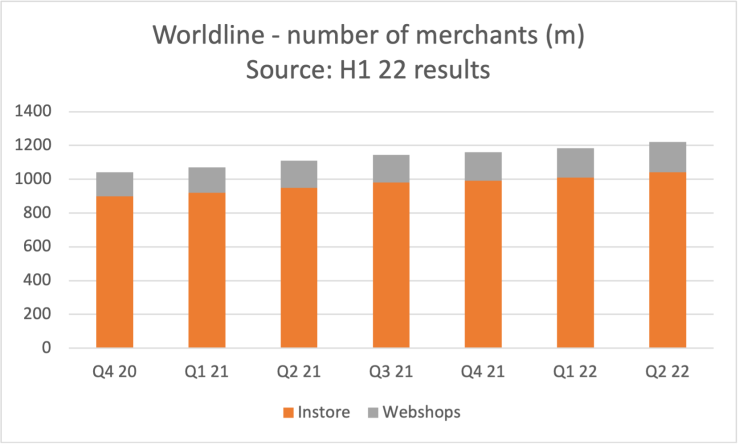
Payment volume was up a very impressive 30% in H1 to €177bn as the impact of new acquisitions kicked in. The positive result  was also “reflecting the widespread and rapid shift towards digital payments.”. Organic growth has been positive too and Worldline is adding roughly 10,000 new merchants each month split pretty evenly between in-store and online. Total merchant count now exceeds 1.2m. 

Revenue from merchant services grew 16.8% “fuelled by steady growth in commercial acquiring across all geographies and customer segments” with acquiring growing faster than its payment acceptance or digital business lines. Acquiring delivered “strong double digit growth trending towards 30% with almost all geographies and customer segments contributing…. and a strong performance from DCC products and the positive impacts from strong holiday period boosting the Travel and hospitality verticals.” Much lower growth – mid to high single digits – was reported from payment acceptance (mainly payment gateways and managed POS terminals) and digital services.

The wholesale business fared a little less well as a number of ex-Equens contracts were renewed on less favourable terms although Worldline did re-sign Credit Agricole for a new five year deal, And it started working with AEGON Bank for SEPA instant processing. Overall, higher authentication volumes related to SCA compensated for lower iDeal volumes in the Netherlands.

Highlighting Worldine’s ability to win new bank partnerships, three big acquisitions closed in the half year.

  • Greece – acquired an 80% share of Eurobank’s merchant acquiring business in Greece which brings a 21% market share including 123,000 merchants with 190,000 POS terminals, 219m transactions and € 7bn of payment volume. This acquisition complements Cardlink, the leading Greek network service provider (NSP) which Worldline bought last year for an enterprise value of €155m. The vertical combination of NSP and acquirer under common ownership is likely to accelerate consolidation of the fragmented Greek retail payment market which has recently become the focus of much international investment. 
  • Australia – went live with its joint venture with ANZ. Worldline holds 51% of the new business which brings 80,000 merchants and 2bn transactions pa. Worldine has pledged to spend $22m AUD to localise its platforms for Australia.

Beyond banking, Worldine announced a slew of large merchant wins and new distribution partnerships. These included retailers such as JD Sports and Jysk but also high-risk merchants in the travel sector – TUI Cruises and Iceland Air. New partnerships include Planet Payments (DCC and tax free shopping) and Casio (integrated payments in Japan). More interesting for the future, was the launch of a new Softpos product in Belgium working on the Softpos.eu platform. Worldine has been working with Softpos.eu – a very well regarded start-up – in Poland since 2020 and clearly now sees the proposition as ready for international roll-out.