Newsletter – July 2024

The Payments Business

Klarna has sold its gateway business to a local investor consortium for $520m. Klarna Checkout (KCO) claims 40% share of its home market of Sweden and 20% across the Nordics as a whole.

It’s obvious why Klarna is selling. KCO competed with key distribution partners such as Stripe and Adyen and the very generous sale proceeds will bolster Klarna’s balance sheet and help grow its lending business.

But it’s less clear how KCO’s new owners will make a return on their investment. Stand-alone gateways have been under considerable pricing pressure in recent years, and many have ended up vertically integrated into the larger merchant acquirers.

In banking news, BNP Paribas and BPCE, which together handle c.30% of card payments in France, will invest €100m each and pool their payment capabilities to create a joint-venture with the scale to compete with Worldline and Nexi. Technology will be “home grown” and most likely a continuation of Partecis, an in-house platform based on ACI products. While there’s plenty of scope for synergy in France, the JV will find its hoped for international expansion rather more challenging as PagoNxt, Santander’s payment unit, demonstrated when it recently closed its German operations.

As predicted in last month’s Business of Payments, Sabadell has postponed the sale of its merchant services business to Nexi. Sabadell is subject to a hostile takeover from BBVA, another Spanish bank. BBVA has a good in-house payment offer and has less need of Nexi’s products.

IDC, a London-based research firm, has published vendor evaluations for online and omni-channel retail payments. The full reports cost $20,000 each but the top ranked firms have helpfully made their sections available free of charge. Stripe comes top for online payments although is marked down for being expensive. Adyen is first for omni-channel but customers are warned that its all-in-one solution may lack flexibility.

Stripe is notably missing from IDC’s omni-channel evaluation but is quickly becoming a very credible option for cross-channel merchants in Europe. Stripe has launched a suite of new enterprise services in France including its S700 POS terminal, acceptance of Carte Bancaire and an integration with CEGID, a leading local retail ISV. Stripe claims half the CAC-40 companies as customers and announced that Accor, the hotel group with over 5,600 locations worldwide, is standardising on Stripe for its new, centralised booking system. Stripe obsessives will enjoy this detailed history of the business.

Viva Wallet’s lawsuit with JP Morgan ended in a London courtroom with both sides claiming victory. JPM paid an eye-popping $800m for 48.5% of Viva in 2022, primarily to gain access to SME customer onboarding tools for European markets. Haris Karonis, Viva’s founder, claimed that JPM then deliberately blocked his company’s launch in the US so that the giant American bank could buy the rest of Viva on the cheap. JPM counter-claimed that Karonis failed to understand how far Fintech valuations had fallen.

Financial results of listed payment companies have settled down post-pandemic into a phase of steady but unspectacular growth. FXC have crunched the Q1 numbers so you don’t have to.

A wero for your thoughts

A female white soul singer with big hair sings "I need a Wero" in a German beer cellar while holding a phone displaying a QR code

It’s taken four years and 14 of the original 31 banks have exited the consortium but the European Payment Initiative (EPI) has finally launched wero, the long-long-awaited domestic European payment champion. Wero, a combination of “we” and “euro”, is live for person-to-person money transfer, initially for customers of co-operative and savings banks in Germany and KBC in Belgium. French banks come on stream in the autumn.

Shoppers will be able to make eCommerce payments with wero from early 2025 and Computop, the German PSP, has already begun asking merchants to register to be part of a pilot. In-store payments will follow in 2026.

Payments & Banking, a German blog, explains what wero is and what it is not.

The consensus from payment experts is that for wero to succeed the EPI needs to focus ruthlessly on user experience and keep the member banks firmly in the background. And “I need a wero” is the only song that will do as you can hear in this short commercial. 

Paydirekt and Sofort axed

Even though wero is at least six months away from being ready for eCommerce, its launch sparked the unexpectedly early closure of Paydirekt/Giropay, a domestic competitor to PayPal launched by the German banks in 2016. 

Insiders tell me that the service termination was badly handled. Giropay switched off its old integration interface at the end of June even though many acquirers had not yet migrated to the new version.

Meanwhile, Klarna has announced the closure of Sofort, the German online bank transfer service which it bought for $150m in 2013. Merchants will be migrated to Pay Now, Klarna’s open banking product. This includes buyer protection which is great for shoppers but less exciting for Sofort’s many merchants in the gambling and adult sectors. These customers will be looking for alternatives.

Klarna’s new wrapper doesn’t come cheap. In Germany, Adyen is charging 1.35% + €0.20 for Klarna Pay Now transactions. For UK merchants, Mollie is asking a punchy 4.99% + £0.30.

If that wasn’t enough disruption, Shopify is deactivating Amazon Pay as a payment option from all European merchants. No reason was given and merchants are really unhappy.

Scheming

Blik, the wildly successful Polish mobile payment standard, continues its stunning growth with payment volume up 53% in 2023 to €29bn. Blik is jointly owned by Mastercard and a number of local banks who have suddenly woken up to the importance of their investment. From now on, the banks will send their CEO’s to Blik’s board meetings.

Bancomat, the Italian domestic debit scheme, is finally getting its act together. Milan-based investment fund FIS has made a €100m investment, the board has been slimmed down to speed decision making and a new CEO appointed from Mastercard. Nexi runs the technology for Bancomat and has put the card scheme live on Apple Pay and as a payment option on Amazon.

Read more about Bancomat’s 2023 results on the Business of Payments blog.

ISV

We’re taking a keen interest in the convergence of software and payments. Flagship Consulting’s latest report shows quite how dependent many American ISV’s have become on payment and other financial services revenue. 

In response, payment processors know they need to partner with ISVs and some have gone further, buying or building an in-house range of vertical software. 

Intriguingly, the stock market value of payment processors that offer software is rather lower than software vendors that offer payments processing. Jevgenijs Kazanins looks at why Toast (an ISV that offers payments) is valued more highly than Shift4 (a processor that offers software) even though Toast makes much less money. His conclusion is that ISV’s are better at securing recurring revenues under contract.

European ISV’s have now realised they too can make money from processing. The  opportunity is smaller than in North America because payment margins in Europe are much lower. Nevertheless, a savvy commerce software vendor can still double profit margins by embedding payments in its core merchant offer.

With so many acquirers and PSP’s pivoting towards ISV’s as their primary distribution channel, a number of start-ups have begun offering key parts of the technology stack as-a-service. Here are a few that have caught my eye.

  • Chift, based in Brussels, offers PSPs connections to a range of leading accounting, eCommerce and ePOS software though a single API. The company just raised €2.3m
  • Shape Technologies is offering payments-platform-as-a-service to payment facilitators with capabilities including onboarding, KYC and billing. Shape is founded by alumni from Cardstream and is helping put Taunton, Somerset on the Fintech map.
  • Fung, in Amsterdam, offers a similar product set to Shape but is also a payment institution and can handle the money flow too.
  • Dublin/Vilnius based Paynt, goes one step further with a full acquiring-as-a-service proposition.Subscribe

New shopping

We’re keeping a close eye on the progress of autonomous stores as one possible driver of a seismic shift in grocery transactions from POS to the shopper’s phone.

Rewe is leading the deployment of “just walk out” formats in Europe. The German supermarket giant has opened a 1200 sq metre autonomous store in Hamburg using technology from Trigo which can even identify fresh meat and cheeses picked from the deli counter. Showing confidence in the concept, even where labour costs are much lower than Germany, Rewe has also opened an autonomous store in Bucharest.  

Although sceptics point out that frictionless checkout often involves more manual intervention than the vendors let on, the use cases are multiplying. For example, in a village store in Switzerland a shipping container is transformed into an unmanned convenience store (or walk-in vending machine) using technology from FastaXs.

Biometric payments

With early pilots looking positive, there’s growing momentum behind new biometric payment technology in the US, including palm payments (favoured by Amazon) and even face payments. JP Morgan is taking an interest in the latter with a partnership with PopID, a Californian start-up which has an early lead in the technology.

In Europe, Mastercard is backing PayEye, a Polish start-up which is piloting its iris/facial recognition product at five locations of Empik, a large retailer of books, toys and games.

Digital reciepts

A number of start-ups are trying to make it easier for merchants and consumers to move to digital receipts. Habits are hard to shift. Despite a new legal requirement in France that paper receipts should be opt-in only, Auchan, the grocery chain, reports 60% of shoppers still ask for paper.  

  • In the UK, Slipp, which boasts JD Sports as an early client has raised £750K. Slipp integrates with the ePOS software to send the shopper a text or email. JD Sports says using Slipp’s SMS receipts to promote its loyalty programme is increasing the number of customer sign-ups.
  • Anybill, from Regensberg in Germany, asks customers to scan a QR code presented by the ePOS. Pricing ranges from €4.49 to €35.99 per month per outlet.
  • Yocuda, a French start-up acquired by Global Blue, claims to have delivered over 2m electronic receipts to over 200,000 identified shoppers. Clients include Halfords and Decathlon.
  • Receipt Hero, based in Helsinki, has raised additional funds to supplement the $5.7m already invested. Receipt Hero offers cardlinking as well as QR scans. Partners include PayOne.
  • Pi-xcels from Singapore has an elegantly simple product that delivers an e-receipt automatically when the shopper taps their phone on the payment terminal. The product integrates with the terminal not the ePOS software and is available on Ingenico and PAX.

There’s an open question whether digital receipts can establish themselves as product category in their own right or whether merchants would prefer to buy the capability as a feature of existing POS or CRM software.

Artificial Intelligence

Artificial Intelligence is moving up and down the hype curve faster than any previous technology as Benedict Evans explains. McDonalds has already hit the trough of disillusionment  and shut down a pilot with IBM that used AI to automate order taking at 100 drive-thru restaurants. The robots made too many mistakes such as adding bacon to ice cream.

Worldline is taking a more measured pace and has detailed how it is managing its AI initiatives. This is 1500 words of big company governance, stage gates and committees. I wish them luck.

SoftPOS

This technology, which allows any off the shelf consumer device to accept contactless card payments, was originally touted as a micro-merchant proposition but is proving most popular with large enterprises.

LVMH is leading the innovation. Liberated from the need to locate the nearest payment terminal, sales associates at Christian Dior, an LVHM brand, each have their own iPhone to serve customers wherever they are in the store. Dior has worked with Adyen, Global Blue and Vo2 Group, a Paris HQ’d tech consultancy, to add instant VAT tax refunds to the proposition.

In vendor news, Rubean, based in Munich, has raised an additional €2m capital to finance its strong growth. Sales are forecast to rise to €2.2-€2.5m this year from €1m in 2023 on the back of new distribution deals.

Rubean’s partnership with Global Payments may be threatened by the Atlanta processor’s unpublicised purchase of Yazara. The Global/Yazara tie up is likely also to be bad news for MyPinPad  which local sources suggest may be replaced as supplier to eService, Poland’s largest acquirer, which Global bought last year.

In better news for MyPinPad, Ur&Penn, a leading chain of jewellers in Norway, is using its SoftPOS application to take store payments on the associate’s Android phones. 2izii is the integrator and Elavon the acquirer.

Phos, acquired by Ingenico in 2023, is making good progress building out its distribution network, announcing a key partnership with Shift4, a US processor with big ambitions in Europe. Phos is also the technology partner for BORICA, which provides SoftPOS to the three largest banks in Bulgaria. BORICA claims 1,500 “terminals” live today.

In Italy, Ultroneo has implemented MarketPay’s PayWish SoftPOS application for its Get Your Cash merchant proposition. Volumes are growing swiftly (see below) but it’s not been plain sailing. Writing on LinkedIn, one Ultroneo director explained “For nearly 12 months now we have been struggling with the teething problems of this new technology. Bug after bug, incident after incident, we have managed to stabilize the SoftPos to the delight of our customers.”

Image preview

Openbanking

The UK’s incoming Labour government is making very positive noises about fintech. Quoting from its manifesto: “Financial services are one of Britain’s greatest success stories. Labour will create the conditions to support innovation and growth in the sector, through supporting new technology, including Open Banking and Open Finance and ensuring a pro-innovation regulatory framework.”

There is much that a new regulatory approach could deliver, including an open banking acceptance mark, “scheme” rules to ensure common standards for authorisation codes, refunds etc, the introduction of consumer protection and a recognition that all this cannot be provided free of charge.

Positively, the number of open banking payments made in the UK rose c.50% year-on-year to 17m in May 2024. Variable Recurring Payments (VRPs), the open banking equivalent of direct debits, now account for 11% of the total.

The increase is encouraging but compared with the 2bn debit card transactions made in the UK in a typical month, volumes remain very small.

The slow take up of open banking has implications for the large number of vendors operating in this sector. There are twenty listed on the UK government’s procurement framework alone. If revenues don’t arrive soon, only the best capitalised will be able to keep trading until the product goes mainstream.

Truelayer, hopes to be one of the survivors, having raised a remarkable total of $271m from its investors. Truelayer’s CEO has given an interview  to explain that he is playing a long game, saying “We are an infrastructure business. That means we are likely going to spend a lot of time and a lot of years building and spending money before actually earning,”Subscribe

Cash

Germany is often cited as the last hold-out of the cash economy but the latest Bundesbank payment survey shows a further decline in the use of paper money. The cash share of transactions fell 7% points in 2023 to 51% and its share of volume by 4% points to 26%.

Old habits die hard. A Bavarian bar-owner called the police after a Latvian customer paid for 16 beers with 16 separate card transactions.  

It’s no surprise that policy-makers in many countries are grappling with the implications of the world going cashless. For example, Ireland has passed an “Access to Cash” law which gives the government powers to set minimum numbers of ATMs for each area. The local banks, and their customers, will bear the cost. Revolut, wildly popular in Ireland, will likely get a free ride.  

Without this kind of subsidy, independent operators will stuggle. In Poland, Euronet, which manages 50.000 ATMs, limited withdrawals to PLN200 (€46) for one day as a protest at the government’s refusal to let it to charge for transactions. Euronet complains that it is losing money because local banks pay just PLN 1.2 (€0.28) per withdrawal. We assume that Euronet probably more than makes up for the shortfall with its eyewatering DCC charges for tourists.

An enterprising British artist commented on his struggles to find a place to withdraw cash by fixing an ATM to a bridge in the middle of a river.

Facade of grey atm machine with screen, buttons on brick buttress with rippling water below

Of course, even if cash is available, retailers may decide not to accept it. This British pub says it has saved 12 hours work each week by going cashless. Cash is expensive to handle and the costs grow as volume declines. The Portuguese Central Bank believes cash costs merchants 2.96% compared to 0.78% for debit cards.

Image preview

Crypto corner

Crypto currencies are assets not money, yet vendors persist in bringing forward payment acceptance solutions at POS.

Few have heard of SpacePay, but give it a year, and it will likely be a household name” is the bold claim from this London based start-up which graduated from Barclays’ fintech accelerator. SpacePay, which has raised $750K, says it will allow people to spend crypto at “most existing point of sale card machines.” It’s not clear how this would work in practice.

If there is a user base for crypto at POS anywhere, it’s going to be in a cross-border market such as Luxembourg where some shoppers may not want their home country authorities to know what they are buying.

Done4You, an ISO based just across the border in Namur, Belgium, has implemented crypto at POS for a petrol station in the Grand Duchy using GoCrypto’s technology. Crypto transaction are 1.25% compared to interchange + 0.5% for credit cards.

In other news

Fiserv’s brand association with the Republican National Convention in Minneapolis is dividing opinion.

Good news for travellers. International cards are finally accepted at 97% of Dutch payment terminals and will reach 100% by the end of this year.

The Netherlands experienced its longest payment outage for five years as 30%-40% of PIN transactions failed over a three hour period. The problem was blamed on Equens (Worldline), the domestic inter-bank network. Worldline is also reportedly behind a shorter outage affecting UK grocers earlier this month.

A sign of the times. Such is the consumer uptake of Apple and Google Pay, one French bank has found that 20% of customers opt not to be sent a physical card.

Advent, whose portfolio companies include MangoPay, Planet and MyPOS, is excited about vertical payment/software bundles, specialist tools to support eCommerce and solving cross-border challenges.

Follow the money. European VCs have picked their top payment start-ups

We’ve not seen many layoffs recently but Rapyd, the Israeli acquirer/processor, is cutting 30 posts in its home country

TSG, an American consulting business, runs an annual payments API competition. Adyen is the overall winner with Square as runner up.

And Finally

Stripe has opened a new London office and is celebrating with a rather mystifyingbrand advertising campaign aimed at enterprise customers.

Image

Photo credit Jevgenijs Kazanins

How to get in touch

Geoffrey Barraclough

geoff@barracloughandco.com

www.businessofpayments.com

Newsletter – April 2024

A person standing at a podium

Description automatically generated

The Payment Business

Forrester’s latest analysis of merchant payment providers makes for fascinating reading. The scoring can be a little incoherent at times but the report includes unparalleled direct feedback from Forrester’s clients. Stripe and Adyen come out best but don’t escape criticism. Stripe is “expensive” and Adyen’s support “can be hit and miss.

Image

Global Payments and Worldline, neither of whom participated in the research, score badly. Forrester doesn’t think either has done enough platform integration.

To celebrate its top spot, Adyen has made the report available free of charge. It’s worth a read and a reminder to always engage with analysts. The more you communicate – product roadmaps, customer testimonials, invitations to events etc – the better coverage you get.

Forrester aside, Worldline had a good month by recent standards. The beleaguered processor has won the fight with arch-rival Nexi to become the exclusive partner of Cassa Centrale Group. The deal doubles the size of Worldline’s Italian business by adding more than 90,000 POS terminals processing €9bn annually.

The next Italian bank up for grabs is Banca Popolare di Sondio which is reportedly considering selling its merchant services business and ending its partnership with Nexi. Worldline is said to be in poll position to pay €70-€100m for 25K POS processing €2.2bn. Nexi, BCC Pay and Market Pay are also in the running.

Worldline has also finalised its JV with Credit Agricole in France. Meriem Echcherfi, currently head of merchant services at the French bank, will run the new business which will should be live in early 2025. This is smart move. The first rule of bank partnerships is to hire your general manager from the bank.

Nexi reported decent full year results with merchant services revenue up 6% in Q4 2023 and a particularly good performance in Germany. Management will be relieved that Unicredit, Italy’s largest bank, looks set to renew it partnership with Nexi and extend the relationship to additional countries.

Stripe celebrated becoming cashflow positive for the first time. This takes the pressure off a possible IPO. “We’re not in a rush,” said the CEO. Stripe’s 2023 letter to shareholders was very bullish but didn’t disclose the company’s revenue or profit numbers.

The letter did reveal that payment volume rose 25% in 2023 to exceed $1tn and that the business is increasingly servicing larger merchants. More than 100 of Stripe’s clients process over $1bn and it has been signing good omni-channel customers such as Hertz. The car rental giant is moving its worldwide payment acceptance to Stripeincluding installing BBPOS terminals in 3,000 locations. The big win for Hertz is to be able to accept Apple Pay. Although this seems a low bar, it’s a real pain point in the US.

PAX Technology had a difficult 2023 as key customers showed “increased prudence in payment terminal deployment.” Revenue was down 18% to $860m and profits down 12% to $150m. In Europe, PAX called out good performances in Italy, the United Kingdom, Turkey, Spain and France but Germany proved more challenging.

Although than 50% of sales are Android terminals, PAX is struggling to generate revenue from services. Sales of SaaS solutions associated with the 11m devices connected to MAX Store were just $13m.

Paypoint, one of the UK’s leading ISO’s, will consolidate all its processing with Lloyds Bank Cardnet. Paypoint’s 20,000 merchants deliver around £7bn volume and the acquiring relationship had been at risk, notably from Global Payments Inc., which inherited a chunk of Paypoint’s merchants when it bought EVO last year. It looks like Lloyds’ ability to extend its offer to include a bank account and commercial card won the deal.

We saw several interesting fund raises this month.

  • PPRO, the white label local payments platform, raised €85m, taking its total investment to an eye-popping $462m. PPRO has some great customers including Stripe and PayPal and insiders tell me it hopes to be EBITDA positive by the end of 2024. 
  • Flowpay, the Czech merchant cash advance specialist, raised €2.1m to expand out of its home market. Already boasting key local ISV partnerships including Dotypos, Storyous and Shoptet, Flowpay is one to watch.
  • Bezahl, a Cologne based supplier of payment acceptance to car dealers, raised €22m. The business already has 130 clients serving 1,100 locations. Bezahl charges a monthly fee per location and sends most transactions to Adyen for processinghttps://www.youtube-nocookie.com/embed/zplTu4QN3zA?rel=0&autoplay=0&showinfo=0&enablejsapi=0

Staying in Germany, REWE, the supermarket giant, has spun out its payment acceptance team with the brand name of Payment Tools. REWE’s strategy mirrors that of its French rival, Carrefour, which demerged its payment division as MarketPay.

Finally, GoCardless has bought Nuapay, a specialist in SEPA Instant, UK direct debits and open banking, from EML Payments, the hapless Australian processor, for €34m. Nuapay, based in Ireland processes €44bn of A2A transactions annually and is forecast to lose €1.2m EBITDA this year. GoCardless also revealed its latest financial results in an exclusive interview with Sifted. Discussing a substantial loss of £80m on sales of £92m, the CEO said “The results demonstrate that we’re moving from strength to strength.

MPE 2024

This year’s Merchant Payment Ecosystem conference in Berlin was as good as ever. Read this special edition of Business of Payments to discover more about the end of cards, digital Euro and the slow uptake of open banking. 

I moderated an entertaining panel discussion nominally about consumer behaviour but actually covering a variety of topics from Saudi investment in Fintech to why Finland’s largest retailer chose Adyen for its payment processing. The panelists were Adil Riaz from NearPay, a SoftPOS vendor, Gábor Bujáki from OTP Bank, Hungary’s largest acquirer, Janine Kaiser from The Payments Association EU and Kai Lindström from S-Group, Finland’s largest retailer. Watch the conversation below..

Schemes

Visa and Mastercard’s landmark deal to end 20 years of US litigation on “swipe fees”attracted much press coverage. The schemes have conceded an average 7bp reduction in Interchange paid to card-issuing banks. Although retailers will have more freedom to introduce surcharging, it’s likely that large merchants on IC++ pricing will see most of the benefits. Consumers may be annoyed by some potentially rather complex POS flows as merchants attempt to calculate differential surcharges by card type.

Immediately after this announcement, Mastercard revealed it was increasing scheme fees in the US. Just like a casino, the house always wins.

On this side of the Atlantic, leading French retailers including SNCF and Auchan report that the transaction share of Carte Bancaire, the domestic card scheme, has fallen from 97% to 85% in just three years. Shoppers are increasingly choosing to pay with mobile wallets or Visa/Mastercard branded cards issued by the neo banks. The retailers are not happy, saying that international cards cost 1.2% on average compared to 0.9% for CB.

JP Morgan has become the first US bank to join Carte Bancaires. A spokesman said the move was “mainly a request from our customers, the use of the [CB] network being less expensive than that of other card networks.” 

Ireland no longer has a local scheme so it’s hard to understand recent thinking in Dublin. Ireland’s Central Bank announced that the country’s payments strategy “needs drastic change” only months after the competition authorities killed an attempt to do just this by outlawing the introduction of a domestic mobile payment scheme. Revolut, which is wildly popular in Ireland, will likely profit from this regulatory confusion.

Blik, the fast-growing Polish mobile payment standard, has restated its international ambitions. With launches already planned in Slovakia and Romania, management believes “Blik Euro” could become a pan-European payment system. Local vendors are innovating with Blik. Posnet is offering Blik acceptance at cash registers without the need for a payment terminal. eService (Global Payments) is providing the processing. Fees are 0.6% + 1.4c.

Wero, the new QR based mobile payment scheme promoted by the European Payment Initiative is supposed to launch in June. However, the EPI has not posted any news on its website since December. We await updates with interest.

Capital One has revealed more of its plans for Discover, the US card network it hopes to acquire later this year. The new owners want to “fix” the network’s international acceptance, “which is not quite where it needs to be, for the entirety of our card business today,” said its VP Finance.

New Shopping

Amazon shocked the industry by axing its “Just Walk Out’ Stores in the USA, resulting “a few hundred” layoffs in its technology team. Instead, the company will focus on its new range of Smartcarts. Retail analysts conclude that Just Walk Out technology does not scale for large format stores – it’s too expensive and needs too much manual intervention. Amazon had previously revealed that 1,000 staff in India acted as “virtual cashiers” for its autonomous stores.

While there still seems a strong business case for Just Walk Out in small format stores, Amazon’s decision will come as a blow to other retailers that have bought its technology, presumably to benefit from Amazon’s well-funded roadmap. One of these may be Delaware North, a hospitality vendor that has just installed Just Walk Out technology to sell beer at London’s Wembley Stadium.

Other vendors are available. Lekkerland has installed three AI-based smart fridges at an EV charging station in Saxony. You tap your payment card, open the door, remove the items and are automatically billed. Portuguese start-up, Reckon.ai is providing the technology.

We’ve been talking about RFID to automate grocery checkouts for over twenty years but it’s still not ready. Walmart has withdrawn a pilot in which it used RFID to verify whether customer’s self-scanned purchases were accurate. 

Sometimes simpler is better. Take a look at Sticky, a Manchester-based start-up which allows consumers to pay by simply tapping a cheap NFC label. “You can get a drink in five seconds with our physical digital labels. It’s faster than a card,” says the CEO. Sticky charges £60/month for eight “flows.”

Product

Retailers say that returns abuse is the leading source of fraud, overtaking phishing for the first time. Here’s a good round up from Edgar Dunn which shows the scale of the challenge. Unsurprisingly, this trend is leading to a big increase in chargebacks so why don’t retailers dispute more of them?  One reason may be the risk of offending good customers. This New York restaurant complained when a customer used a chargeback to reclaim a deposit for a cancelled booking and the ensuing argument became very public.

The UK has a cunning plan to fight fraud. New legislation will make Faster Payments slower to give PSP’s time to investigate suspected bad transactions.

Dwayne Gefferie lays out the strategic case for PSP’s to move into orchestration or infrastructure-as-a-service. Or both. However, it’s not clear how much money is in orchestration. One analyst says the market will grow from $846m today to $4.8bn by 2032. Aite, a more reliable source, suggest the actual revenue reported by dedicated fintech orchestrators today is less than $25m. Looking on the bright side, Aite says “there’s plenty of room for providers to grow.”

Merchants are divided on whether to go with a single payment provider or use “orchestration” to manage a series of best of breed vendors. Hugo Boss is using Adyen for all its in-store and online requirements. Why not use multiple suppliers? “We are not a petrol station. We are Hugo Boss,” explains the retailer’s head of payments.

InPost, Poland’s last mile delivery specialist, has launched a payment wallet called InPostPay. It could do well as it builds on an installed base of over 9m mobile app users.

Many are sceptical about Click to Pay but the schemes’ much delayed attempt to compete with one-click wallets is finally coming to Europe. ING is offering Click to Pay with Mastercard, initially in Spain. Visa has launched Click to Pay in Francewhere Adyen is the first PSP to offer the product. It claims 4% points increase in authorisation rates compared to a standard transaction.

ISVs and their payment partners are scrambling to offer pay-at-table. Toast, the US restaurant software vendor, has launched in the UK with an impressive solution running on Adyen’s POS hardware. “Long battery life and durable,” says one IT Director.

Revolut launched its acquiring business in 2021 but we heard little news until it launched point of sale software with integrated payments. Aimed at retail and hospitality, Revolut POS is based on Nobly, the ISV it bought in 2021. The software appears to be free and transactions start from 0.8% and 2c for domestic cards. International cards are 2.6% which is pricey for any merchant in a tourist location.

Here’s a good case study from the introduction of contactless ticketing across 60,000 validators covering the whole Dutch public transportation network. The new system is saving money and travellers seem happy. EMS (Fiserv) is the acquirer. Meanwhile, Getnet has resigned the Madrid bus network including acceptance, gateway and acquiring.

There’s a small but growing category of software vendors aiming at making life easier for people who run payment businesses. Kani, founded in Newcastle, reconciles PSP transaction data with the information provided by the card schemes. Torus, started by an ex Mastercard consultant, won the innovation competition at MPE with its pricing software that gives acquirers better control over their portfolio profitability. Both are worth a look.

SoftPOS

SoftPOS is a downloadable payment application that turns any Android or iOS device into a payment terminal. The standards regime is quite complicated. Matt Jones gives a good explainer of how it all fits together.

This technology seems finally ready for prime time. Tabesto, a vendor of intelligent ordering tools for restaurants, says 90% of sales are a new product called Fox, an integrated all-in-one kiosk with no external POS or printer. Customers can choose SoftPOS payment apps from Worldline or DejaMobile. Here’s it is in action at Waffle Factory.

Deja Mobile, based in France and now owned by MarketPay, has some good case studies. Two months after launch with Rabobank in the Netherlands, 1,200 micro-merchants have activated the service of which 80% are generating transactions.

I’m not convinced PSPs can make any money out of micro merchants but if you want a mass-market customer base you will need to spend money on marketing. Best of luck to Viva, the mPOS vendor partly owned by JPMorgan, which has launched a major advertising campaign in France.

No alt text provided for this image

Softpay is another vendor in the news, announcing a partnership with Elavon, targeting SMEs in the Nordics. SoftPay is now listed on the Sunmi app store giving access to a broad range of merchants.

Rubean, the German softPOS vendor quoted on the Munich stock exchange, expects 2024 revenue of c.€2.5m, doubling year on year but below expectations. The company predicts sales rising to c.€10m by 2027 on the back of new contract wins including Commerzbank Global Payments.

BT, still the UK’s largest telco, is offering SoftPOS to its 1m SME customers with Adyen is providing the technology. The service is good value. All transaction are priced at 1.4% and there is no monthly fee. BT’s move could start a trend. Ericsson says mobile operators worldwide want to offer financial services to their customers.

Openbanking

Growing disquiet at the UK’s slow progress on open banking was highlighted by a speech made by Chris Hemsley of the Payment Systems Regulator to the Pay360 conference.

Referring to emerging rules for variable recurring payments (VRPs), widely believed to be the best hope of driving mass market adoption, the regulator says it has asked the industry to “get on with it.” Jack Wilson from TrueLayer takes issue with this and writes the industry is now “moving at the pace of the slowest” and that the slowest is the regulator itself. The industry is complaining that it is in limbo waiting for the results of a consultation on how open banking should be priced and without a clear way of making money, has little incentive to commercialise new products.

The lack of an acceptance mark or scheme brand is also major stumbling block. Looking at the checkout page below, how would consumers know they can pay with their banking app? Clue: Vyne is an open banking vendor.

Despite the current uncertainty, there is some good news. Ecospend, Trustly’s UK business says that 30% of payment volumes at Hargreaves Landsdowne, a retail investment manager, are made using open banking. 

Ecospend has been the supplier to HMRC (the UK tax authority) which has long been the poster child of UK open banking payments. With Ecospend’s initial 3 year term completed, HMRC is retendering its banking contract. The winner is likely to be one of the 15 vendors selected to join the Government’s framework contract.

In partnership news, Nexi has selected Mastercard as its open banking provider. Mastercard’s product is based on a white-label of Token’s service. Visa-owned Tink has won a contract from Deutsche Bahn for direct debit setups to power its bike sharing service and also a deal with Micropayment, a Berlin-based PSP.

A number of vendors are building an interface to allow open banking payments at POS using contactless NFC in place of cumbersome QR codes. Kevin, the Lithuanian fintech which made some high-profile layoffs before Christmas, has demonstrated A2A NFC payment on iPhone. Click through and read the comments which indicate some scepticism.

MultiPay, the UK POS focused PSP is doing something similar. Acquired.com is providing the open banking connections. Assuming the technology works, is there a business case? Alexander Peschkoff explains why A2A payments at POS don’t have commercial appeal.

More importantly, A2A payments may just be too slow for POS. A killer table from the UK Future of Payments Review shows the time it takes for a user to initiate a payment. PIX is regarded as best in class but, with Apple Pay as a comparator, even 20 seconds is too slow for POS merchant payments. Shoppers will keep using cards for a long time yet.

Artificial Intelligence

Klarna’s CEO has clarified that although the company’s AI chatbot is doing work equivalent to 700 people, this is entirely unrelated to the 700 people he layed off in 2022.

It doesn’t matter how clever your chatbot. RSR Resarch says consumers want to talk to a real person.

A bar graph with text

Description automatically generated

But the AI demos keep getting better. This ChatGPT video certainly passes the Turing Test.

Possibly, one of the most appropriate uses of AI is to count the number of mentions of AI in corporate earnings calls. Hat tip to PayPal. And to FXC for asking its robots to research this pressing question.

How often did payments companies mention AI in 2023?
AI mentions across Q1-Q4 2023 earnings calls by payments company

In other news

In a disastrous week for the UK payment industry, there were outages at Greggs, Sainsburys, McDonalds and Tesco. Although the incidents do not seem connected, the regulator is investigating. McDonalds blamed a “configuration change” but Burger King had the last word.

Rapyd’s Icelandic boss hit back at calls for a merchant boycott following the Group CEO’s strong support for Israel’s war in Gaza. “Claims such as that Rapyd works in Israeli settlements in the West Bank and that the company supports the Israeli army’s war on Gaza are completely false”, he wrote.

A fascinating piece from Matt Jones on the rise of Ali/Wechat Pay and the implications for Chinese soft power. On a similar theme, FXC looks at Asian QR code payment schemes and asks what happens when they become interoperable.

It’s been a good month for bloated corporate buildings. Fiserv has finally opened its new $37m HQ. “Welcome to Milwaukee. We have been waiting for you Fiserv,” said the mayor. PAX went bigger. Its new $46m HQ in Shenzen is 18 storeys high. 

Payments from a Merchant Perspective – useful (and free) research from Arkwright. Standardised and low-friction open banking is their number one ask.

We may think of payments as an environmentally friendly business but Edgar Dunn calculates transaction processing generate 3.3m tonnes of greenhouse gases each year. And card production releases a further 1m.

Wirecard latest. Dan McCrum, the FT journalist who broke the story, gives a good interview to Chris Skinner. Four years on, the story itself gets even stranger. It seems that Jan Marsalek, Wirecard’s fugitive COO, was working for Russian intelligence and has recently been living in Russia under the assumed identity of an Orthodox priest.

And finally

Kevin Hart, the US comedian, bought a bored ape NFT in January 2022 for $200,000. This is a particularly fine ape which sits under a rare “spinner hat.” Hart just sold the NFT for $47,000. Which still seems a lot for a jpg, even one as fine as this.

Stripe International revenues grow, losses narrow, keeps hiring

Revenues at Stripe Payments International rose strongly in 2021 and losses narrowed. This is the Irish-based holding company for Stripe’s numerous businesses across EMEA and APAC. 

It is refreshing for a payment business to have a bold ambition that is about more than just moving money around. Stripe “aims to increase the gross domestic product of the Internet” by “building the economic infrastructure” that underpins commerce.

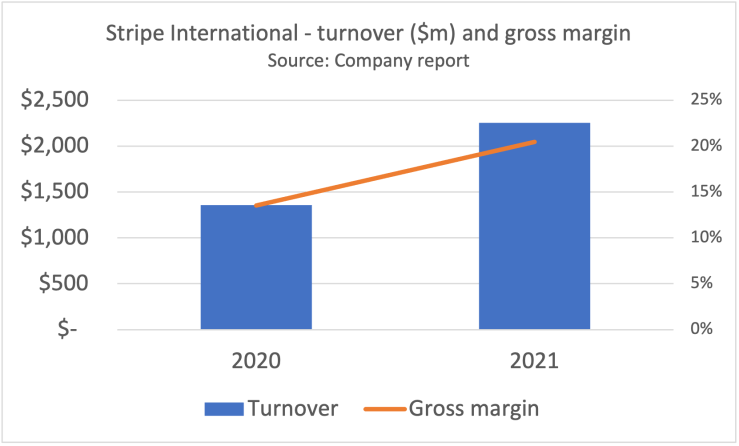
Turnover rose 66% to $2.22b.

Cost of sales increased 53% to $1.79bn with gross margins expanding from 14% to 20%. This is relatively low and reflects heavy investment in R&D and new market expansion.

Administrative expenses rose 50% to $475m driven by continued aggressive hiring. Staff numbers doubled in 2021. The group employed 1,048 staff at the end of the year compared with 569 a year earlier. Employees are well paid. The average cost per team member is $148K.

Total losses before tax narrowed from $136m to $22m. 

Total accumulated losses stand at €294m

After year end, Stripe acquired BBPOS, a Hong Kong based manufacturer of payment terminals. This allows Stripe to take full control of its push into payments in the physical world. 

In separate filings at Companies House, Stripe disclosed its UK revenues tripled in 2021, rising from £123m to £371m. Staff numbers grew from 61 to 152 at a very generous average cost of £191K.