Newsletter – September 2025

A person standing at a podium

Description automatically generated

The Payment Business

Worldline’s half-year results disappointed investors as its core merchant services division once again underperformed the broader European market. Net revenue in the division fell 7%, while EBITDA dropped 19%, prompting a colossal €4.1 billion impairment, a remarkable figure considering Worldline’s current market cap is just under €1 billion.

chart, line chart

The bad news kept coming. Worldline took an additional €142 million write-down on its minority stake in Ingenico, S&P has downgraded its bonds and the Financial Times raises questions about whether the parent company has ready access to cash held in subsidiaries.

The sales slump in merchant services is blamed on a tough SMB environment, particularly in Germany and the Benelux, where Worldline is struggling against the “Tap Pack” of SumUpViva.commyPOSFlatpay as well as ISV’s offering payments bundled with their retail or restaurant software.

Still, there are some glimmers of hope. External auditors brought in following the “Dirty Payments” scandal reported no further issues. Worldline has successfully offloaded its mobility and e-ticketing unit for €410m, and there are signs of life in markets like Australia, Italy, and Greece. The company also reports solid progress in platform consolidation and has re-entered the UK acquiring market. Worldline’s new management team remains upbeat, targeting a return to growth in 2026, though that promise may sound familiar.


Adyen’s H1 results were quite a contrast. Worldwide revenues grew 20% while EBITDA margins remained above 50%. Very few companies can boast such strong financial results but the stock price fell 18% as the Amsterdam-based acquirer reduced H2 guidance citing the impact of Trump’s tariffs on its Asia-Pacific clients selling goods to the USA. This is thought relate to Shein and Temu suffering from the imposition of customs duties on small packages.S

A graph of a number of countries/regions

AI-generated content may be incorrect.

Despite years of effort and tens of millions of dollars in incentive payments to PSP’s, Discover’s global acceptance network had made little progress in attracting volume. Capital One, Discover’s new owner, is now looking to create a rival to American Express. The CEO said “there are only 2 banks in the world with their own network, and we are one of them. We are moving to capitalize on this rare and valuable opportunity. We need to achieve greater international acceptance and then build a global network brand.”

Dojo has established itself as arguably the UK’s leading SME payments provider but 2024/25 results show growth is slowing – revenue up just 11% and merchant numbers flat. Successful launches in Italy and Spain are critical to the future of the group because, despite a new $190m equity injection, Dojo must run fast to escape the interest payments on its £649 million debt mountain. Read more on the Business of Payments blog.

A graph with numbers and a line

AI-generated content may be incorrect.

Today’s CEO normally boasts about using AI to cut staff numbers but FlatPay, the fast growing Danish-HQ’d PF, is delighted to have reached 1000 employees. The hiring spree is linked to new market entry into France and Italy where it is signing 2,400 merchants a month and expects to capture 3% share within 12 months.

The German Sparkasse are some of the few incumbent banks making a success of payments today. Revenue at S-Payment – which provides merchant services to the 353 member banks – was up 17% in 2024, the terminal estate grew 5% and girocard transactions increased 12% – well ahead of the market. Read more on the Business of Payments blog.

Bar chart showing S-payment sales revenue (€m) from 2022 to 2024, with increasing values in each year.

Secupay is another German payment business producing good numbers. Based in Dresden, Secupay is the country’s largest remaining independent PSP and processes c.€2bn annually from over 300,000 merchants. 2024 sales almost doubled to €19m. Secupay has recently secured full scheme membership and has built an acquiring capability using Silverflow software.

Deutsche Bank also uses Silverflow and has won its first large customer – Bolt – since relaunching its own merchant acquiring proposition.


Global Payments stock price improved after management reassured investors on the near-term outlook which included Q2 results showing European revenues up 6%, flattered by the weaker dollar.

chart, line chart

Global is performing best in central Europe. NBG Pay, the joint-venture with National Bank of Greece inherited from the acquisition of EVO Payments, processed €14bn of in 2024, grew net revenues 25% to €40m and reported a maiden operating profit. Global has entered Croatia with the acquisition of the acquiring unit of Erste Card Club,through its existing Vienna-based JV with Erste Bank.

Although Global has reported positive progress with regulatory matters in the US relating to the acquisition of Worldpay, it’s not commented on the situation in the UK where the combined business will probably have a >40% share of the acquiring market. Competition authorities in London have not yet decided whether to mount a full investigation.


In a busy month for payments-related fundraising, here are some highlights:

  • Bumper, based in Sheffield in the UK, secured an additional £8m from the venture arms of Jaguar Land Rover, Suzuki, Porsche and others to expand its car repair software and payments platform to new European markets including Germany, Ireland, Netherlands and Spain. Bumper bought Cocoon Payments, an open banking specialist earlier this year.
  • Appcharge, a Tel Aviv based merchant-of-record specialising in helping mobile games publishers take money directly from consumers (avoiding app store charges) has raised $58m, bringing total financing to $89m. Appcharge claims $500m annual payment volume and growing quickly.
  • Reckon.ai, from Porto, has raised a further €5.1m (total of €8.5m) to grow its business selling autonomous smart cabinets – best thought of as walk-in vending machines where shoppers pay via an app or by tapping a payment card before entering.
  • Handwave, based in Latvia has raised $4.2m for its biometric payment products – hardware and software. You first must link your card credential to your palm print and then you can pay by putting your hand on a special reader. Palm payments make sense for saunas and swimming pools but, otherwise may be a solution looking for a problem.
  • MyPinPad, the Cardiff-based SoftPOS vendor, has raised a further £4.6m.
  • Papercut, based in Sofia and led by ex-SumUp execs, has raised €2m for its BNPL aggregation service for SMEs. Embed is providing the payment infrastructure and money movement.

Turning to corporate activity, Payroc, a highly acquisitive US acquirer/processor, has bought Bluesnap, an online PSP and payment gateway based in Dublin and Boston. Payroc processes $115bn from 190,000 merchants and the deal gives it significant reach into Europe for the first time.

PayRetailers, a Barcelona-based PSP specialising in cross-border sales into Latin America, has acquired Celeris, an Amsterdam-based payment orchestrator. The deal should help PayRetailers improve authorisation rates.

Finally, Nexi has retained its partnership deal with Crédit Agricole in Italy, despite the bank’s French parent having bought a 7% stake in Worldline in 2024. This will come as a relief to Nexi’s management as it has been under pressure from Worldline for bank partnership in Italy. The Crédit Agricole deals covers processing for 100,000 POS terminals and 3m payment cards.

Scheming

Q2 2025 was another storming quarter for the schemes in Europe. Combined Visa and Mastercard payment volume rose 18% although the headline figure was flattered by the weak dollar. But 12% in Euro terms is still very impressive and reflects 10% growth in transactions and 2% uplift in ATV.

chart, line chart

Mastercard and Visa have been neck and neck for a while but in Q2 Mastercard processed (marginally) more volume in Europe than Visa for the first time. This will be cause for a small celebration in Waterloo although Visa still managed a slightly higher number of transactions.

Cross‑border volumes remain robust for both networks; despite Adyen’s issues, neither reports geopolitics hurting demand with Visa’s CEO saying: “We see no meaningful impact from tariffs.”


Europe’s reliance on Visa/Mastercard – 13 of 20 eurozone countries use them for most POS payments – is spurring work on the digital euro (see below) and the European Payment Initiative’s wero wallet.

In Germany, the savings banks, which have integrated wero into the Sparkasse app, now claim 1m active users. For now, wero only works for P2P payments but eCommerce is coming later this year and merchants will certainly like the pricing. S-Payment is proposing 0.77% + gateway charges: rather cheaper than cards or PayPal. And, unlike open banking payments, wero comes with a payment guarantee.

chart, bar chart

Launching any new payment method is difficult but consumer awareness of wero has grown from 12% to 30% in Germany over the last 12 months thanks to some sustained marketing such as this determined effort to have wero adopted at flea markets.

Wero is also live in France although pitched as something rather cooler and cosmopolitan.

Turning to domestic schemes: Poland’s Blik, which has Mastercard as a key shareholder, posted standout 2024 results with revenue up 93% to €98m (~€0.06/tx) and profit at €48m.

A graph of a company

AI-generated content may be incorrect.

Growth continued in H1 2025: total transactions were up 24% including almost €2bn of POS volume, managed through a virtual Mastercard which also allows Poles to use Blik at terminals abroad. Feel the chemistry as Mme Curie buys supplies in Paris.

Customers of Caixa Bank, BBVA and Santander can use Bizum, the fast-growing Spanish mobile payment wallet at POS for the first time. In contrast to Blik, the Bizum user experience is clunky – shoppers need to type their phone number into terminal to be sent a payment link.

Brazil’s Pix mobile wallet has attracted global attention for its stratospheric growth but seems to be taking share from cash, not cards. Since Pix launched in 2020, card transactions have been growing faster than ever – an annual growth rate of 20% compared to 14% in the previous years. Despite this, Donald Trump has launched an investigation into Brazil’s unfair trade practices including Pix which he says discriminates against Visa and Mastercard. Brazil’s President responded: “PIX is Brazil’s. We will not accept attacks on PIX, which is the patrimony of our people.”

ISV

The shift in payments distribution from banks to software vendors (ISVs) is one the biggest disruptions in the industry and is delivering big numbers to processors that have invested in building the right relationships.

Shopify, which provides websites for over 5m merchants worldwide, has aggressively shifted volume from 3rd party gateways (chosen by the merchant) to its in-house product – Shopify Payments. Processed via Stripe, Shopify Payments’ volume was up 38% in Q2 to $41bn and accounts for two-thirds of all sales made by Shopify merchants.

A graph of a bar chart

AI-generated content may be incorrect.

Stripe tends to be the partner of choice for eCommerce ISVs but Adyen’s platforms business is the go-to acquirer for vendors serving online and store-based channels. Latest results show Adyen’s payment volume from platforms up 80% to €27bn in H1 2025 from 255,000 terminals. 31 of its partners now process over €1bn each annually.

A graph with blue and orange bars

AI-generated content may be incorrect.

Adyen’s deployment capability in multiple countries and across channels is very attractive to retail software specialists that need a single solution for their multi-national clients. Sitoo from Sweden is a great example. From Sitoo’s perspective the key USP of partnering with Adyen is an increase in first-time help desk resolutions and reduction in time taken to troubleshoot faults. 

Other payment processors want a piece of the action. Worldpay is finally taking the European ISV market seriously with some strong marketing support for the launch of Worldpay for Platforms. The proposition is based on the acquisition of Payrix in 2022

Electronic Payments, has bought Handpoint the Iceland-based mPOS vendor. Handpoint, which claims 100 ISV partners, processes $2bn annually from 18,000 devices in Europe and the USA. Electronic Payments is known for giving generous commercial terms to its partners (URL = www.residuals.com) and could be a disruptive new entrant to many European markets.

New shopping

Agentic commerce has potential to transform online shopping; replacing the established online commerce journey which begins with a Google search and ends at a finely honed checkout page with a chat-based conversation between you and an agent that has delegated authority to spend money with your payment card.

In surveys, 50% of Americans are already using AI agents for shopping which is leading to a speedy reassessment of online retail. Anecdotal evidence suggests that small speciality retailers are seeing 20-40% drop in visits as AI prefers to funnel shoppers to large brands. Here’s a good round-up of what merchants are finding.

A16z, a top US venture capitalist, looks at the scenarios and concludes that Amazon and Shopify (which together account for 50% of US eCommerce sales) have strong enough differentiators to prosper in this coming shift. The retail giants want agents to play on their terms and interact based on published APIs. Both have blocked AI bots from crawling their extensive data.

Instead, Shopify has given each of its 5m merchants a “chatbot accessible storefront API”and launched Shopify Catalog which aggregates products across all Shopify merchants to enable AI agents to search, recommend and (in the near future) transact. Shopify claims 12.3% conversion on AI-assisted shopping compared to 3.1% the old-fashioned way.

The payment industry has begun to launch product. Worldpay has introduced a Know Your Agent (KYA) framework to help merchants determine whether an agent is good (working for a genuine shopper with funds to complete the purchase) or bad (working for a scammer). Trulioo, the global ID vendor, is behind the product and has a helpful white paper here.

Open banking

Industry commentators have focused on the positive aspects of the UK’s National Payment Vision, notably a commitment to form a new delivery company, create a payment guarantee and find a commercial model that rewards all market participants. These all may take some time. Meanwhile, investors worry whether the open banking industry – suffering from low volumes and lower margins – can remain solvent long enough to see the fruits of these endeavours.

One example is Ordo, a high profile open banking startup which featured in last year’s Fintech 40. Ordo was bought by Neonomics of Norway in 2023 but the new owners have given up on UK open banking and Ordo has ceased trading. Writing on LinkedIn, Neonomics CEO said VRP (the open banking equivalent to direct debit) had been too slow to arrive resulting in a UK market size of just c.30m transactions/month. This is not enough to sustain an industry.

Mollie, the very well-funded Dutch PSP, is reported to be close to acquiring GoCardless, the loss-making London-based direct debit specialist after Trustly declined the deal. If true, this indicates investor nervousness as Mollie would be unlikely to match the $2.1bn valuation attached to GoCardless 2022 funding round.

Thanks to partnerships with FIS and Visa, and backed by blue-chip investors including NAB, Citi and Rapyd, Banked – another high profile open banking start-up – will be well positioned if/when A2A merchant payments become mainstream. Meanwhile, 2024 accounts show that Banked generated just £700K revenue and will likely need yet more capital to supplement the £55m already raised.

chart, waterfall chart

On the positive side, it’s increasingly common to see open banking offered at checkout. Ryanair, working with TrueLayer, has started putting “pay by bank” first on its payment page as you can see below.

graphical user interface, application, email

Open banking’s current lack of consumer protection will aways be an issue in travel payments. Meagan Johnson gives an example of an A2A transaction for which neither Air France, Trustly or Monzo will take responsibility. Next time, she says she will use a card.

It’s clear that open banking needs “scheme rules” that give clear guidelines for managing disputes. Following two recent product launches, it’s increasingly likely these will be card scheme rules. Following the announcement of Visa Protect earlier this year, Mastercard has followed suit with A2A Protect. Early adopters include NatWest, Santander and Monzo in the UK.

Crypto corner

Plans for the digital euro are accelerating. Regulators already worried about European over-dependence on American payment schemes are now equally concerned about a possible tsunami of dollar denominated stablecoins arriving from the USA.

However, Central Bank Digital Currencies, like the digital euro, are a very different proposition to commercial stablecoins. CBDC’s are designed as cash-substitutes that bring direct benefits to citizens rather than as infrastructure-level plumbing to facilitate international trade. The European Central Bank hopes to have a political deal on the digital euro by early next year.

The commercial banks aren’t happy and paid PwC to write a study that put the cost of digital euro adoption at €30bn if the digital euro sucks deposits out of current accounts leading to banks making fewer loans.

The Bank of England, apparently unbothered about payment sovereignty, is said to be cooling on the digital pound.

Turning to crypto proper, Stripe has begun developing its own blockchain. Simon Taylor is very excited about this.

There are still few signs of crypto (stable or unstable) being used for retail payments. Undeterred, SpacePay, based in London, is raising $1.1m from the sale of its $SPY tokens, to promote crypto currency acceptance on its Android payment terminals. SpacePay says it charges just 0.5% and settles in fiat currency.

Coinbase, a platform that allows people to buy/sell crypto, is running adverts in the UK suggesting that investing gambling in crypto is the solution to inflation, stagnating wages, crumbling infrastructure and a withering welfare system. This won’t end well. 

In other news

Numia won the merchant acquiring business of Banco BPM from Nexi last year. One of the first deliverables is “100 kiosks in 100 churches” allowing the faithful to make contactless donations.

100 totem in 100 chiese”: il digitale entra nei luoghi di culto - Pagamenti  Digitali

German banks stopped €10bn of suspicious direct debits from PayPal following a failure in the US giant’s security systems.

Netherlands Railways has blocked virtual cards issued by Revolut, Paysafe and Vividfollowing discovery of a loophole that allowed passengers to travel for free. People would create a virtual card, take a trip, and then delete the card before the overnight settlement run.

Pedro Carvalho, sales director at Primer, which supplies payment infrastructure to large merchants, has spent the summer posting checkout crimes on LinkedIn. Here’s my favourite – the merchant asking shoppers to choose the processor. Why?

graphical user interface, text, application, email

It’s been a busy summer for payment outages. In Denmark, Nets went down and paralysed traffic at the Great Belt Bridge. In France, SocGen and La Banque Postale went down two days in a row with Crédit Mutuel and CIC also failing for two hoursone Saturday evening.

Shopify’s head of engineering gives advice on how to use AI. He says get your lawyers to default to “yes” and don’t skimp on letting your staff subscribe to the best tools. “If your engineers are spending $1,000 per month more because of LLMs and they are 10% more productive, that’s too cheap. Anyone would kill for a 10% increase in productivity for only $1,000 per month.”

Sam Altman says AI will kill KYC as we know it. Risk systems need to be “always on” to cope with the growing wave of deepfakes, spoofing and voice-cloning, he says.

The team behind PayEye, a high-profile facial recognition payment solution, are now in a legal dispute in Poland about who owns the intellectual property.

And finally

How does a Shift4 logo get on an Adyen terminal? An Adyen exec responds: “What you’re seeing is an odd choice of background image, which is fully customizable on any of our terminals.”

No alternative text description for this image

Photo credit: James Lloyd

Where to find me

I’ll be at the Checkout.com’s conference in Venice 7-9 October, at the ESPM meeting in London on 23 October, at the ePay Summit in London on 28 October and MPE in Berlin next March.

Newsletter – July 2024

The Payments Business

Klarna has sold its gateway business to a local investor consortium for $520m. Klarna Checkout (KCO) claims 40% share of its home market of Sweden and 20% across the Nordics as a whole.

It’s obvious why Klarna is selling. KCO competed with key distribution partners such as Stripe and Adyen and the very generous sale proceeds will bolster Klarna’s balance sheet and help grow its lending business.

But it’s less clear how KCO’s new owners will make a return on their investment. Stand-alone gateways have been under considerable pricing pressure in recent years, and many have ended up vertically integrated into the larger merchant acquirers.

In banking news, BNP Paribas and BPCE, which together handle c.30% of card payments in France, will invest €100m each and pool their payment capabilities to create a joint-venture with the scale to compete with Worldline and Nexi. Technology will be “home grown” and most likely a continuation of Partecis, an in-house platform based on ACI products. While there’s plenty of scope for synergy in France, the JV will find its hoped for international expansion rather more challenging as PagoNxt, Santander’s payment unit, demonstrated when it recently closed its German operations.

As predicted in last month’s Business of Payments, Sabadell has postponed the sale of its merchant services business to Nexi. Sabadell is subject to a hostile takeover from BBVA, another Spanish bank. BBVA has a good in-house payment offer and has less need of Nexi’s products.

IDC, a London-based research firm, has published vendor evaluations for online and omni-channel retail payments. The full reports cost $20,000 each but the top ranked firms have helpfully made their sections available free of charge. Stripe comes top for online payments although is marked down for being expensive. Adyen is first for omni-channel but customers are warned that its all-in-one solution may lack flexibility.

Stripe is notably missing from IDC’s omni-channel evaluation but is quickly becoming a very credible option for cross-channel merchants in Europe. Stripe has launched a suite of new enterprise services in France including its S700 POS terminal, acceptance of Carte Bancaire and an integration with CEGID, a leading local retail ISV. Stripe claims half the CAC-40 companies as customers and announced that Accor, the hotel group with over 5,600 locations worldwide, is standardising on Stripe for its new, centralised booking system. Stripe obsessives will enjoy this detailed history of the business.

Viva Wallet’s lawsuit with JP Morgan ended in a London courtroom with both sides claiming victory. JPM paid an eye-popping $800m for 48.5% of Viva in 2022, primarily to gain access to SME customer onboarding tools for European markets. Haris Karonis, Viva’s founder, claimed that JPM then deliberately blocked his company’s launch in the US so that the giant American bank could buy the rest of Viva on the cheap. JPM counter-claimed that Karonis failed to understand how far Fintech valuations had fallen.

Financial results of listed payment companies have settled down post-pandemic into a phase of steady but unspectacular growth. FXC have crunched the Q1 numbers so you don’t have to.

A wero for your thoughts

A female white soul singer with big hair sings "I need a Wero" in a German beer cellar while holding a phone displaying a QR code

It’s taken four years and 14 of the original 31 banks have exited the consortium but the European Payment Initiative (EPI) has finally launched wero, the long-long-awaited domestic European payment champion. Wero, a combination of “we” and “euro”, is live for person-to-person money transfer, initially for customers of co-operative and savings banks in Germany and KBC in Belgium. French banks come on stream in the autumn.

Shoppers will be able to make eCommerce payments with wero from early 2025 and Computop, the German PSP, has already begun asking merchants to register to be part of a pilot. In-store payments will follow in 2026.

Payments & Banking, a German blog, explains what wero is and what it is not.

The consensus from payment experts is that for wero to succeed the EPI needs to focus ruthlessly on user experience and keep the member banks firmly in the background. And “I need a wero” is the only song that will do as you can hear in this short commercial. 

Paydirekt and Sofort axed

Even though wero is at least six months away from being ready for eCommerce, its launch sparked the unexpectedly early closure of Paydirekt/Giropay, a domestic competitor to PayPal launched by the German banks in 2016. 

Insiders tell me that the service termination was badly handled. Giropay switched off its old integration interface at the end of June even though many acquirers had not yet migrated to the new version.

Meanwhile, Klarna has announced the closure of Sofort, the German online bank transfer service which it bought for $150m in 2013. Merchants will be migrated to Pay Now, Klarna’s open banking product. This includes buyer protection which is great for shoppers but less exciting for Sofort’s many merchants in the gambling and adult sectors. These customers will be looking for alternatives.

Klarna’s new wrapper doesn’t come cheap. In Germany, Adyen is charging 1.35% + €0.20 for Klarna Pay Now transactions. For UK merchants, Mollie is asking a punchy 4.99% + £0.30.

If that wasn’t enough disruption, Shopify is deactivating Amazon Pay as a payment option from all European merchants. No reason was given and merchants are really unhappy.

Scheming

Blik, the wildly successful Polish mobile payment standard, continues its stunning growth with payment volume up 53% in 2023 to €29bn. Blik is jointly owned by Mastercard and a number of local banks who have suddenly woken up to the importance of their investment. From now on, the banks will send their CEO’s to Blik’s board meetings.

Bancomat, the Italian domestic debit scheme, is finally getting its act together. Milan-based investment fund FIS has made a €100m investment, the board has been slimmed down to speed decision making and a new CEO appointed from Mastercard. Nexi runs the technology for Bancomat and has put the card scheme live on Apple Pay and as a payment option on Amazon.

Read more about Bancomat’s 2023 results on the Business of Payments blog.

ISV

We’re taking a keen interest in the convergence of software and payments. Flagship Consulting’s latest report shows quite how dependent many American ISV’s have become on payment and other financial services revenue. 

In response, payment processors know they need to partner with ISVs and some have gone further, buying or building an in-house range of vertical software. 

Intriguingly, the stock market value of payment processors that offer software is rather lower than software vendors that offer payments processing. Jevgenijs Kazanins looks at why Toast (an ISV that offers payments) is valued more highly than Shift4 (a processor that offers software) even though Toast makes much less money. His conclusion is that ISV’s are better at securing recurring revenues under contract.

European ISV’s have now realised they too can make money from processing. The  opportunity is smaller than in North America because payment margins in Europe are much lower. Nevertheless, a savvy commerce software vendor can still double profit margins by embedding payments in its core merchant offer.

With so many acquirers and PSP’s pivoting towards ISV’s as their primary distribution channel, a number of start-ups have begun offering key parts of the technology stack as-a-service. Here are a few that have caught my eye.

  • Chift, based in Brussels, offers PSPs connections to a range of leading accounting, eCommerce and ePOS software though a single API. The company just raised €2.3m
  • Shape Technologies is offering payments-platform-as-a-service to payment facilitators with capabilities including onboarding, KYC and billing. Shape is founded by alumni from Cardstream and is helping put Taunton, Somerset on the Fintech map.
  • Fung, in Amsterdam, offers a similar product set to Shape but is also a payment institution and can handle the money flow too.
  • Dublin/Vilnius based Paynt, goes one step further with a full acquiring-as-a-service proposition.Subscribe

New shopping

We’re keeping a close eye on the progress of autonomous stores as one possible driver of a seismic shift in grocery transactions from POS to the shopper’s phone.

Rewe is leading the deployment of “just walk out” formats in Europe. The German supermarket giant has opened a 1200 sq metre autonomous store in Hamburg using technology from Trigo which can even identify fresh meat and cheeses picked from the deli counter. Showing confidence in the concept, even where labour costs are much lower than Germany, Rewe has also opened an autonomous store in Bucharest.  

Although sceptics point out that frictionless checkout often involves more manual intervention than the vendors let on, the use cases are multiplying. For example, in a village store in Switzerland a shipping container is transformed into an unmanned convenience store (or walk-in vending machine) using technology from FastaXs.

Biometric payments

With early pilots looking positive, there’s growing momentum behind new biometric payment technology in the US, including palm payments (favoured by Amazon) and even face payments. JP Morgan is taking an interest in the latter with a partnership with PopID, a Californian start-up which has an early lead in the technology.

In Europe, Mastercard is backing PayEye, a Polish start-up which is piloting its iris/facial recognition product at five locations of Empik, a large retailer of books, toys and games.

Digital reciepts

A number of start-ups are trying to make it easier for merchants and consumers to move to digital receipts. Habits are hard to shift. Despite a new legal requirement in France that paper receipts should be opt-in only, Auchan, the grocery chain, reports 60% of shoppers still ask for paper.  

  • In the UK, Slipp, which boasts JD Sports as an early client has raised £750K. Slipp integrates with the ePOS software to send the shopper a text or email. JD Sports says using Slipp’s SMS receipts to promote its loyalty programme is increasing the number of customer sign-ups.
  • Anybill, from Regensberg in Germany, asks customers to scan a QR code presented by the ePOS. Pricing ranges from €4.49 to €35.99 per month per outlet.
  • Yocuda, a French start-up acquired by Global Blue, claims to have delivered over 2m electronic receipts to over 200,000 identified shoppers. Clients include Halfords and Decathlon.
  • Receipt Hero, based in Helsinki, has raised additional funds to supplement the $5.7m already invested. Receipt Hero offers cardlinking as well as QR scans. Partners include PayOne.
  • Pi-xcels from Singapore has an elegantly simple product that delivers an e-receipt automatically when the shopper taps their phone on the payment terminal. The product integrates with the terminal not the ePOS software and is available on Ingenico and PAX.

There’s an open question whether digital receipts can establish themselves as product category in their own right or whether merchants would prefer to buy the capability as a feature of existing POS or CRM software.

Artificial Intelligence

Artificial Intelligence is moving up and down the hype curve faster than any previous technology as Benedict Evans explains. McDonalds has already hit the trough of disillusionment  and shut down a pilot with IBM that used AI to automate order taking at 100 drive-thru restaurants. The robots made too many mistakes such as adding bacon to ice cream.

Worldline is taking a more measured pace and has detailed how it is managing its AI initiatives. This is 1500 words of big company governance, stage gates and committees. I wish them luck.

SoftPOS

This technology, which allows any off the shelf consumer device to accept contactless card payments, was originally touted as a micro-merchant proposition but is proving most popular with large enterprises.

LVMH is leading the innovation. Liberated from the need to locate the nearest payment terminal, sales associates at Christian Dior, an LVHM brand, each have their own iPhone to serve customers wherever they are in the store. Dior has worked with Adyen, Global Blue and Vo2 Group, a Paris HQ’d tech consultancy, to add instant VAT tax refunds to the proposition.

In vendor news, Rubean, based in Munich, has raised an additional €2m capital to finance its strong growth. Sales are forecast to rise to €2.2-€2.5m this year from €1m in 2023 on the back of new distribution deals.

Rubean’s partnership with Global Payments may be threatened by the Atlanta processor’s unpublicised purchase of Yazara. The Global/Yazara tie up is likely also to be bad news for MyPinPad  which local sources suggest may be replaced as supplier to eService, Poland’s largest acquirer, which Global bought last year.

In better news for MyPinPad, Ur&Penn, a leading chain of jewellers in Norway, is using its SoftPOS application to take store payments on the associate’s Android phones. 2izii is the integrator and Elavon the acquirer.

Phos, acquired by Ingenico in 2023, is making good progress building out its distribution network, announcing a key partnership with Shift4, a US processor with big ambitions in Europe. Phos is also the technology partner for BORICA, which provides SoftPOS to the three largest banks in Bulgaria. BORICA claims 1,500 “terminals” live today.

In Italy, Ultroneo has implemented MarketPay’s PayWish SoftPOS application for its Get Your Cash merchant proposition. Volumes are growing swiftly (see below) but it’s not been plain sailing. Writing on LinkedIn, one Ultroneo director explained “For nearly 12 months now we have been struggling with the teething problems of this new technology. Bug after bug, incident after incident, we have managed to stabilize the SoftPos to the delight of our customers.”

Image preview

Openbanking

The UK’s incoming Labour government is making very positive noises about fintech. Quoting from its manifesto: “Financial services are one of Britain’s greatest success stories. Labour will create the conditions to support innovation and growth in the sector, through supporting new technology, including Open Banking and Open Finance and ensuring a pro-innovation regulatory framework.”

There is much that a new regulatory approach could deliver, including an open banking acceptance mark, “scheme” rules to ensure common standards for authorisation codes, refunds etc, the introduction of consumer protection and a recognition that all this cannot be provided free of charge.

Positively, the number of open banking payments made in the UK rose c.50% year-on-year to 17m in May 2024. Variable Recurring Payments (VRPs), the open banking equivalent of direct debits, now account for 11% of the total.

The increase is encouraging but compared with the 2bn debit card transactions made in the UK in a typical month, volumes remain very small.

The slow take up of open banking has implications for the large number of vendors operating in this sector. There are twenty listed on the UK government’s procurement framework alone. If revenues don’t arrive soon, only the best capitalised will be able to keep trading until the product goes mainstream.

Truelayer, hopes to be one of the survivors, having raised a remarkable total of $271m from its investors. Truelayer’s CEO has given an interview  to explain that he is playing a long game, saying “We are an infrastructure business. That means we are likely going to spend a lot of time and a lot of years building and spending money before actually earning,”Subscribe

Cash

Germany is often cited as the last hold-out of the cash economy but the latest Bundesbank payment survey shows a further decline in the use of paper money. The cash share of transactions fell 7% points in 2023 to 51% and its share of volume by 4% points to 26%.

Old habits die hard. A Bavarian bar-owner called the police after a Latvian customer paid for 16 beers with 16 separate card transactions.  

It’s no surprise that policy-makers in many countries are grappling with the implications of the world going cashless. For example, Ireland has passed an “Access to Cash” law which gives the government powers to set minimum numbers of ATMs for each area. The local banks, and their customers, will bear the cost. Revolut, wildly popular in Ireland, will likely get a free ride.  

Without this kind of subsidy, independent operators will stuggle. In Poland, Euronet, which manages 50.000 ATMs, limited withdrawals to PLN200 (€46) for one day as a protest at the government’s refusal to let it to charge for transactions. Euronet complains that it is losing money because local banks pay just PLN 1.2 (€0.28) per withdrawal. We assume that Euronet probably more than makes up for the shortfall with its eyewatering DCC charges for tourists.

An enterprising British artist commented on his struggles to find a place to withdraw cash by fixing an ATM to a bridge in the middle of a river.

Facade of grey atm machine with screen, buttons on brick buttress with rippling water below

Of course, even if cash is available, retailers may decide not to accept it. This British pub says it has saved 12 hours work each week by going cashless. Cash is expensive to handle and the costs grow as volume declines. The Portuguese Central Bank believes cash costs merchants 2.96% compared to 0.78% for debit cards.

Image preview

Crypto corner

Crypto currencies are assets not money, yet vendors persist in bringing forward payment acceptance solutions at POS.

Few have heard of SpacePay, but give it a year, and it will likely be a household name” is the bold claim from this London based start-up which graduated from Barclays’ fintech accelerator. SpacePay, which has raised $750K, says it will allow people to spend crypto at “most existing point of sale card machines.” It’s not clear how this would work in practice.

If there is a user base for crypto at POS anywhere, it’s going to be in a cross-border market such as Luxembourg where some shoppers may not want their home country authorities to know what they are buying.

Done4You, an ISO based just across the border in Namur, Belgium, has implemented crypto at POS for a petrol station in the Grand Duchy using GoCrypto’s technology. Crypto transaction are 1.25% compared to interchange + 0.5% for credit cards.

In other news

Fiserv’s brand association with the Republican National Convention in Minneapolis is dividing opinion.

Good news for travellers. International cards are finally accepted at 97% of Dutch payment terminals and will reach 100% by the end of this year.

The Netherlands experienced its longest payment outage for five years as 30%-40% of PIN transactions failed over a three hour period. The problem was blamed on Equens (Worldline), the domestic inter-bank network. Worldline is also reportedly behind a shorter outage affecting UK grocers earlier this month.

A sign of the times. Such is the consumer uptake of Apple and Google Pay, one French bank has found that 20% of customers opt not to be sent a physical card.

Advent, whose portfolio companies include MangoPay, Planet and MyPOS, is excited about vertical payment/software bundles, specialist tools to support eCommerce and solving cross-border challenges.

Follow the money. European VCs have picked their top payment start-ups

We’ve not seen many layoffs recently but Rapyd, the Israeli acquirer/processor, is cutting 30 posts in its home country

TSG, an American consulting business, runs an annual payments API competition. Adyen is the overall winner with Square as runner up.

And Finally

Stripe has opened a new London office and is celebrating with a rather mystifyingbrand advertising campaign aimed at enterprise customers.

Image

Photo credit Jevgenijs Kazanins

How to get in touch

Geoffrey Barraclough

geoff@barracloughandco.com

www.businessofpayments.com

November 2023 Business of Payments newsletter

The Business of Payments

Last month’s poor results from Worldline and Adyen have not set a trend. Nexi’s Q3 numbers came ahead of market expectations. Management said there was no sign of the slowdown in Germany which has so rattled Worldline’s shareholders. Nexi’s stock price is recovering nicely while Worldine is still bumping along the bottom.

Adyen bounced back after its plain-speaking Dutch management presented analysts with a more realistic assessment of the company’s growth prospects and promised a slowdown in the breakneck pace of new hires. Adyen’s Q3 revenue was up 22% and with the processor now targeting 50% EBITDA margins by 2026, significant cash profits are on the horizon.

The dilemmas faced by European legacy acquirers are well described in Nightmare on Acquiring Street, a new paper from PSE Consulting. This lays out the speed at which the market is moving to “gateway acquirers” such as Stripe, Adyen and Checkout, which offer a tightly integrated bundle of services operating over a single platform.

Source: PSE Consulting

Processors operating with old technology and without modern checkout and boarding tools are struggling. Barclays and Credit Agricole are the only banks remaining in the list of top European acquirers and both now recognise the need for change. Credit Agricole has announced a JV with Worldline and Barclays is exploring options for Barclaycard which could involve a sale or joint-venture.

As well as the impact of technology trends, European acquirers also need to contend with a profound shift in channel buying behaviour by small businesses, the most profitable customer segment. A new report from Flagship Consulting demonstrates the extent of the risk.

Source: Flagship Consulting

Independent software vendors (ISVs) and other platforms are now taking between 40% and 65% of new merchants signed in the US. This trend is coming to Europe and threatens banks ability to sell direct to SMBs. ISVs are demanding increasingly high commissions from the acquirers. Bain estimates that 90% of payment revenue is at risk of changing hands.

The impact on the ISV’s themselves is less well documented but these businesses are now finding they can generate up to half their revenue from commissions on payment processing. This is incentivising bad behaviour and we’re seeing incidents of market abuse where ISVs impose penalties for merchants that use 3rd party payment products.

Shopify, the leading eCommerce retail platform, charges a 2% surcharge if merchants don’t process transactions through Shopify Payments. And Lightspeed, a restaurant POS software vendor with over 10,000 customers worldwide, insists that all new customers take its integrated payments product. Those who don’t will be hit with a 0.5% transaction surcharge. 

This hasn’t gone down well in Canada where one restaurateur reported being charged $300 for using a competitor payment terminal“It’s not illegal, but it’s unethical,” said the local business association. Lightspeed have now introduced a price pledge to match competitor pricing in any country. But it’s worrying that many ISVs are now treating their customers as hostages. This won’t end well.

Corporate activity

Advent, the US private equity giant has bought London-based MyPOS for $500m.MyPOS, which became a merchant acquirer last year, claims 170,000 mPOS merchants in 30 countries and generated €11m EBITDA in 2022 on revenues of €60m. Advent has bought MyPOS through a newly established “payment and technology platform” called Circle which will be chaired by Laurent Le Moal, ex CEO of PayU. Expect more deals to come.

Total Processing, a small but fast growing ISO based in Manchester, recruited Martin Gilbert of Revolut as a heavyweight chair just six months ago. He has wasted little time in arranging the sale of the business to Nomupay, the well-funded Dublin-HQ’d processor formed from the ashes of Wirecard. Nomupay is clearly one to watch. 

Tencent, the Chinese technology platform, has paid $100m for an 8% stake in Global Blue, the market leader in Tax Free Shopping, at a valuation of $1.25bn. The Tencent relationship will cement Global Blue’s position with high-spending outbound Chinese travellers.

Silverflow, the Amsterdam based payment orchestrator has raised €15m at a valuation “significantly higher” than its previous raise in 2021. The money will be used to support the company’s expansion into Latin American and the Far East.

Shift4 has finally closed the $525m acquisition of Credorax Finaro. The eighteen-month delay, caused by the presence of a sanctioned Russian oligarch on the Finaro share register, has given management plenty of time to plan the integration. The combined business has scale (c.$200bn volume), international reach and the capability in eCommerce which Shift4 has been lacking. 

AIB and Bank of Ireland have abandoned efforts to create a domestic money transfer app to compete with the runaway success of Revolut. The banks had spent a total of €17m on the project which was to be called Yippay (yes, really) but ran into regulatory obstacles. Nexi had been contracted to build the product.

The Irish banks may be better served joining the European Payment Initiative (EPI) which has completed its acquisitions of iDEAL and Payconiq. This gives the EPI a solid basis of technology and transaction flow on which to build a common digital wallet for all European markets.

New Shopping

We’re keeping a close eye on grocery. Shifts in supermarket payments can move the whole market. But not yet. The FT concludes that, twenty years after the debut of online groceries, shoppers still prefer buying food in real life. Despite the pandemic boost only 12% of UK groceries are bought online.

But in-store shopping is changing rapidly with the introduction of self-checkout, Smartcarts and autonomous stores.

Italy’s first autonomous store has opened in Verona. In contrast to many pilot implementations, this one is a large format Tuday supermarket. The technology, supplied by Sensei, a Portuguese start-up, can even detect variable weight items through an integration with the scales. Payments are from Nexi. Shoppers don’t need to use the app. They can pay at a standard POS if they choose.

Tesco is trialling a similar process at one UK store. Again, shoppers don’t need to use the retailer’s app. They just walk up to the checkout which will “magically present them with a list of the products they have picked up”. Shoppers can pay with a card in the normal way. The technology is from Trigo, an Israeli start-up already working with REWE, Aldi and Auchan and in which Tesco has a small stake.

A2Z, the Israeli start-up which is leading development of smart carts, announced the delivery of an initial order of 250 to Monoprix, the French supermarket. These carts contain sensors that automatically record your purchases. A2Z believes it will sell a total of 30,000 smart carts in France alone over the next three years through IR2S, its distribution partner.

There is a live debate about self-checkouts. It’s clear they can work well for small basket sizes but not for the weekly shop. Whether it’s using a handheld scanner or fixed self-checkout terminal, the process puts too much work on the shopper. 

Booths, an upmarket UK supermarket, has removed self-checkouts completely. The customers seem very happy.

In biometric news, PayEye, a Polish start-up which allows people to pay with an iris scan has launched a new range of hardware. Called eyePOS, the terminals include a special camera but also take standard payment cards. PayEye offers them for an introductory price of €11.25 per month.

Despite overwhelming consumer demand to pay at POS by tapping their mobile phone on the terminal, there are still some circumstances when a physical card is needed. One is the M6 toll road in the English midlands. The operator has annoyed tens of thousands of motorists by removing the ability to use Apple or Google Pay. The rationale? A Government dictat that it was illegal have a mobile phone in your hand while in control of your vehicle.

After a predictable outcry, the Government has conceded an exemption for making a contactless payment and the toll road systems will be upgraded for Apple Pay.

In-car payments

The toll road problem would be avoided if all motoring-related payments – parking, charging and fuelling – were brought together in a single app accessed from the car dashboard. 

Mercedes Benz has built its own payment service but Volkswagen is following a different approach of co-ordinating a set of partners. VW has launched “Pay to Fuel” for its Skoda brand working with Mastercard, Parkopedia and ryd, a German fintech that offers a pay-to-fuel app.

Meanwhile, VW has sold PaybyPhone to Fleetcor, a large US B2B payment company for $300m. PayByPhone, generates c.$40m annual revenues from its app which gives access to 4m parking spaces in 1,000 cities across Europe and North America. Payment volume was $900m in 2022, giving a very healthy take rate of 4.4%.

Fleetcor plans to expand the PayByPhone service to include EV charging and automatically buying fuel at service stations.

Product

Alcohol and cigarette vending machines are common in Germany, but age verification can be tricky. It’s  good to see Girocard, the domestic debit scheme, working with Feig, a leading vending machine supplier, to restrict sales to those old enough to buy the products.

Also in Germany, Bluefin has gained Giro certification for the TECS platform it acquired earlier this year and launched a white-label POS service for ISVs. Newland is providing the Android terminals. In other hardware news, ITCARD, a Polish acquirer with 90,000 POS, has started deploying Ingenico’s Axium terminals. This is positive news for Ingenico which has been very slow to market with a workable Android product.

One reason why Stripe is so popular, despite its high prices, is that it makes life easy for its customers. For example, you can now manage Klarna disputes from within the Stripe dashboard. Previously, Stripe merchants needed to deal with Klarna customer services via email.

It’s no surprise that Stripe can get its merchants to write great testimonials. Here’s the CIO of La Redoute, the giant French catalogue retailer, explaining why he chose Stripe as its global PSP/processor. “It has been an incredible and enjoyable journey working with Stripe’s team,” he says.      

Stripes’ platform strategy is sparking interesting innovation. Lopay is a UK mPOS provider built on top of Stripe’s APIs.  Lopay (the clue is in the name) undercuts SumUp and iZettle by charging just 0.99% for debit/credit transactions. It says it has signed 20,000 merchants in 18 months. Lopay charges 0.8% extra for instant settlement and says this is a very popular option. 

DeluPay is targeting a similar market in France with a solution based on QR codes linked to open banking transfers. 1,000 merchants have signed up to benefit from transactions free under €2 and 0.5% thereafter. If you understand French, watch the CEO get quite a grilling on this early morning business TV show. The presenters struggle with the consumer proposition and keep asking why they wouldn’t keep using Apple Pay or Paypal.

The Polish Post Office is looking to capitalise on the 10m users of its mobile app by adding InPost Pay as a checkout button for local web shops. Customers can then pay within the app using Blick, cards or cash on delivery.

Finally, take a look at Shop.app. This is a very impressive AI powered search engine that allows you to construct a basket across over 1m Shopify merchants. Payment through Shopify Payments of course.

SoftPOS

SoftPOS is a downloadable payment application that allows any Android device equipped with an NFC chip to take money on cards. This represents a clear threat to the terminal manufacturers who, together, ship over 100m units each year. Sunmi is the first to respond. It’s latest Android hardware range includes a low-cost terminal designed for SoftPOS and shipped without a PCI certificate.

I think SoftPOS will make a quicker impact in the enterprise market than for micro-merchants. For example, Alaska Airlines is working with Stripe to allow 7,000 crew members to accept contactless payments for food and drink using their airline issued iPhones. This should speed up in-flight service. 

Symphopay, a Romanian POS payment gateway has sold its SoftPOS application to Raiffeisen Bank. The solution is already deployed at 880 easybox lockers of Sameday courier company.

Dotykacka, the Czech retail and restaurant software provider with over 20,000 merchants, has launched SoftPOS  in the Czech Republic and Slovakia. The solution is from Softpos.io, a Danish start-up with Nexi providing the processing.

MyPOS has launched SoftPOS in the UK with merchants paying 1.6% + 7p per transaction and no monthly fee. I think it’s a mistake for vendors to forgo a standing charge as there’s a high risk of attracting large numbers of merchants that never make any transactions.

The steady rollout of Apple’s Tap to Pay as an alternative to Android has reached France. Group BPCE, Adyen, myPOS, Revolut, SumUp, Viva Wallet and Wordline are offering the product at launch. 

Open banking

The latest Open Banking Impact Report shows UK open banking payments doubled compared to 2022 and now running at £4.5bn a month, still small modest compared to c.£65bn on cards and c.£110bn on direct debits.

There are now 45 open banking payment providers in the UK. This is probably rather more than the market needs and many vendors must be wondering they can stay in business long enough to reach break-even.

Who is going to consolidate the overcrowded open banking market? The CEO of Go Cardless, a very well-funded UK direct debit specialist, said it would likely be making acquisitions. Go Cardless already bought Noridgen, a Latvian open banking provider earlier this year.

If open banking payments are going to become mass market, vendors need to provide a superior customer experience to cards. One good example is William Hill, provider of online gambling and sports betting, which will be offering open banking for both pay-ins and pay-outs. This is a sector where bank transfers offer clear advantages over cards, notably the ability to pay winnings instantly. Truelayer is providing the technology.

If the industry doesn’t move quickly, the tech giants will drive the market forward. 

Apple has started using open banking to offer iPhone users the chance to view their bank balance and transaction history before confirming an Apple Pay transaction. Although it would be a small additional step for Apple to start directing Apple Pay transactions over open banking rails, it may be reluctant to lose the 0.15% commission it charges card issuers today.

Cash

We’ve covered the rip-off fees from many ATMs in tourist locations before. Honest Guide (1.3m subscribers) explains the scandal better than we can. Euronet doesn’t come out well.

With the debate raging about whether merchants should be obliged to accept cash, it’s good to see merchants playing an active role for or against. This sign was spotted by Chris Higham in Newcastle.

Image preview

And which button would you press in this Las Vegas taxi?  Photo from Booshan Rengachari.

No alternative text description for this image

In other news

French railways has introduced ticketless transit based on contactless payments for regional trains. This is a wonderful idea which should be adopted by all transit authorities everywhere.

Farewell Dotpay. The pioneering Polish eCommerce gateway was acquired by Nets Nexi in 2018 and its brand is now folded into Przelewy24.

Klarna management has averted a strike by conceding a collective bargaining agreement with its workers. Its CEO didn’t handle a subsequent all-hands call very well, likening union reps to the corrupt pigs in Animal Farm.

CAB Payments has been one of the least successful IPO’s of 2023 with shares down 80%. The FT explains why.

French authorities have levied €414m fines on four Meal Voucher providers for anti-competitive practices in this €6bn market. This is very profitable business – the providers charge 2.5% to the employers and 2-5% for the restaurants.

BCG reports that eCommerce growth, which slowed sharply as real life returned after the pandemic, has now returned to its longterm trend.

If you watch one video this month, check out this US start-up’s application of AI to wearable technology.

One of the rare European banks making a success of payments is Santander whose Getnet unit is now number two merchant acquirer in Latin America.

What??? Nearly 1% of the entire US GDP goes through Delta Airline’s American Express card, generating $5.5bn annual revenues for the airline.

Two slices of archive magic from the BBC. The Future of Credit Cards (1986) and the Future of Banking (1968).  

And finally

Accounting for inflation, this is spending a penny in an Irish toilet. JustTip is providing the attendant service. Spotted by Rónán Gallagher.

A white rectangular device with a screen on it

Description automatically generated

Where to find me?

I’ll be at the PSE Merchant Acquiring Conference in London on 5 December and then at MPE 2024 in Berlin on 12-14 March.

Get in touch

Geoffrey Barraclough

geoff@barracloughandco.com

www.businessofpayments.com

Adyen’s “gaze fixed on the horizon” despite deteriorating margins

Investors took fright at the latest earnings report from Adyen showing declining take rate and EBITDA margins as the Amsterdam based processor continues to invest heavily in market expansion and product development. Making a contrast with the layoffs and cost cutting elsewhere in the sector, Adyen made a plea for shareholders to back its long-term thinking, stating: “This philosophy, which often necessitates greater and more lengthy investments, has ultimately come to differentiate us.

Nobody can argue with the operational success of the business – happy customers, market-leading technology and strong market share growth. Customer churn is less than 1% and 80% of new volume comes from existing merchants. Yet Adyen is finding it tougher to turn fast growing market share into revenue, and incremental revenue into profits.

Payment volume grew 41% to €422b for H2 2022. Adyen’s core customer base of digital merchants continues to trade strongly but, encouragingly, the business added as much incremental volume from the unified commerce segment which includes omni-channel merchants such as H&M, Levi’s and Lacoste. Management points to the success of its in-house POS solution as vindication of its long-term investment theses. The product was first launched in 2016. In H2 2022, Adyen processed a very impressive €64bn of POS transactions from omni-channel merchants, up 57%. Unified Commerce was recently extended to Mexico and Japan.

The platform segment, which is hoped to become a major growth engine in coming years, reported only 16% volume growth although management says this would have been 79% excluding the eBay relationship.  

Net revenue grew 30% to €722m, a healthy number in normal circumstances but 11pts behind volume growth. Take rate (net revenue as a share of payment volume) dropped a further 2bps to 17bps. The fall was blamed on “continued growth of customers already on the platform” and “increased overall ATV due to travel volumes rebounding.” Although management stresses that it sees take rate as an outcome not a target, the continued decline in this metric suggests Adyen is finding it harder to convert market share gains into revenue.

Revenue growth was particularly strong in North America (up 45%) where future sales will be boosted further by a new partnership with Oracle. Europe, Adyen’s largest market saw sales 20% higher than H2 2021. Adyen’s investments in Latin America and Asia Pacific are also beginning to pay off with revenues up 44% and 36% respectively, albeit from a relatively low base.

Operating expenses rose 78% to €388m with the continued fast pace of hiring resulting in employee costs ballooning 92% to €193m. Total staff numbers grew from 2,180 to 3,392 during 2022 with average cost per staff member up 17% to €65K. Management says its “deliberate decision to continue scaling the team… further situates us to capitalise on the sizeable opportunity at hand.”

Adyen has also stepped-up sales and marketing activity, with spend growing 64% to €31m “as we invest in driving brand awareness to unlock commercial growth at a global level and were able to host events to meet our customers in-person again.”  Travel expenses more than trebled to €23m as teams got back on the road. 

Income before tax was down 1% at €334m while EBITDA, the company’s preferred measure of profitability, was up just 4% to €372m. EBITDA margins dropped to 52% from 64% “driven by employee benefits exceeding net revenue growth as we accelerated our hiring pace.”  Management says it could return to c.65% EBITDA margin “if we shifted to optimizing for this metric, but our gaze is fixed on the horizon.”

The staff may be expensive, but they have not been idle. Adyen has launched its one-click checkout (to match Stripe’s USP) and rolled out new in-house designed payment terminals. Merchants baffled by 3DS complexity will be pleased Adyen has also followed Stripe in taking on the responsibilities of delegated authentication itself. And, in the platform segment,  Moneybird, an Dutch SME accounting software provider, is piloting the SME finance tools, including card issuing and business accounts that Adyen announced in November 2022.

Adyen margins under pressure as it invests for growth

Adyen’s share price took a knock after H1 results as investors were unimpressed at a sharp reduction in margins. The business is growing faster than ever but incremental payment volume is delivering diminishing revenue. The extra €46bn processed in H1 (over H2 21) produced an additional €43m revenue (a take rate of just 9bps) and zero EBITDA.  

Management insisted that no customers are loss-making and that it was still “onboarding profitable volume at scale” and that “there is strong operating leverage in the business.”

Adyen take rate and gross margin

Overall, payment volume grew 60% year on year to €346bn with the recently established POS business up 97% to €45bn as Adyen grows its share of multi-channel retailers. On the results call, Ingo Uytdehaage, CFO, assured analysts of continued progress. Adyen is in a “fast growing space and our runway is significant.”

The declining take rate was explained by a number of factors including a rebound in airline volume (for which Adyen only provides gateway services) and tiered pricing which offers discounts to enterprise merchants as their volume increases. More positively, existing customers seem happy. Churn remains <1% and current merchants are providing 80% of the volume growth. This indicates how well Adyen has positioned itself as the go-to provider for many of the most successful digital businesses.

Adyen has divided its business into three segments – Digital, Unified Commerce and Platforms.

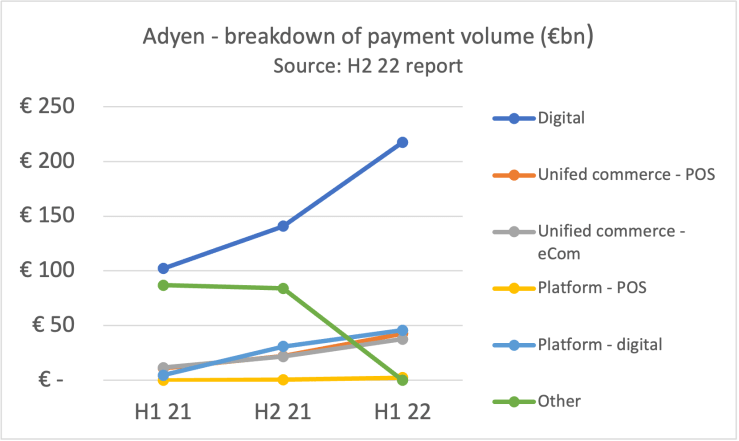
Adyen payment volume breakdown

Digital includes merchants trading purely online. Volume more than doubled from €102bn to €218bn. 

Unified Commerce includes merchants trading both POS and eCommerce. Volume was up from €22bn to €80bn of which POS now accounts for more than half. Adyen says it wins business because of its single platform which allows it to “translate the most complex consumer demands into seamless shopping journeys such as self-checkout, cashierless stores and buy-online-return-in-store.” New customers include Dior, All Saints and Uniqlo.

To help deliver a better customer experience, Adyen has taken the unusual step of commercialising its own design of payment terminals. Two were announced alongside the financial results – a PINpad which connects to smartphone or tablet and a more highly configurable Android terminal which can run ECR and payment software on same device. Hardware is a means to an end. The CFO explained the aim “is certainly not to increase profits on the terminal hardware side. It’s more on the innovation side and making sure that … by having full control that we could drive down the cost of the terminal.” Adyen is also one of small number of vendors working with Apple on launching SoftPOS in the US.

Platform includes marketplaces and ISV. Volume grew 53% to €48bn. Platform is Adyen’s strategy to address the high-margin SME market through partnerships although the volume is suspected by some commentators to be mainly coming from eBay – a customer Adyen won from Paypal. 

Adyen has developed a broader range of financial services to sell to SMBs through its platform relationships – business bank accounts, loans and card issuing – but these are “still in beta” and for the foreseeable future, it does not expect significant financial contributions.” The CFO explained “it’s going to take a couple of years to really see the revenues.

Net revenue was up 37% to €608m with strong performances from APAC and North America. Revenue growth of 30% in EMEA probably indicates Adyen is not gaining share as fast as previously. EMEA remains the largest market and accounts for 57% of total net revenues.

Adyen net revenue breakdown H2 2022

EBITDA was up 31% year-on-year to €356m but actually declined slightly from H2 21 to H1 22. Overall margins remain a very healthy 59%. Profits were hit by higher payroll costs as 395 staff were added, together with a sharp increase in travel as employees got back on the road to meet customers and each other. Adyen made a very clear commitment to F2F business life: “It’s clear that building trusted relationships and driving innovation moves faster when time is spent together. The speed and excitement that meeting each other in person brings has always been a crucial part of our success and our view on how to build the Adyen culture for the long term.”

Capex was €40m (up 160bps to 6.6% of net revenue) as a result of the geopolitical crises. “We invested in our data center infrastructure at a larger scale than we would have under different macroeconomic circumstances.”