Strong European performance at Visa gets lost in translation

Visa reported another strong performance in the July-September quarter. This is Visa’s Q4 and completes the 2022 financial year. Despite looming headwinds of inflation, the Ukraine war and the threat of global recession, consumers keep spending on Visa cards. Alfred Kelly, CEO, said “the reality is that while consumers might be altering a bit what they buy in different categories.… they’re still spending the same amount of money and using the same ways to pay as they did before.”

Looking forward, management remains confident reporting that “business trends have remained strong and stable” into the new financial year. “We remain as certain as we’ve ever been about our extraordinary long-term growth opportunity. There is still plenty of cash to digitize in core consumer payments.”

Distancing itself from plastic cards, Visa now describes the paying public as “credentials” and there are 9% more of these than one year ago. Many credentials are now tokenised by Apple Pay and other services. In fact, there are now more tokens than credentials. And there are 10% more merchant locations worldwide at which these credentials are accepted. 

The recovery of international travel is a positive for Visa as its charges higher fees for cross-border transactions. Vasant Prahbu, CFO, said “summer travel in and out of Europe was also very strong, with a travel index to 2019 in the 130s, up 13 points from the third quarter. European travel appears to have benefited most from the strong dollar.”

While a strong greenback is great news for American tourists, it’s less helpful for US listed corporations that report in dollars. A very positive European performance by Visa got lost in translation. 

Despite quarterly transaction growth of 16%, European payment volume actually fell 6% year-on-year in the quarter to $533m. ATV declined from $50 to $42. Taking constant currencies paints a much happier picture. Payment volume was up 12%. It’s an even more positive story when the UK (where Visa has lost issuing clients) is removed. Mainland European volume was up 30% at constant currencies. 

Management is particularly pleased with progress in the German debit market. Visa has profited from Mastercard’s withdrawal of Maestro to add more than 12m debit credentials including ING, DKB and Comdirect. Santander Germany will begin issuing Visa credentials in 2023. 

Shrugging off currency fluctuations, Al Kelly is taking the long view, saying “We really like what we’re seeing in the continent in Europe in terms of the growth that we’re seeing there, which is really strong.”   

Turning to product updates, while Mastercard is investing in inter-bank payment rails, Visa is pushing Visa Direct as safe and secure alternative to account-to-account payments. These often lack basic consumer protection. In contrast, Visa Direct offers “zero liability, chargebacks and solid dispute management.” There are a claimed 7bn “endpoints” worldwide to which a Visa Direct payment can be pushed. FY 22 transactions were 5.9bn up 42% year on year. New programmes include Vipps, the Norwegian mobile payment app, which is to offer users access to Visa Direct for all domestic payments. Another new signing is Thunes, which boasts a network of mobile wallets in over 44 countries, giving Visa Direct  access to 1.5bn digital wallets.

Other news included:

  • The UK is no longer the world’s number one market for contactless transactions. The US has finally begun to adopt tap-to-pay and is now the global leader in number of transactions.
  • Mass transit (tap to ride) was up 70% in 2022 surpassing 1bn transactions worldwide for the first time.
  • Although the crypto market continues to be volatile, Visa (like Mastercard) is signing deals to help people spend their crypto. FTX, a crypto-exchange, will issue Visa credentials. Click here to join the wait list.

Worldline Q3 – solid revenue growth, buys into softpos and marketplace payments

Worldline’s Q3 update provided another very solid set of results demonstrating continued progress towards its objective of building “a premium global Paytech at the heart of the European payment ecosystem.” Revenue is growing nicely, bolt-on acquisitions are filling product gaps and the sale of the Ingenico hardware business brings capital firepower to compete with Nexi and others for merchant portfolios as they become available.

Total revenue increased 20% in Q3 to €1.158bn although the company prefers to quote a rather lower figure of 10% growth, excluding currency and acquisitions. This is sensible expectations management although an American business wouldn’t be so modest. Forward guidance is 8-10% organic revenue growth.

Originally spun out of ATOS, primarily as a back-office processor, Worldline has reorientated itself. Merchant services now account for 72% of group revenue, up from 66% a year ago. Merchant services revenue is the powerhouse, growing 30% in Q3 to €828m or a still impressive 14% excluding acquisitions and a positive exchange rate boost from the strong Swiss franc. Worldline cites market share gains and volume growth. 

Payment volumes grew 17% year on year to €90bn and stand 33% higher than 2019. Growth is broad-based; in-store volume was up 16% and online volume up 23%. Q4 is reported to have begun “still in a very solid trajectory.”

Q3 highlights include a rebound in tourism which boosted travel and hospitality verticals and contributed to a strong performance from DCC. Client wins included Lufthansa Group which will make use of Worldline’s TravelHub solution which “brings 150 payment methods, multi-acquiring, tokenisation and a range of fraud services through a single connection.”

In contrast to merchant services, Worldine’s two other business segments look underpowered, growing sales well below inflation. Financial services revenue increased just 1.5%. Worldline is under sustained price pressure from its large banking customers.

The sale of the Ingenico terminal business to Apollo has finally completed. This brings €1.4bn extra capital which Worldline is likely to spend on further acquisitions as it consolidates the European merchant services market in competition with arch-rival Nexi. The Apollo deal comes with a five year partnership agreement which is likely to commit Worldline to continue selling Ingenico terminals to its banking and merchant customers. An extra €0.9bn is available subject to performance. 

Wordline made two important product acquisitions in Q3. 

  • Marketplaces – a 40% stake in Online Payment Platform (OPP), a Dutch payment gateway which boasts over 100 marketplaces and platforms as customers including eBay Kleinanzeigen, Marktplaats and Royal FloraHolland. Marketplaces account for about one third of European online payment volume today but require specialist support. OPP has sixty staff and its product set includes fast merchant onboarding, split payments, pay-outs, virtual IBANs and dispute management. Worldine has a call option to buy the remaining 60% in 2026.
  • SoftPOS – Worldine has bought a 55% stake SoftPOS, a very well regarded Polish softpos vendor which launched in 2019. Softpos is an existing Worldline partner but is also working with ING in Poland and Romania as well as Credit Agricole in Poland. The latter is through an arrangement with Elavon. It’s not clear whether SoftPOS’s current banking partnerships will be negatively influenced by the stronger Worldline relationship. Worldline has the option to take full control in 2024. 

The SoftPOS capability forms the basis for new product called Worldine Tap on Mobile which is aimed at all merchant segments but also as a white label through partners. For example, Worldine is making Tap on Mobile available on Zebra’s range of handheld devices. Zebra is a giant in the world of enterprise devices with over 10,000 channel partners globally. Many of these are ISV’s that will be interested in providing merchants a bundle of Zebra hardware, Worldine payments and their own software application.

SoftPOS has many transformational use cases but the one chosen for the launch video is not one of them. In this scenario, softPos makes life more difficult for both merchant and customer.

Discover Global Network – Q3 volume up 15%, signs Korean issuer

Discover is the third card brand in the USA, a long way behind Visa and Mastercard, but very profitable nonetheless. Discover bought Diners Club International from Citbank in 2008 which gave it the basis of a global acceptance network. 

Diners cards are still issued in various countries by franchise partners. Discover has continued to support the brand by investing in growing its international acceptance network through deals with merchant acquirers and payment gateways. This also gives Discover’s US cardholders the opportunity to use their card abroad. At the same time, the company has partnered with local card schemes so that their customers too can access this worldwide acceptance network. This is an alternative to co-badging domestic cards with Visa or Mastercard for use outside the home country.

More than 25 other networks, issuers and fintechs now run on Discover Global Network’s rails. Latest signings include Woori Card, “one of the largest issuers in South Korea” and US based TYDEI,  a healthcare vendor management system. 

Despite the years of investment, payment volumes remain quite modest. Volume from Discover’s network partners was $11.9bn in Q3, up 15% primarily reflecting higher volume at AribaPay. This is a tool that offers simple payments for invoices generated by SAP.

Meanwhile, Diners Club volume is growing rather faster “reflecting an improvement in global travel and entertainments spending.” This was $8.8bn, up 34% in Q3.

Payment volume on Discover’s own cards worldwide was $56.6bn, also up 15%.

Euronet’s strong recovery continues – EFT revenues up 41%

Euronet’s impressive recovery continued in Q3 as resurgent international travel boosted revenues and profits. The company processed 48% more transactions than a year earlier with average profit per transaction up 25%. Euronet is headquartered in Kansas but does most of its business outside the US

Total group revenue in Q3 was $931m, 14% higher than the same period in 2021. In addition to the rebound in travel, sales were also boosted by the acquisition of Piraeus Bank’s merchant acquiring business in March 2022 and “a significant volume increase in low-priced payment processing transactions in Asia Pacific.”

Michael Brown, Chairman and CEO said, “Consumers across the globe, not only want to travel, but can’t wait to travel and they still want to use cash when they finally arrive at their destination.” The travel recovery has been patchy. Happily for Euronet, Greece outperformed. International arrivals were up 2% in Greece on 2019 levels although total European inbound travel remains down 26% on pre-pandemic numbers. 

Euronet comprises three divisions. The ePay and money transfer units grew sales in low single digits but EFT (which includes ATM processing and merchant services) once again had a stand-out quarter. EFT grew revenues 41% to $319m with total transactions up 48% at 1.7bn.

The new Greek operation seems to have made a positive start. It contributed $30m to EFT revenues and is winning ISVs partnerships and marquee corporate accounts. For example, Euronet has signed a resale agreement with EpsionNet, a local software company with “more than 100,000 customers” and added 3,000 new merchants including Carrefour, McDonalds, Odeon and Heron Energy. Outside Greece, Euronet signed and onboarded 770 new merchants during Q3 through its Innova Tax Free and Pure Commerce business units.

While some commentators fear for the future of ATMs as customers shift spending to cards, Euronet remains optimistic. Michael Brown explained that travellers still need some cash and, with banks closing branches at an increasing pace, they will get money from the “first ATM you trip over when you’re on vacation… and there’s a higher likelihood they’ll trip over my ATM versus the bank’s ATM.

Euronet continues to expand its footprint as the leading independent ATM operator. The company finished the quarter with 51,437 ATMs, up 8% despite “facing some challenges in the ATM supply-chain, which has slowed down some of our ATM expansion.”

Total operating income was up 47% to $168m driven once again by a strong EFT performance which demonstrated strong operational leverage in growing income 85% to $116m. Margins expanded from 27.8% to 36.4% boosted by a 25% increase in operating income per transaction to 6.3c. As international travel recovers, Euronet’s search for high value transactions can sometimes push pricing a little too far. I found a Euronet ATM in Malta last month charging 9.5% commission for DCC. 

Total adjusted EBITDA, the company’s preferred measure of profitability, was up 36% to $212m. EFT again outperformed with EBITDA increasing 63% to $140m. Michael Brown said “we spend a lot of money on R&D. And that’s why we’ve got the tech stacks that continue to win more and more business. But we don’t whine about it. I mean we don’t say, “Oh, we’re spending this much more on R&D this year, just to make your future better and use that as an excuse for bad results today.”

Revenue recovers and losses narrow at Elavon Europe

Losses at Elavon’s European operations narrowed in 2021, according to documents deposited at Companies Registration Office Ireland. Although revenues picked up from their pandemic lows, the bounce back was not yet strong enough to cover fixed costs. Elavon has a large market share in the travel sector and was hit harder than most of its competitors by the lockdowns. 

Elavon is a unit of US Bancorp and trades in Europe as Elavon Financial Services DAC, based in Dublin. 80% of revenues are from merchant acquiring and related products. The remainder are generated by Global Corporate Trust Services. 

Merchant services volume rose 23% in 2021, having fallen 24% in 2020. This still leaves volumes running 6% below 2019 levels. Nevertheless, management believes the business is “well positioned for opportunities as economies recover.” 

Elavon gives two measures of geographical breakdown of its operations by branch booking location for merchant and issuer receivables. These indicate that 55%-85% of its merchant services business is booked in UK/Ireland with the remainder in Poland, Germany and Norway.

Total operating income (net revenue) rose 24% to €330m. 

Merchant services fee and leasing income rose 17% to €248m of which 90% was processing fees. This number is net of interchange, scheme fees and partner commissions. Equipment rental rose 7% to €26m.

Operating expenses rose 14% to €389m. Staff numbers were down slightly at 2,184 but average costs per employee grew 13% to €90K each.

Losses before tax narrowed to €59m from €76m in 2020, a negative EBIT margin of -18%.

Strategic goals include completing the integration of Opayo, the former Sage Pay business, bought for £232m in March 2020. This acquisition brought £40bn gateway transaction volume and 50,000 merchant customers in UK and Ireland. Opapyo boosts Elavon’s eCommerce merchant services capability “as well as giving access to a broader client base, particularly in the SME sector.” The integration of Opayo is said to be well advanced and its new owner is optimistic. The annual report says: “Together with increasing merchant services acquiring volumes as COVID 19 restrictions are lifted, [Opayo] is expected to drive revenue and net profit growth in future years.” 

Operating in the travel sector, Elavon needs strong risk controls. The value of airline tickets processed but not delivered was €2.3bn at the end of 2021, up slightly on 2020. This represents significant potential liability in the event of airline business failure. To mitigate this, Elavon is demanding more security from its customers. Merchant escrow deposits rose 35% to €151m at the end of 2021 although unrecovered losses remained relatively low at just €3.5m – 59% below 2020. 

Sterling weakness knocks c.$20m from US Bankcorp’s Q3 merchant acquiring revenues

Sterling’s continued weakness knocked about $20m from US Bancorp’s merchant acquiring revenues in Q3. The bank owns Elavon which is one of the larger cross-border acquirers in the European market with a strong position in travel and tourism.

Global merchant volume was up 9% to $136bn. Transaction count grew 12% and ATV fell 2% to $68.98.

Revenues would have grown at a similar rate to volumes but for the strong dollar and weak European currencies. Total merchant acquiring revenue, which has been growing a double digit levels, rose just 4% to $408m in Q3, about $20m lower than at constant currencies. The shortfall was “negatively impacted by unfavorable foreign currency exchange rates, given market volatility in Europe and specifically in the U.K.” according to Terry Dolan, CFO.

Take rate fell 2bps to 0.30%. 

Management believes there is significant untapped potential to cross-sell to its 1.1m business customers in the US. Only 30% of banking customers take payments products today while less than 50% of payments customers do their banking with USBC.

Like most other acquirers, USBC is building a “tech-enabled” distribution channel through partnerships with ISVs and gateways. It claims to have signed 2.5x as many partnerships in Q3 2022 as in the whole of 2019. Tech-enabled revenue outperformed and was up 7%. The company says Talech, an ECR software vendor acquired in 2019, is growing quickly but declined to give numbers other than new sales are running more than 5x 2019 levels. 

Deutsche Bank’s “Vert” looking a little green

Deutsche Bank has returned to merchant services although its launch proposition looks rather limited. There are also questions about how easy it will be to cross-sell payments to the bank’s large SME base in Germany.

DB has changed its merchant payment strategy more than once. The German banking giant was initially slow to enter the market before later buying and selling an acquiring business and finally announcing its latest plan – a joint venture with Fiserv. 

The new deal with Fiserv represents a fresh start for DB which fully exited merchant services in 2015 after it sold both Cologne-based Deutsche Card Services and Frankfurt HQ’d POS Transact (Postbank’s acquiring business) to EVO Payments International.[1]

DB adopted a new approach in 2020. When Wirecard imploded, Santander bought its technology but Deutsche hired the product team. The German bank engaged Wirecard’s rockstar product chief, Kilian Thalhammer, and tasked him with building a new Deutsche Bank payments unit. 

Two years later, we see the fruits of the strategy. Instead of buying or building the capabilities needed, the bank has chosen to partner with one of the global processing giants. Deutsche Bank and Fiserv have launched “Vert” a joint-venture aimed at the German SME market. Fiserv is already present in Germany through Telecash which offers a full range of POS and eCommerce payment acceptance. 

According to Finanz-szene, Fiserv has control of Vert with 51% of the shares. Joint managing directors are Gerd Vido, former MD of Telecash and long term Fiserv exec and Thorsten Woefel, former head of payments as Adidas who has joined from Deutsche Bank.

The Vert proposition looks a little rushed. There is no eCommerce or dynamic currency conversion (DCC) although these are promised soon. It’s not clear whether the online acceptance product will be Fiserv’s or based on Better Paymentsa payment gateway acquired by DB earlier this year. Vert’s terminals accept just Visa and Mastercard. There are no other international schemes offered and no Girocard, the widely used German debit scheme. If a terminal doesn’t accept Giro, the transaction is processed as Maestro which attracts higher scheme fees for merchants. 

Vert is offering just three products at launch: 

  • PAX A50 at a very keen price of €4.99/month plus merchant fees  
  • Clover Flex at  €19.99/month plus merchant fees
  • “Go by Vert” a SoftPOS which is listed as “coming soon”

Boarding and customer service appear quite manual. Prospective customers are asked to fill out a form on the website and wait for a call-back. Vert’s address is a co-working office in Frankfurt which indicates it has not yet found permanent accommodation. 22 employees are listed on LinkedIn.

Longer term, the DB side of the venture hopes to integrate payments with banking products. “In co-operation with Vert, we can provide accounts, payment solutions and banking services to our SME customers,” says Kilian Thalhammer. DB has 800,000 SME customers; some with Fyrst, a neo-bank, but most with Postbank.

Both Postbank and Fyrst already offer Telecash products on a referral basis. Neither has updated its websites to push potential customers to Vert. One reason may be that Telecash’s standard product set (which includes Giro as standard) is considerably more extensive than Vert offers right now.

However, DB claims “some merchants already live” with Vert and there is an expectation of “rapid growth within its existing customer base”.

It’s not easy cross-selling payments to small business banking customers. Success requires strong and sustained senior management commitment, investment in staff training and incentives and, critically, seamless integration of boarding systems. A JV structure can make this harder. Business advisors in large banks have hundreds of products to talk to customers about and will sell the ones which are least hassle. Vert’s products will need to be easy to buy and easy to sell otherwise Postbank’s sales channels won’t deliver the volume of merchants needed to make Vert the success its investors are hoping for.


[1] I worked at EVO Payments 2015-2022 including on the Deutsche Bank & Postbank relationships.

Cashflows reports “solid” year but will likely need extra financing

Cashflows Europe, a merchant acquirer based in Cambridge UK, reported “a solid year” in 2021 according to documents filed at Companies House. However, management warned that investments in technology, people and marketing are not yet yielding the financial results hoped for and that the business “will likely require additional financing in the next twelve months.”  The good news for staff and customers is that Cashflow’s shareholders have indicated that they will provide the additional funds.  

The company offers “omni-channel native” acquiring, processing and gateway services with a focus on SMEs and small corporates, especially in the financial services sector. This is an attractive part of the market – margins are high although these merchants can bring credit risk. Cashflow’s innovations include “anytime settlement” in which customers can pay extra to have their funds released early.  Here are a couple of nice case studies from Cash4U and SplitPay.

Pollen Street Capital, the private equity group which owns Cashflows, has recently installed a new management team under CEO, Hannah Fitzimons. She joined in May 2022 from Elavon and reports to a heavyweight board including Chair, Simon Haslam, formerly CEO of Network International. 

Overall, the UK card market bounced back strongly in 2021 with debit volumes up 23% and credit volumes up 21%. Cashflow’s acquiring volume underperformed, rising just 15% to £3.8bn. The push into SME (and possibly additional contactless POS transactions) may be behind the sharp fall in average transaction value to £31 in 2021 from £41 the previous year.

Gross revenue grew 58% to £33.4m in 2021. Acquiring services revenue doubled from £13.7m to £28.4m partially offset by a fall of 21% in ATM revenue to £3.6m. ATM has been much slower to recover from Covid than card payments. Gross take rate rose a healthy 22bps to 0.88%.

Net revenue after interchange and scheme fees was up 51% to £16.7m. Net take rate rose 11bps to 0.44%.

Cost of sales increased 57% to £13.9m. Cashflows works with a network of independent sales organisations (ISO’s) and payment facilitators as well as selling direct to merchants. Partner commissions rose to £3.6m, representing 22% of net revenue.

Gross profit rose from £7.3m to £11.6m giving gross margins of 35% over net revenue or 69% over gross revenue. Both measures ticked up slightly over 2020.

Despite the healthy top line growth, overheads (rising 22% to £19.0m) continue to exceed net revenue. Merchant acquiring has significant economies of scale and £3.8bn payment volume is too small make up for the high fixed costs.

Although headcount was unchanged at 131, people costs rose 28% to £12.8m, possibly indicating significant wage inflation. Marketing expense doubled to £581K but remains just 3% of net revenue. 

Spending on technology rose 34% to £3.8m with investments in platform enhancements delivering an “API centric technology stack” centred around a “vertically focused platform specifically tailored to the needs of SME’s and small corporates.” New products in 2021 included additional payment acceptance methods and 3DSv2 to comply with new strong customer authentication regulations.

Impressive credit management saw exceptionally low fraud losses of just 3bp compared with 30bps in 2021. The chargeback ratio was also very respectable, falling 2bps to 6bps

EBITDA losses improved slightly from £8.1m to £7.4m

Stripe International revenues grow, losses narrow, keeps hiring

Revenues at Stripe Payments International rose strongly in 2021 and losses narrowed. This is the Irish-based holding company for Stripe’s numerous businesses across EMEA and APAC. 

It is refreshing for a payment business to have a bold ambition that is about more than just moving money around. Stripe “aims to increase the gross domestic product of the Internet” by “building the economic infrastructure” that underpins commerce.

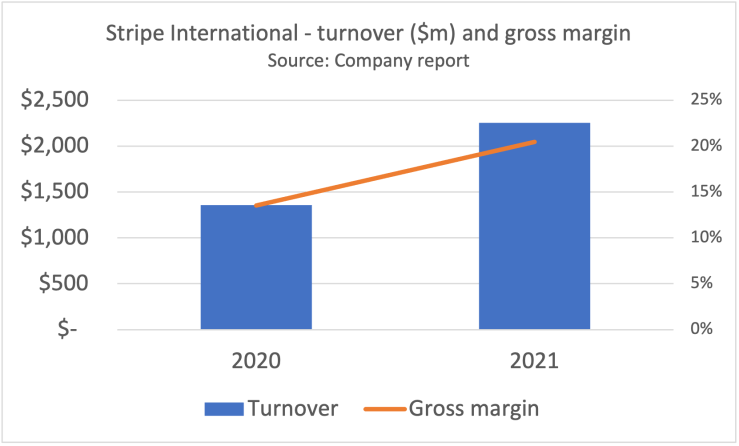
Turnover rose 66% to $2.22b.

Cost of sales increased 53% to $1.79bn with gross margins expanding from 14% to 20%. This is relatively low and reflects heavy investment in R&D and new market expansion.

Administrative expenses rose 50% to $475m driven by continued aggressive hiring. Staff numbers doubled in 2021. The group employed 1,048 staff at the end of the year compared with 569 a year earlier. Employees are well paid. The average cost per team member is $148K.

Total losses before tax narrowed from $136m to $22m. 

Total accumulated losses stand at €294m

After year end, Stripe acquired BBPOS, a Hong Kong based manufacturer of payment terminals. This allows Stripe to take full control of its push into payments in the physical world. 

In separate filings at Companies House, Stripe disclosed its UK revenues tripled in 2021, rising from £123m to £371m. Staff numbers grew from 61 to 152 at a very generous average cost of £191K. 

DNA Payments reports 12% revenue growth, keeps buying ISOs

DNA Payments reported revenues up 12% in 2021 according to documents filed at Companies House. The company is a very well funded London-based payments roll-up which has, so far, swallowed eight businesses.

DNA was founded by two Kazakh bankers, Nurlan Zhagiparov and Arif Babayev. It received £100m investment from Alchemy Partners in 2021 to build “one of the largest independent, vertically integrated omnichannel payments companies in the UK and EU.” DNA claims 100.000 acceptance points (terminals or checkout pages), 65.000 customers and £11 bn transaction value processed annually. DNA expects to be the “4th largest payment provider in the UK by close of 2022” although it’s not clear which metric would be used to judge.

DNA’s technology is based on the acquisition of Optomany, an omni-channel payment gateway with a strong relationship with PAX, which was purchased for a bargain price of £2.5m in 2019. 123 Send, a leader in short-term rental of payment terminals also came as part of the deal. Since then, DNA has been busy acquiring many more businesses, mainly small UK ISOs. 

Logically, the business plan must be to boost these ISO’s profitability by centralising operating expenses, migrating customers to the Optomany product and boosting new business through modern sales and marketing. This could be a rewarding strategy but, with £100m investment in the bank, the founders will very likely have bigger ideas.

There are now eight businesses under the DNA umbrella. In 2021 the company bought Active Merchant Services, a Barclaycard ISO for £3.1m and EFT Solutions, for £2.6m. After year-end, DNA acquired First Payment Merchant Services, a Barclaycard ISO, and Card Cutters, which works with AIBMS and EVO. The group also includes Zash, a small Swedish ePOS vendor whose software it hopes to cross-sell to its small merchant customers. 

These eight businesses are all still trading but the Group has also created a DNA Payments brand to sell more complex solutions direct to larger merchants. It is having some success. Here’s a good case study from an EV charging business which needed a joined up solution of in-app and contactless payments.

Total revenue for DNA Group in 2021 was up 12% at £11.7m. The take rate of just c.10bps reflects that, despite strong omni-channel capabilities, DNA is still heavily dependent on the sale and leasing of payment terminals. These accounted for 74% of turnover.

Gross profit was up 15% at £6.6m with margins up very slightly to 56.3%.

Administrative expenses grew 90% to £14.9m as staff numbers expanded from 84 to 143. 

EBITDA losses rose from £0.6m to £6.9m and total loss before tax was £8.9m. Accumulated losses now stand at £12.8m.